
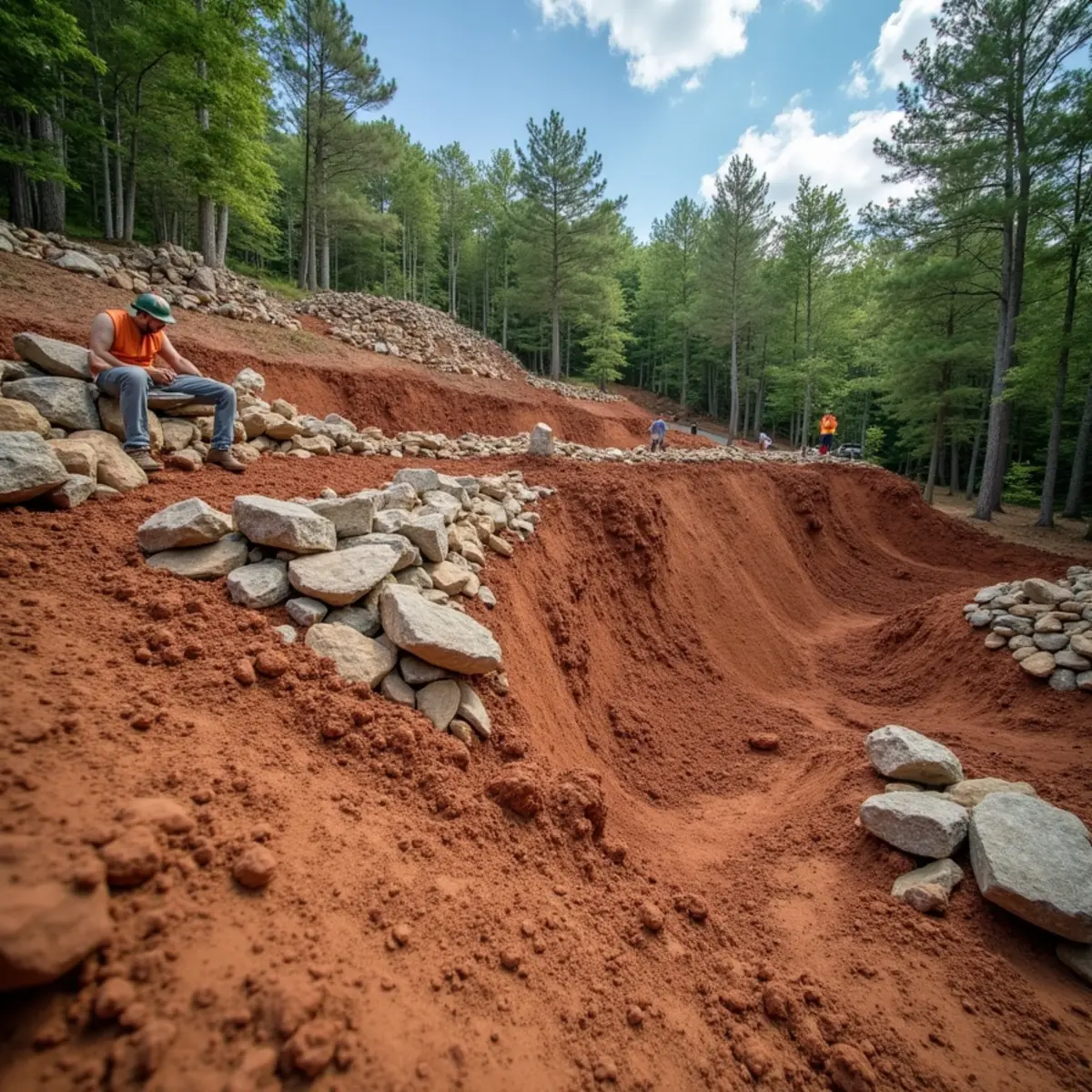
Signs You Need Emergency Washout Repair Now
- A hillside that visibly slid or slumped during or after a heavy rain
- A new gully or channel cutting across a slope that was not there before the storm
- Exposed soil, roots, or rock face where vegetation and topsoil used to be
- Water actively undermining a driveway, deck footing, or foundation edge
- Mud and debris deposited at the base of a slope near a structure
- A slope that is still visibly wet, cracking, or moving days after the rain stopped
Stopping the Damage Before It Spreads
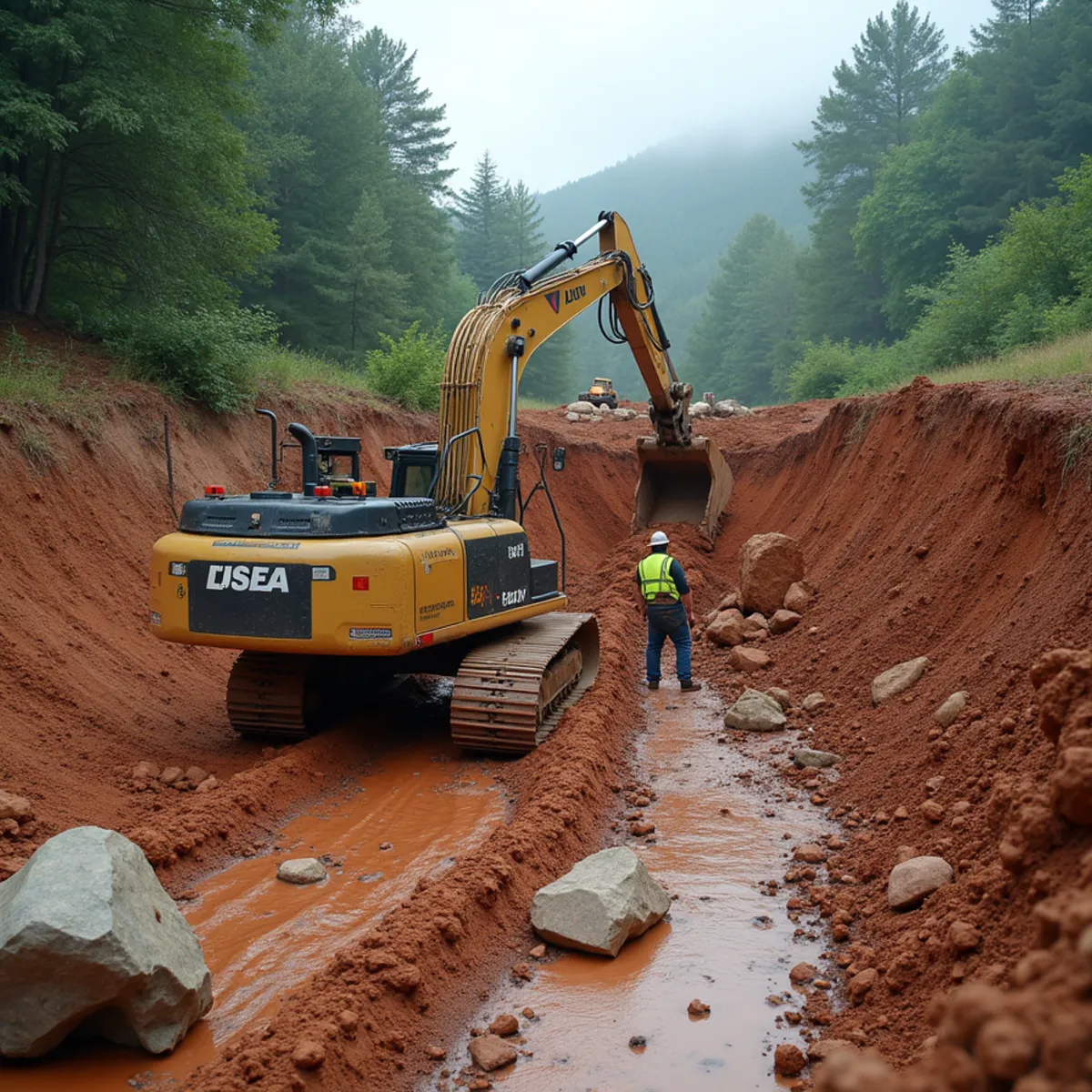
The first priority on any washout call is reading whether the slope is still actively moving or has settled into a stable but damaged state, because that determines whether we can start permanent repair immediately or need to install temporary stabilization first. Active movement - fresh cracking at the top of the slope, ongoing soil slumping, or water still channeling through the failure - gets addressed with temporary measures the same day: silt fence and straw wattle staked below the disturbed area, and where needed, tarping or erosion blanket over the most exposed soil to reduce further loss while we plan the permanent fix.
Once the site is stable enough to work safely, repair follows the same principles as planned slope work, compressed into an urgent timeline: we regrade the failure to a stable slope angle, place rock riprap or rebuild with boulders sized to the water volume the gully proved it could carry, and rebuild drainage so the same concentrated flow does not simply recreate the washout at the next storm. On sites where the washout has undermined structural elements, this connects directly with retaining wall structural shoring and gully and stormwater repair to address both the slope and the water source causing it.
- Same-day assessment of whether the slope is actively moving or has stabilized
- Temporary silt fence, wattle, and erosion blanket to limit further soil loss
- Regrading to a stable slope angle once the site is safe to work
- Rock riprap and boulder placement sized to the water volume proven by the failure
Rebuilding So It Does Not Happen Again
A washout is proof that the slope's existing drainage could not handle the water it received, so permanent repair always includes a drainage fix, not just regrading and rock. We trace where the concentrated flow originated - often a driveway, roof runoff, or an upslope neighbor's yard - and build a swale, French drain, or culvert to intercept that water before it reaches the repaired slope again. Compacting new soil in lifts and re-establishing groundcover or erosion control matting completes the repair so the slope has both structural stability and living root mass holding it long-term.
We run this emergency work throughout Clarkesville and the surrounding mountain communities where steep, wooded lots and red clay soil combine to make washouts a recurring risk after any significant storm. If your property has taken repeated hits in the same spot, we will design the permanent fix to break that cycle rather than patch it again next season.
- Drainage source tracing to identify what caused the concentrated flow
- Swale, French drain, or culvert built to intercept water before it reaches the slope
- Compacted soil replacement in lifts with erosion control matting
- Groundcover or planting re-established to hold soil long-term
Equipment on the Truck and How We Size the Rock On Site
Our emergency response equipment travels ready to work - mini and midsize excavators, skid steers with grading buckets, and a standing supply of silt fence, straw wattle, and erosion blanket staged for immediate deployment rather than ordered after the assessment. This matters because the gap between assessing a washout and stabilizing it is exactly when the next rain does the most additional damage, and a crew that has to source materials after diagnosing the problem loses that window.
Riprap and boulder sizing for emergency repair is based directly on evidence the failure itself provided - the size of channel the water cut, debris deposited at the base of the slope, and visible high-water marks all tell us the actual peak flow the site needs to handle, which is more reliable than a generic sizing chart. We oversize rather than undersize on emergency rebuilds specifically because a repeat failure at the same spot compounds both cost and property damage, and the storm that caused the first washout is rarely a one-time event on that particular slope.
- Mini and midsize excavators and skid steers staged and ready, not sourced after diagnosis
- Standing supply of silt fence, wattle, and erosion blanket for immediate deployment
- Rock and boulder sizing based on evidence of actual peak flow from the failure itself
- Emergency rebuilds intentionally oversized against repeat failure at the same location
Our Process
- 1
Emergency Call & Site Assessment
We respond quickly to assess whether the slope is still moving and what immediate risk it poses.
- 2
Temporary Stabilization
Silt fence, wattle, or erosion blanket goes in the same visit if the slope needs immediate protection.
- 3
Permanent Regrading
Once safe, we regrade the failure to a stable angle and remove unstable spoil material.
- 4
Rock & Drainage Rebuild
We place riprap or boulders and rebuild drainage to handle the water volume that caused the failure.
- 5
Restoration
New soil is compacted in lifts and groundcover or erosion matting is installed to hold the repair long-term.
Materials & Equipment
- Rock riprap and boulders sized to proven water volume
- Silt fence, straw wattle, and erosion control blanket
- Compacted fill soil and crushed stone
- Drainage pipe, fabric, and culvert materials
- Excavators and skid steers suited to emergency site access
What Affects Your Price
Every mountain and lakefront project is different. These are the factors we weigh in a free on-site estimate — no fixed price fits every property.
- Size and severity of the washout or slide
- Whether temporary stabilization is needed before permanent repair
- Volume of rock, soil, or spoil that must be moved or hauled off
- Drainage rebuild scope required to prevent recurrence
- Site access for emergency equipment
- Any structural undermining requiring coordination with wall shoring work
Why Choose Kipps Kustom Landscapes for Emergency Hillside Washout & Erosion Repair
24/7 Emergency Erosion Response
A washing hillside does not wait for business hours, and neither do we; we run 24/7 emergency erosion response specifically because saturated red clay can keep moving well after the rain stops.
We Own the Equipment - No Waiting on a Rental Yard
Our excavators and skid steers are ours, staged and maintained for immediate dispatch, so an emergency call is not held up by equipment availability at a rental counter during the same storm that is flooding everyone else's yard too.
15+ Years Responding to This Exact Failure
Since founding the company in 2010 we have handled hillside washouts across Habersham County's steep, wooded lots, so we recognize the difference between a slope that has stabilized and one that is still actively moving before we ever set foot on it.
Documentation You Can Submit to Insurance
We photograph and document the damage and repair as we go, giving you a written record for insurance purposes even though we cannot guarantee what a specific policy covers.
Frequently Asked Questions
- We prioritize active slope failures and aim to assess the site quickly after your call, especially when water or structural undermining is ongoing. Call (323) 606-0255 directly for the fastest response.