
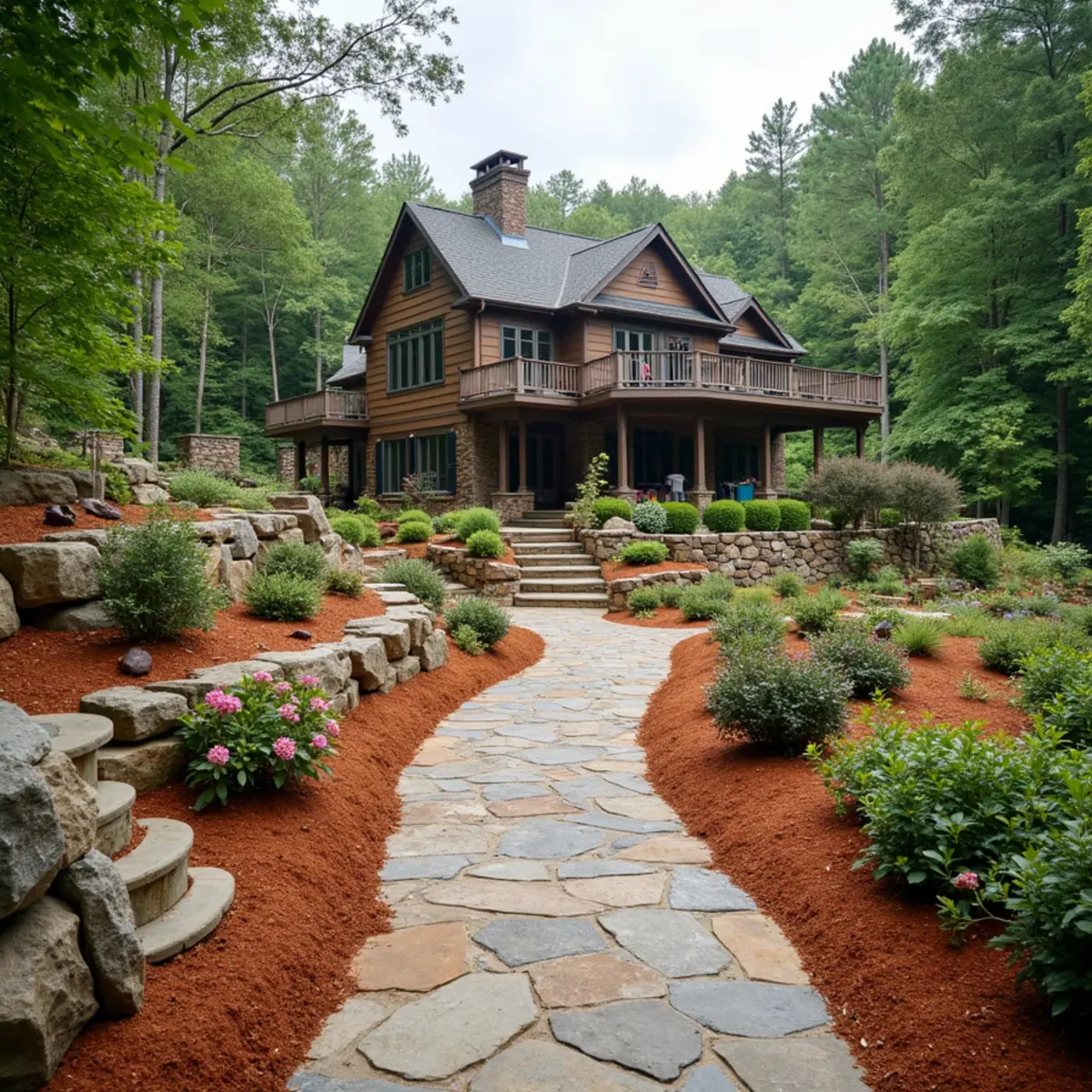
Landscaping on the Edge of a Gorge
The land around Tallulah Gorge State Park drops away fast, and even properties a good distance back from the rim itself often sit on grades steep enough that standard suburban landscaping techniques fail immediately. The canyon also creates its own microclimate: cooler, damper air pools in the gorge, fog lingers longer on rim-adjacent lots than it does a few miles away in Clarkesville, and that persistent moisture changes how soil behaves and how fast erosion channels can form on exposed slopes.
Vertical drop is the defining design constraint here. A retaining structure that would be overbuilt anywhere else in Habersham County is often the minimum standard near the gorge rim, because a failure does not just mean a collapsed flower bed, it can mean material sliding a significant distance downslope.
Heavy Riprap for Extreme Grade Control
For rim-adjacent and steep-approach properties, we place heavy riprap stone rather than lighter decorative rock, sizing individual stones large enough that storm flow and gravity cannot dislodge them once set. Riprap gets keyed into the slope with a proper toe footing dug below the anticipated scour line, not just laid on the surface, which is the mistake that causes most riprap failures we get called to repair elsewhere. Combined with structural boulder retaining walls at the top of steeper transitions, this approach holds a slope that a typical block wall would not survive.
Where full stabilization is not practical because of the terrain, we focus on managing water instead of soil, using upslope French drains to cut off subsurface flow before it reaches the steepest sections and destabilizes them from underneath.
Native Rhododendron and Gorge-Appropriate Planting
The gorge's natural understory is thick with native rhododendron and mountain laurel, and that is not an accident of aesthetics, those root systems are genuinely good at holding steep, damp slopes in place. We border stabilized grade transitions with native rhododendron rather than ornamental shrubs that were never built for this microclimate, which gives Tallulah Falls properties a planting palette that looks like it belongs next to a state park and actually performs on a slope.
Because Tallulah Falls straddles the Habersham-Rabun line, we coordinate closely with jobs near Turnerville and Clarkesville to keep travel efficient for this more remote gorge-area work.
Fog, Freeze, and Vegetation Management Near the Rim
The gorge microclimate means rim-adjacent properties in Tallulah Falls hold moisture longer than a lot just a few miles away in Clarkesville or Turnerville, and that persistent dampness, combined with the shade cast by the canyon walls themselves, creates freeze conditions on north-facing slopes that linger well after surrounding areas have thawed. Ice can hold on a shaded gorge-adjacent path or stone step for days after a winter storm passes, which we account for in how we grade and surface any walkway near the rim, favoring textured stone over smooth-cut surfaces specifically for traction. That same lingering moisture also means fungal and moss growth on north-facing stonework happens faster here than elsewhere in our service area, something homeowners should expect and plan light maintenance around rather than treat as a defect.
Vegetation management near the gorge carries extra weight because Tallulah Gorge State Park borders so many of these properties, and invasive species like kudzu and English ivy that would be a nuisance elsewhere can spread from a neglected residential lot into protected park land if left unmanaged. We clear invasive growth along property lines that border park boundaries as a standard part of our gorge-area work, replacing it with the native rhododendron and mountain laurel that actually belongs in that ecosystem. For homeowners building new near the rim, we also strongly recommend a phased approach, stabilizing the slope with riprap and drainage before any structure goes in, since building first and stabilizing later is the single most common and most expensive mistake we get called to fix in this part of Habersham County.
Because access roads near the rim are often narrow, gravel, and shared with neighboring cabins, we also plan equipment staging carefully for any Tallulah Falls project, sequencing heavy machinery deliveries to avoid blocking the limited turnaround space many gorge-adjacent driveways have, and coordinating drop-off timing with property owners who share a single access easement.
Permits, Codes & Compliance Near Tallulah Gorge
Because so much of Tallulah Falls sits close to Tallulah Gorge State Park and the steep drop toward the Tallulah River, grading work here often draws more attention from Habersham and Rabun County plan review than a typical inland lot. A retaining structure near the rim that would sail through review elsewhere in the county may need an engineered stamp at a lower height threshold given the exposure, a distinction we also flag for ridge-adjacent jobs near Clarkesville, so we confirm the exact rule with the relevant county building department before design work starts rather than assuming the standard four-foot benchmark applies unchanged.
Land-disturbing work above a certain size near the gorge can also trigger Georgia EPD erosion and sediment control obligations, and because runoff here eventually reaches the Tallulah River and the state park boundary itself, we treat that review as a first step, not paperwork to sort out after equipment is already staged, the same standard we apply on emergency hillside washout repair calls near the rim of the gorge.
What a Typical Tallulah Falls Project Looks Like
A typical call from this area involves a rim-adjacent or steep-approach property where a homeowner has watched a slope creep or a section of yard slump toward the gorge after a wet season. We walk the grade, identify where riprap needs to be keyed below the scour line, and pair it with boulder retaining walls at the top of the steepest transitions rather than treating the visible slump as the whole problem.
The second common project is planting-focused: replacing cleared or failing groundcover near the rim with native rhododendron and mountain laurel that actually holds a damp, shaded gorge slope, work we coordinate closely with jobs near Turnerville given how close the two areas sit.
Native Plant Palette & Microclimate Notes for Tallulah Falls
The gorge's cool, damp microclimate favors native rhododendron, mountain laurel, and ferns that thrive in the same shaded, high-moisture conditions the canyon walls create, and we source those plants specifically for rim-adjacent properties rather than ornamentals bred for drier, sunnier Georgia yards. Established root systems on that palette also do real structural work holding a damp slope in place.
That planting approach pairs with the same hillside excavation and slope terracing standard we use near Turnerville, since gorge-area terrain rarely holds with planting alone.
Our Services in Tallulah Falls
Every core Kipps Kustom Landscapes service is available to Tallulah Falls property owners:
Why Tallulah Falls Residents Choose Kipps Kustom
Twelve Miles From Clarkesville to the Gorge Rim
Tallulah Falls sits about 12 miles out, and we coordinate rim-area jobs with our regular Turnerville and Clarkesville routes to keep travel efficient for this more remote gorge work.
15+ Years Building for Extreme Grade
Riprap keyed below the scour line and reinforced boulder walls for an 800-foot drop-off are not catalog work, they come from more than fifteen years building for North Georgia's steepest terrain.
Own Heavy Machinery for Narrow Gorge Access
We own and stage our own excavation equipment, which matters near the gorge rim where access roads are narrow, gravel, and often shared with neighboring cabins.
4.9-Star Rating on High-Stakes Slope Work
A near-canyon-rim retaining wall failure is not a minor repair, and our 4.9-star rating across 47 reviews reflects work engineered to hold on that kind of exposure.
Tallulah Falls Landscaping FAQs
- It can be, but it requires oversized structural design, not standard residential specs. We use heavy keyed riprap and reinforced boulder walls specifically engineered for the extreme grade near Tallulah Gorge.