
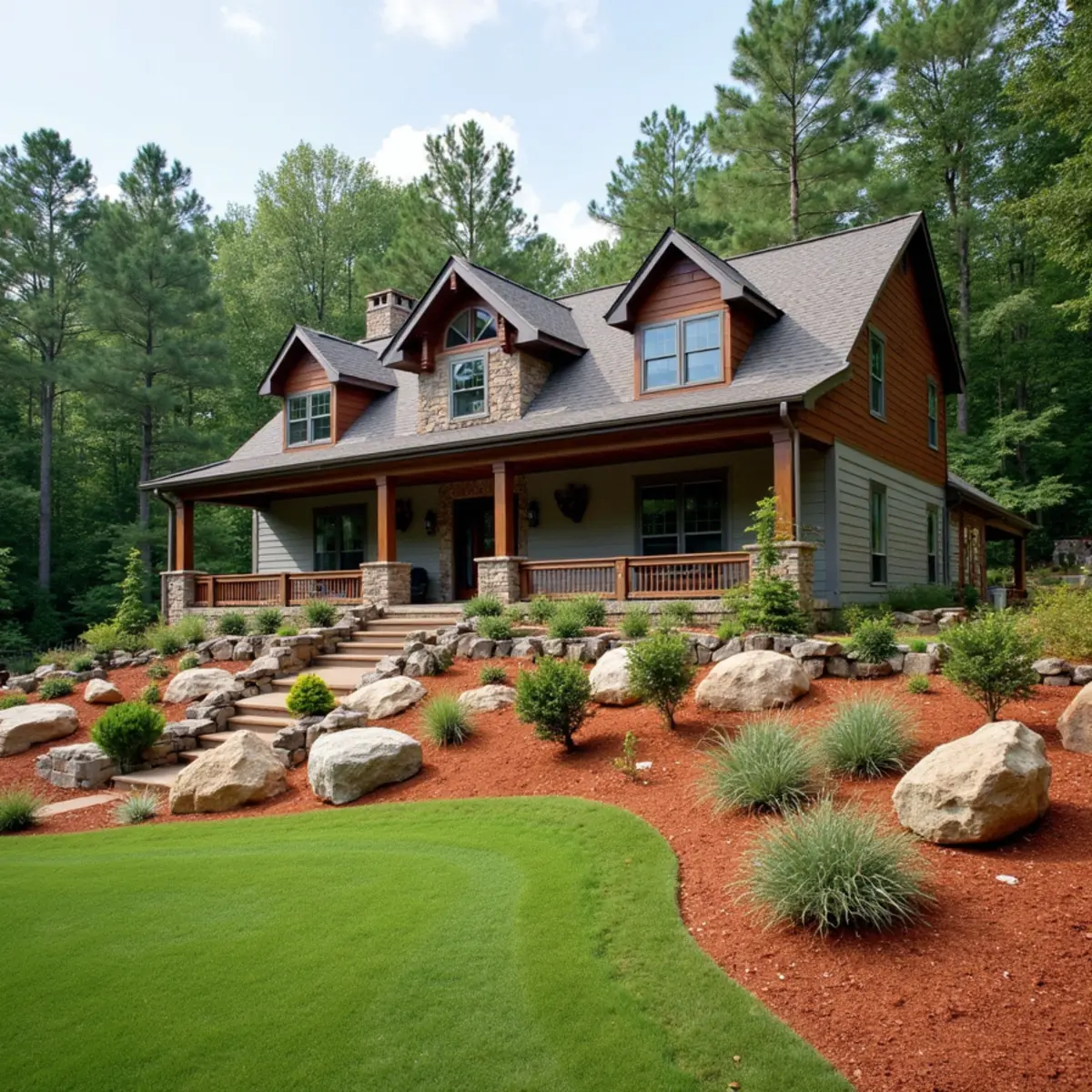
Building on the Divide
Baldwin's position near the Eastern Continental Divide means rainfall on one side of a ridge can end up in a different watershed entirely than rain falling a few hundred feet away. For landscape design, that translates into properties where the back yard sheds water toward one drainage basin and the front yard sheds toward another, and a drainage plan that ignores which side of the ridge a feature sits on will misroute water every time.
The elevation also brings more sustained wind than sheltered towns like Demorest or Cornelia see, particularly on cleared ridgetop lots without a windbreak of hardwoods. That wind load matters for anything tall and freestanding.
Wind-Resistant Hardscape Construction
For ridge properties, we build boulder retaining walls with deeper base embedment and wider batter than we would use on a sheltered lot, because a wall exposed to sustained wind and the freeze-thaw cycling that comes with elevation needs more mass to stay put. Freestanding stone features like fire pits and low garden walls get extra base compaction for the same reason. We also avoid tall, thin vertical stacks in favor of broader, lower profiles that shed wind rather than catching it.
Drainage on a divide lot has to be split-planned rather than treated as one system. We often install two independent French drain runs on opposite sides of a single ridgetop house, each routed to the watershed that side of the property actually feeds.
Deep-Root Lawns for Exposed Ground
Turf on an exposed ridge dries out faster and takes more wind stress than turf in a valley, so we lean on deep-rooting tall fescue blends over shallow-rooted alternatives for most Baldwin lawns, combined with core aeration and compost topdressing to build a soil profile that actually holds moisture between rains. On the steeper sections common near the divide, we integrate slope terracing so new sod has a chance to establish before the first hard runoff event washes it out.
Baldwin's location along the corridor connecting Cornelia and Alto puts it squarely in our regular service loop, so ridge-elevation site visits do not carry extra scheduling delay.
Freeze Exposure and Windbreak Planting on the Ridge
Elevation on Baldwin's ridge means winter temperatures run a few degrees colder than sheltered valley towns close by, and combined with the wind exposure the divide already creates, frost penetrates deeper into exposed clay here than it does in a wooded low-lying yard. That deeper frost line is part of why we set boulder wall footings lower on ridge lots than our standard depth elsewhere, since a footing that sits above the active frost zone will eventually heave regardless of how well the wall itself is built. Rainfall on the divide also arrives harder and faster than in sheltered towns, because there is less forest canopy on cleared ridgetop lots to intercept it before it hits the ground, which means bare soil during construction erodes faster here than almost anywhere else we work in Habersham County.
To manage both wind and exposure long term, we plant windbreak rows of native eastern red cedar and white pine along the exposed edges of ridge lots, spaced to knock down sustained wind before it reaches the house or a newly planted lawn area, rather than relying on the house itself as the only wind barrier. That windbreak also moderates how fast newly seeded fescue dries out between rains, which matters on a lot that gets more direct sun and wind than a valley lawn. For homeowners building new on a cleared ridge parcel, we recommend windbreak planting early in the project timeline, months before hardscape goes in, so the trees have a head start establishing before the property loses its natural tree cover during grading. Baldwin's ridge conditions carry over into the drainage work we do near Alto to the south.
Soil testing on Baldwin's ridge lots consistently shows a thinner topsoil layer than valley towns nearby, since wind and historical grazing use stripped away organic matter faster than it could rebuild on exposed high ground. Before seeding any new lawn area, we amend with compost at a heavier rate than we would use in a sheltered Cornelia or Demorest yard, simply because there is less natural fertility already in the ground to build on. Homeowners relocating from lower-elevation towns are often surprised how much more establishment care a Baldwin lawn needs in its first year compared to a valley lot.
Neighborhoods & Areas We Serve in Baldwin
Baldwin's ZIP 30511 covers ground that splits noticeably by elevation: the ridge properties near the Eastern Continental Divide that we already build wind-resistant hardscape for, and the lower ground along the US-441 and GA-365 corridor where the grade eases and drainage behaves more like a typical Habersham County lot. The two halves of town need different plans, and we do not default to ridge-spec construction on a corridor lot that never sees the same wind load.
Corridor-side properties in Baldwin connect naturally with the commercial and residential runoff work we do in Cornelia, while the ridge side ties into the same wind and frost considerations we apply near Mount Airy.
Permits, Codes & Compliance in Habersham County
Any Baldwin retaining wall on the exposed ridge that approaches four feet of face height falls under the same Habersham County engineered-stamp threshold we track everywhere else in the county, and we confirm that requirement with the local building department before finalizing footing depth, not after it is already poured. Ridge lots that disturb a larger area during grading can also trigger Georgia EPD erosion and sediment control obligations, since exposed clay on a windy ridge erodes fast once vegetation is stripped, a risk we manage the same way during hillside excavation and slope terracing work.
We handle that regulatory conversation directly for Baldwin clients, the same way we do for boulder retaining wall projects throughout Habersham County, so a ridge property owner is not caught off guard by a stop-work notice mid-project.
Native Plant Palette & Microclimate Notes for Baldwin
Baldwin's ridge exposure favors a tougher plant list than sheltered valley towns: native eastern red cedar, switchgrass, and deep-rooted little bluestem hold up to sustained wind and quick-drying soil better than ornamentals suited to a wooded lot. We lean on that palette for windbreak rows and slope plantings rather than defaulting to shrubs that thrive down in Cornelia but burn out fast up on the divide.
Combined with the deep-root fescue we already specify for exposed turf, this ridge-first plant list is part of the same zoysia sod and soil remediation approach we use whenever Baldwin's thin, wind-stripped topsoil needs rebuilding before anything new goes in the ground.
Our Services in Baldwin
Every core Kipps Kustom Landscapes service is available to Baldwin property owners:
Why Baldwin Residents Choose Kipps Kustom
Nine Miles From Clarkesville to the Divide
Baldwin's ridge sits about 9 miles from our 208 Friar Tuck Rd base, and we keep it in our regular loop between Cornelia and Alto so ridge-elevation site visits do not carry extra scheduling delay.
Watershed-Aware Drainage From 15+ Years in NE Georgia
Splitting a drainage plan across two watersheds on the same ridgetop lot takes real local knowledge of how the Eastern Continental Divide behaves, built serving Habersham County terrain for over fifteen years.
Own Equipment for Deeper Footings
We own the excavation equipment that lets us set boulder wall footings below Baldwin's deeper ridge frost line, rather than renting machinery and cutting the job short to save rental hours.
4.9-Star Rated, Licensed and Insured for Exposed Work
Miller Landscaping Group LLC carries full licensing and insurance for wind-exposed ridge work, backed by a 4.9-star rating across 47 reviews.
Baldwin Landscaping FAQs
- Baldwin sits near the Eastern Continental Divide, so different sides of the same ridge can feed entirely different watersheds. We plan drainage per side of the property rather than as one uniform system.