
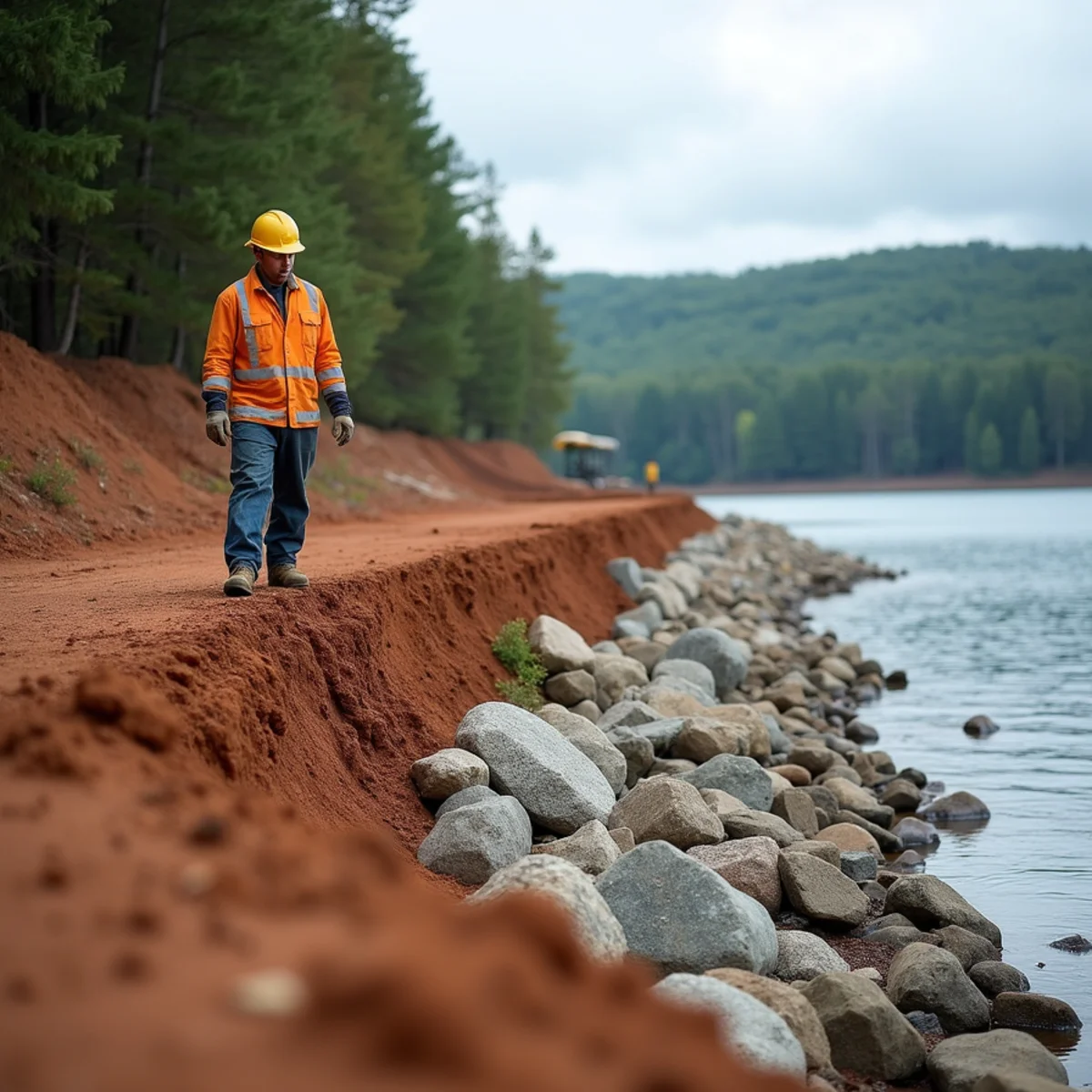
Signs of an Active Shoreline Collapse
- A visible drop or slump in the bank that happened suddenly rather than gradually
- A crack or gap opening in the lawn near the top of the bank
- A dock, seawall, or boathouse post that has shifted or tilted
- Soil or mud actively clouding the water at the base of the bank
- A tree at the bank edge leaning further than it was weeks ago
- Debris or slumped soil visible in the water after a storm or high wake day
Stopping an Active Collapse First
An already-slumped bank is unstable by definition, so the first move is assessing whether it is safe to work the site directly or whether we need to place initial shoring from above before anyone or any equipment gets close to the failure zone. In many cases we bring in heavy armor stone - larger than standard riprap - and place it at the toe of the failed slope first, using it as both a physical buttress against further movement and a base to rebuild the bank profile on top of. Where land access will not support the equipment needed, we coordinate barge-delivered stone so heavy material can reach a water-only lot without crossing an already-compromised bank.
Once the toe is armored and the immediate collapse risk is controlled, we regrade the slumped soil above it to a stable angle, tying the new grade into the surrounding undisturbed bank so there is no sharp transition that becomes the next failure point. This is emergency-timeline execution of the same engineering behind our standard lakefront shoreline stabilization work, compressed because the bank has already partially failed rather than just showing early erosion signs.
- Safety assessment of the failure zone before equipment or crew approach the bank
- Heavy armor stone placed at the toe of the slope as an emergency buttress
- Barge-delivered stone for water-only or already-compromised access
- Regrading of slumped soil to a stable angle tied into the surrounding bank
Rebuilding a Bank That Will Not Collapse Again
Collapse rarely happens without a cause - saturated soil from poor drainage above the bank, wake energy concentrated by a dock or point of land, or a bank that was cut too steep during original construction are the usual culprits. As part of the rebuild we identify which of these applied and address it directly, whether that means tying in upslope drainage so groundwater stops saturating the bank from behind, or re-grading the profile to a genuinely stable slope angle instead of the steep cut that failed. Any work below normal pool elevation on Burton, Rabun, or Seed Lake is coordinated with Georgia Power shoreline management requirements and EPD buffer rules given the emergency nature of the repair.
We handle this response for waterfront properties throughout Tallulah Falls and the surrounding lake communities, where steep original grading and heavy recreational boat traffic combine to make bank collapse a recurring risk. If your shoreline has already failed, time matters - every additional storm or high-wake weekend pulls more soil into the lake and raises the cost and scope of repair.
- Root-cause identification: drainage, wake exposure, or original grade angle
- Upslope drainage tied in where saturation contributed to the failure
- Coordination with Georgia Power and EPD requirements on an emergency timeline
- Rebuilt profile engineered for long-term stability, not just a quick patch
Stone Weight, Access Logistics, and Safety Zones on an Active Collapse
Toe armor stone on an active collapse runs meaningfully heavier than standard riprap - often 300 to 800 pound class stone or larger depending on bank height and exposure - because the goal is not just resisting future wave energy but physically bracing soil that is already in motion, and lighter stone can settle into failing ground instead of stopping it. We set an exclusion zone at the top of the failed bank, typically a minimum of 10 feet back from any visible crack or scarp, and keep it marked until the toe is armored and regrading has removed the overhang that created the original collapse risk.
Where equipment cannot safely reach the toe from land, we coordinate a barge platform sized to carry a compact excavator and staged stone, working the shoreline from the water rather than risking machinery on ground that has already partially failed. Dewatering a section of bank temporarily, using sandbags or a small diversion berm above the work zone, is sometimes necessary so active seepage does not undermine the regrading while it is being placed.
- Toe armor stone in the 300 to 800 pound class or larger, sized to brace soil already in motion
- Minimum 10-foot exclusion zone maintained back from any visible crack or scarp
- Barge-mounted excavator staging where land access is unsafe on a failed bank
- Temporary dewatering or diversion berms to protect regrading from active seepage
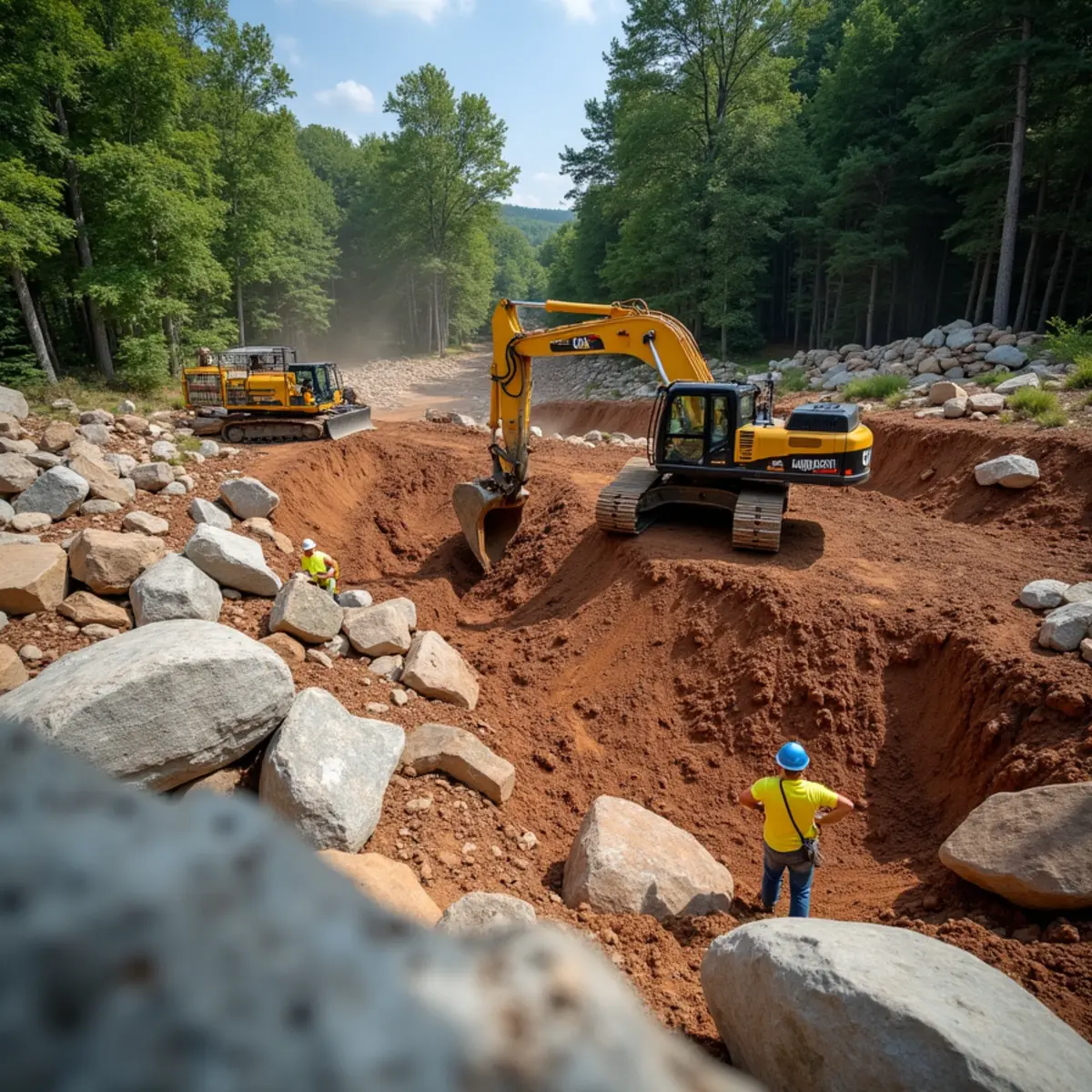
Our Process
- 1
Emergency Response Call
We assess urgency and dispatch to evaluate the collapse and immediate safety concerns.
- 2
Safety & Access Assessment
We determine safe access, whether by land or barge, before any equipment approaches the bank.
- 3
Toe Armoring
Heavy stone is placed at the base of the failure to stop further movement immediately.
- 4
Regrading
The slumped bank is reshaped to a stable, engineered slope tied into surrounding grade.
- 5
Root-Cause Rebuild
We address the drainage, wake exposure, or grading issue that caused the collapse in the first place.
Materials & Equipment
- Heavy armor stone for toe shoring and buttressing
- Barge delivery equipment for water-only access
- Compacted fill for bank regrading
- Drainage pipe and fabric for root-cause correction
- Compact excavators suited to unstable bank conditions
What Affects Your Price
Every mountain and lakefront project is different. These are the factors we weigh in a free on-site estimate — no fixed price fits every property.
- Extent and depth of the shoreline collapse
- Land versus barge access for emergency stone delivery
- Tonnage of heavy armor stone required for toe shoring
- Root-cause drainage or grading correction required
- Georgia Power and EPD permit coordination on an urgent timeline
- Restoration of dock, path, or structure footings affected by the collapse
Why Choose Kipps Kustom Landscapes for Lakefront Shoreline Collapse Shoring
24/7 Emergency Lakefront Response
A collapsed bank does not wait for a weekday appointment, so we run 24/7 emergency erosion response for lakefront failures, dispatching before the next wake or storm pulls more of the yard into the water.
Barge and Land Equipment We Own Outright
We operate our own compact excavators and coordinate barge platforms directly, so an emergency shoring job is not delayed waiting on a rented barge or a borrowed machine during peak lake season.
15+ Years Shoring Failed Banks on These Reservoirs
Since founding the company in 2010 we have handled active shoreline collapses on Lake Burton, Lake Rabun, and Seed Lake, so we recognize the difference between a bank that has settled and one still actively slumping before equipment ever approaches it.
Georgia Power and EPD Coordination, Even on an Emergency Timeline
We handle the shoreline management and buffer paperwork directly with the relevant authorities so an urgent repair does not create a permitting problem after the fact.
Frequently Asked Questions
- This is treated as urgent work given how quickly an active failure grows with each storm or high-wake weekend. Call (323) 606-0255 directly and we will assess response timing based on severity.