
Runoff Off a Bare Granite Face
Mount Yonah's exposed granite dome is dramatic to look at, and it is also, functionally, one of the largest impervious surfaces in this part of White County. Soil and forest floor absorb a meaningful percentage of rainfall before it ever becomes surface runoff, but bare granite absorbs essentially none of it. When a storm hits the face, water sheets off almost instantly and arrives downhill in a concentrated pulse rather than the slower, distributed flow a wooded hillside produces.
For properties positioned below the granite face or in its natural drainage path, this means storm response has to be sized for a flash event, not average rainfall. A drainage system designed around typical residential runoff calculations will be overwhelmed the first time a real storm hits the exposed rock above it.
Oversize Catch Basins for Flash Flow
We size catch basins and grate inlets larger than standard residential specifications for Yonah-area properties, specifically to handle the sudden volume spike that granite-face runoff produces rather than a gradual rain event. These oversized basins tie into wider-diameter drain lines than we would install for a typical wooded lot, since a pipe adequate for gradual infiltration will surcharge and back up the moment a flash pulse off the granite hits it.
We also grade generous overflow paths around every catch basin we install here, because even an oversized system can be exceeded in an extreme event, and a basin with no planned overflow route sends excess water somewhere unplanned, usually toward a foundation.
Drain Lines and Structural Protection Downhill
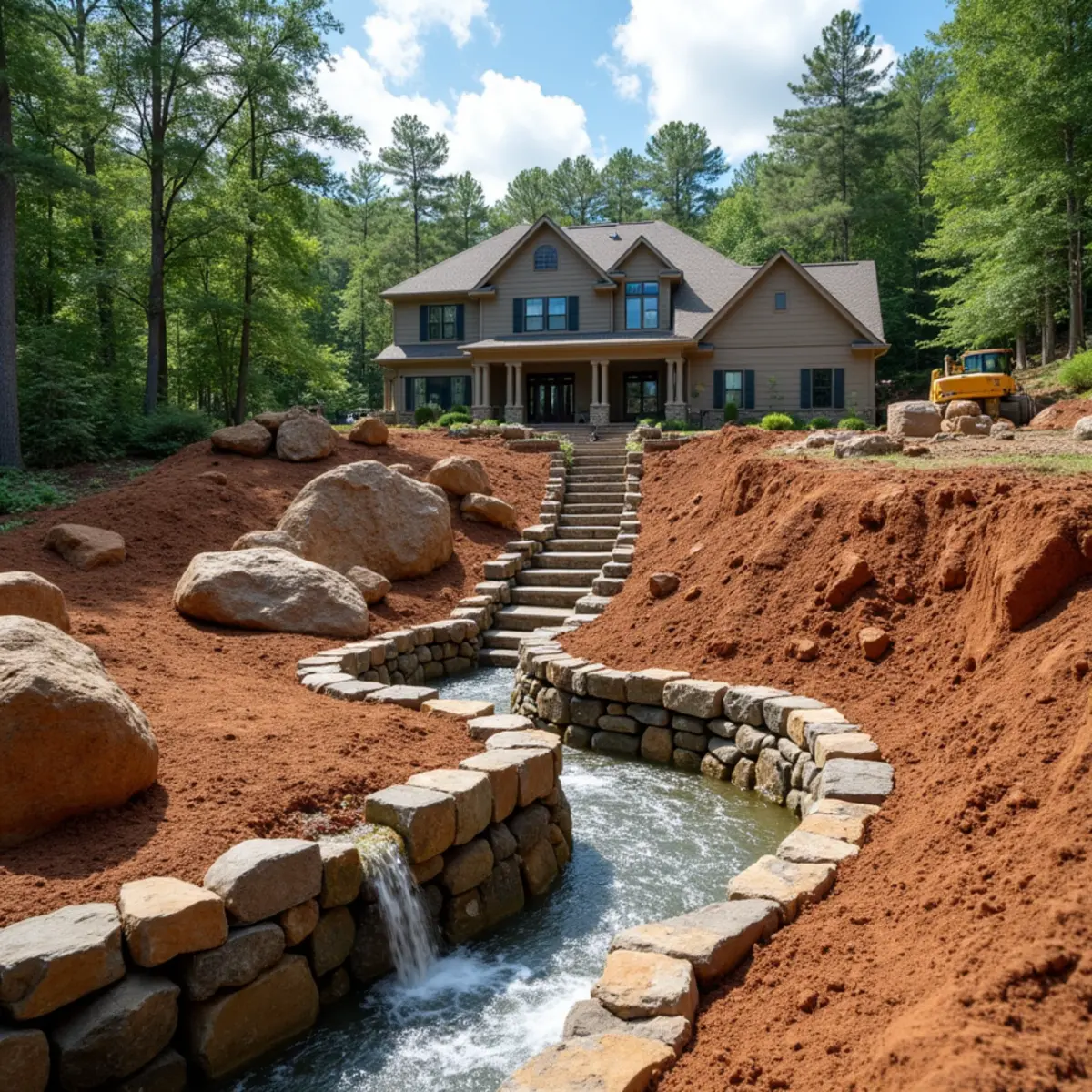
Below the catch basins, we run heavier-duty French drain lines with wider trench beds than standard, and where a property sits directly in the historical flow path off the mountain, we pair drainage work with boulder retaining walls positioned to deflect and slow flash flow before it reaches a structure rather than simply channel it faster downhill. Getting the deflection angle right matters more here than almost anywhere else we work, since a wall built to redirect flash flow incorrectly can concentrate it onto a neighboring property instead of solving the problem.
Yonah's granite-driven drainage challenges share some overlap with the pastoral terrain of Sautee Nacoochee just down the valley, and we serve both areas on the same regular routes out of Clarkesville.
Storm Season Escalation and Structural Protection
Flash runoff off Mount Yonah's granite is not a year-round constant, it spikes hardest during the same summer convective storm season that hits the rest of the North Georgia foothills, when fast-building afternoon thunderstorms can drop a significant amount of rain in a short window directly onto exposed rock with nothing to slow it down. Properties downhill from the granite face see the difference immediately: a storm that produces manageable runoff on a wooded lot elsewhere can send a genuine surge through a Yonah-area drainage path in minutes. Late summer and early fall, when the ground below the granite is already saturated from the season's earlier storms, tends to produce the most damaging events, since there is no absorption capacity left in the soil to buffer even a moderate rain hitting the rock above.
For homes and structures positioned in a historical flow path, we treat foundation protection as a distinct piece of the drainage plan, not an assumed side effect of catch basins and drain lines elsewhere on the property. That means grading a positive slope away from the foundation on all sides regardless of where the primary drainage system runs, and in some cases adding a secondary deflection berm upslope of the structure itself as a backup if the main system is ever exceeded during an extreme event. We size every component of a Yonah-area drainage system with that redundancy in mind, because a single point of failure below an impervious granite face carries higher consequences than the same failure would on an ordinary wooded lot, a standard we also apply to work near Cornelia.
We also advise Yonah-area clients to have granite-face drainage reassessed after any major storm season, since a single extreme event can shift how water concentrates off the rock face, and a system that performed well for years can need re-grading after conditions upstream of the property change.
Neighborhoods & Areas We Serve Below Mount Yonah
Properties positioned directly below Mount Yonah's exposed granite face need the flash-flow drainage sizing we already build into every job here, while parcels set further back from the mountain's natural drainage path behave more like a typical White County lot with gradual rainfall infiltration instead of a sudden pulse. We map where a property actually sits relative to the granite's flow path before pricing any catch basin or drain line work, since that position matters more than distance from the mountain measured in a straight line.
That mapping step is why we serve Yonah on the same regular routes we run near Sautee Nacoochee and Cornelia, keeping granite-face drainage calls on our normal schedule rather than treating them as a special trip.
What a Typical Yonah-Area Project Looks Like
A typical Yonah-area call comes from a property owner who noticed their yard floods faster than anywhere else they have lived, usually without living directly next to a creek. We walk the site, trace the historical flow path off the granite face, and size oversized catch basins and French drain lines to handle the flash volume rather than average rainfall.
The second common project pairs that drainage work with boulder retaining walls positioned to deflect flash flow away from a structure, work we size carefully so it does not simply redirect the problem onto a neighboring parcel.
Native Plant Palette & Microclimate Notes for Yonah
Ground below Mount Yonah's granite face drains fast once water reaches soil, but the thin topsoil this close to bare rock does not hold moisture the way a wooded lot elsewhere in White County does, which limits which plants actually establish near the base of the dome. We favor drought-tolerant native grasses and shrubs on the driest stretches closest to the granite, and we reserve moisture-loving ornamentals for the lower, wetter ground where the flash runoff we manage with oversized drainage actually settles.
That same dynamic shapes planting near Sautee Nacoochee, where valley soil holds water far longer than Yonah's rock-adjacent ground ever will.
Our Services in Yonah
Every core Kipps Kustom Landscapes service is available to Yonah property owners:
Why Yonah Residents Choose Kipps Kustom
Thirteen Miles Out, Still on Our Regular Route
Yonah is about 13 miles from Clarkesville, and we serve it on the same regular routes as nearby Sautee Nacoochee, so granite-face drainage calls do not carry a special trip delay.
15+ Years Sizing Drainage for Flash Runoff
Oversizing catch basins and drain lines for a sudden granite-face pulse rather than average rainfall takes calculation experience built over more than fifteen years across NE Georgia's flash-prone terrain.
Own Equipment to Reassess After Major Storms
We own the machinery needed to re-grade a Yonah-area drainage system after an extreme storm season shifts how water concentrates off the rock, rather than waiting on a rental booking during peak season.
4.9-Star Rated for High-Consequence Drainage Work
A single point of failure below an exposed granite face carries higher stakes than an ordinary lot, and our 4.9-star rating across 47 reviews reflects redundant systems built to hold.
Yonah Landscaping FAQs
- If your property sits below Mount Yonah's granite face, that bare rock sheds nearly all rainfall instantly instead of absorbing it, which sends a concentrated pulse of water downhill much faster than a wooded hillside would.