
Why Mount Airy Erodes Faster Than Nearby Towns
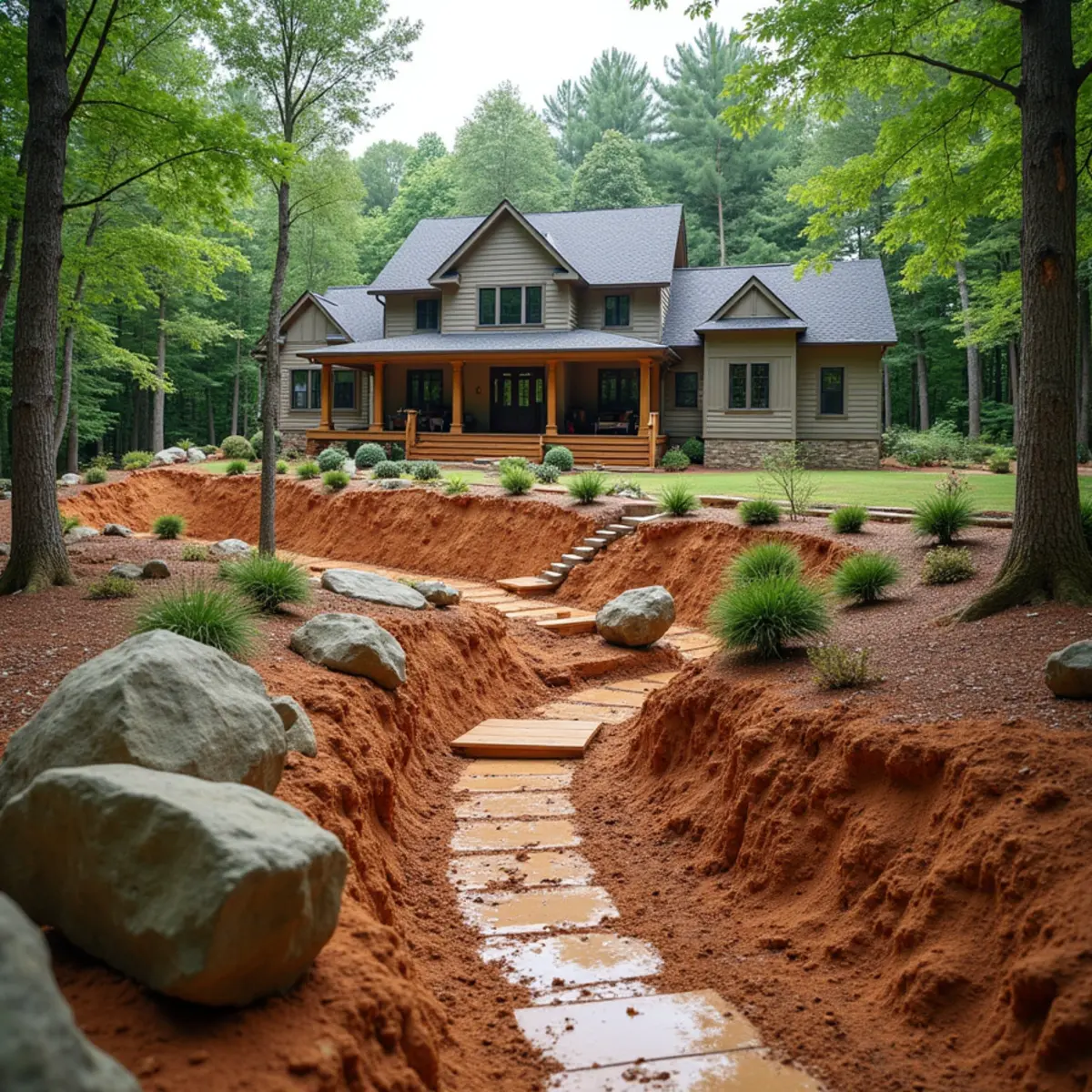
The foothill grades around Mount Airy sit steeper on average than the rolling terrain closer to Clarkesville, and the clay exposed on cut banks along newer subdivisions has almost no organic topsoil layer protecting it. Bare red clay on a slope acts almost like a paved surface during a downpour: water does not soak in, it sheets straight down the grade, picking up clay particles and carving rills that widen every time it rains.
We see this most on newer construction where builders cleared and graded without leaving erosion control in place long-term, and on older properties where a single failed gutter or missing splash block has been feeding the same eroding channel for years.
Dry Creek Beds That Actually Function
For active erosion channels, we do not fight the water's natural path, we armor it. A properly built dry creek bed follows the existing flow line, gets excavated deeper and wider than the current rill, and gets lined with filter fabric under a graded mix of river rock, from cobble at the bottom to smaller stone at the banks, so it can carry a real storm event without blowing out. Done right, it also reads as a landscape feature rather than a scar across the yard.
For sheet flow coming off a whole hillside rather than one channel, we combine the creek bed approach with French drains upslope to intercept subsurface water before it ever reaches the surface and starts carrying clay downhill.
Interlocking Segmental Walls for Slope Stability
Where erosion has undercut a slope enough that regrading alone will not hold, we install interlocking segmental block or boulder retaining walls with proper geogrid reinforcement tied back into the hillside. Segmental interlocking systems handle Mount Airy's clay well because each course locks mechanically to the one below it, so the wall keeps working even as the clay behind it expands and contracts through wet and dry cycles rather than relying on gravity and friction alone.
We treat a lot of erosion repair work in Mount Airy as urgent, since an active gully only gets more expensive to fix the longer it runs, and we coordinate scheduling easily with nearby Clarkesville and Turnerville jobs to keep response times short.
Construction-Season Timing and Groundcover Stabilization
Erosion risk in Mount Airy is not constant through the year, it spikes hardest during the transition seasons, late winter into early spring when frequent rain hits ground that construction or clearing left bare over the previous months, and again in early fall when tropical remnant systems can dump several inches in a single afternoon on slopes that spent a dry summer losing whatever vegetation was holding them. We schedule major regrading and dry creek bed work around those windows when we can, finishing exposed slope work before the spring rain pattern sets in rather than leaving raw clay exposed through the wettest stretch of the year. Newer subdivisions off Highway 441 on the north side of town see this most acutely, where cleared lots sit bare for months between grading and final landscaping.
Between excavation and final stabilization, we seed disturbed slopes with a fast-establishing erosion-control mix, annual rye paired with a slower-germinating fescue, so something is holding the surface within days rather than leaving bare clay exposed to the next storm while permanent turf gets established. On the steepest cut slopes, we combine that seeding with jute or coir erosion blankets pinned directly into the clay, which slows surface flow enough for roots to take hold before the blanket breaks down naturally. This staged approach, temporary cover first, structural boulder retaining walls and permanent turf second, is what keeps a Mount Airy erosion repair from becoming a repeat call the following spring, and it is the same sequencing we use on similar grades near Turnerville.
We also see a specific failure pattern on Mount Airy properties with older corrugated metal culverts installed decades ago, since rust-through and crushed sections routinely go unnoticed until a storm backs up and blows out the road or driveway above them. As part of any drainage assessment here, we inspect existing culvert condition rather than assuming an in-place pipe is still functional, and we replace undersized or failing metal culverts with heavier-gauge HDPE pipe sized for the area's storm intensity rather than simply matching what was there before.
What a Typical Mount Airy Project Looks Like
A typical Mount Airy call starts with an active gully or a driveway that keeps losing gravel after every storm, usually on a newer subdivision lot off Highway 441 where the builder graded and cleared but never left long-term erosion control in place. We walk the eroding channel, figure out where the water is actually originating upslope, and size a dry creek bed or French drain combination to carry the real storm flow instead of patching the visible rill.
The second common project is a slope that has already undercut itself enough that regrading will not hold, which usually means an interlocking boulder retaining wall with geogrid tied back into the hillside. Both project types get the same staged approach: temporary seeding first, structural work second, so bare clay is never left exposed through a storm cycle.
Neighborhoods & Areas We Serve in Mount Airy
Mount Airy's ZIP 30563 covers ground that erodes at very different rates depending on which part of town a lot sits in. The newer subdivisions off Highway 441 on the north side carry bare, recently cut clay banks with almost no established topsoil, while older properties closer to the town center have decades of settled grade and mature groundcover holding the same clay in place. We treat a north-side lot as an active erosion site until proven otherwise, and an older in-town lot as a maintenance job unless something specific, like a failed gutter, has broken that stability.
That distinction also shapes how we schedule crews between Mount Airy and neighboring Turnerville and Clarkesville, since active erosion sites get priority regardless of which town they are in.
Native Plant Palette & Microclimate Notes for Mount Airy
The same steep, exposed clay that erodes fast in Mount Airy also limits what holds a slope once it is stabilized. We favor deep-rooted native grasses and shrubs like switchgrass and Virginia sweetspire on regraded banks, species that establish quickly on raw clay and actually help prevent the next erosion event rather than ornamental groundcover that needs a season of babying to take hold.
On the steepest cut slopes near Highway 441, we pair that planting with native mountain rhododendron where shade allows, the same palette we rely on for slope work near Clarkesville.
Our Services in Mount Airy
Every core Kipps Kustom Landscapes service is available to Mount Airy property owners:
Why Mount Airy Residents Choose Kipps Kustom
Five Miles Out, Same-Day Erosion Response
Mount Airy sits about 5 miles from our Clarkesville shop, and because an active gully only gets more expensive the longer it runs, we prioritize same-day or next-day response for washout calls here.
15+ Years Reading Red Clay Erosion Patterns
We have repaired failing dry creek beds and undercut slopes across Habersham County's steepest foothill grades for over fifteen years, so we know which Mount Airy subdivisions were graded without long-term erosion control.
We Own the Equipment for Emergency Grading
Our own excavation and compaction machinery means we do not wait on a rental yard to stabilize an active gully or swap out a failing culvert.
4.9 Stars, 24/7 Emergency Response
Rated 4.9 stars across 47 reviews, and available 24/7 for emergency response when a Mount Airy hillside washout cannot wait until morning.
Mount Airy Landscaping FAQs
- Mount Airy sits on steeper foothill grades with exposed red clay that has little topsoil protection, so rainfall sheets off the surface instead of soaking in, carving rills that widen with every storm.