
Signs Your Patio or Fire Pit Project Needs It Done Right
- An existing paver or poured patio that has heaved, cracked, or settled unevenly
- A gathering space you want outdoors but no flat, stable spot to build it
- A fire pit built directly on grass or bare soil that has become a fire hazard or mud pit
- Standing water on a patio surface after rain instead of it shedding away
- Wanting a natural stone look that matches boulder walls or existing mountain stonework
- A sloped backyard with no level area for outdoor seating
Base Prep First - Where Every Good Patio Starts
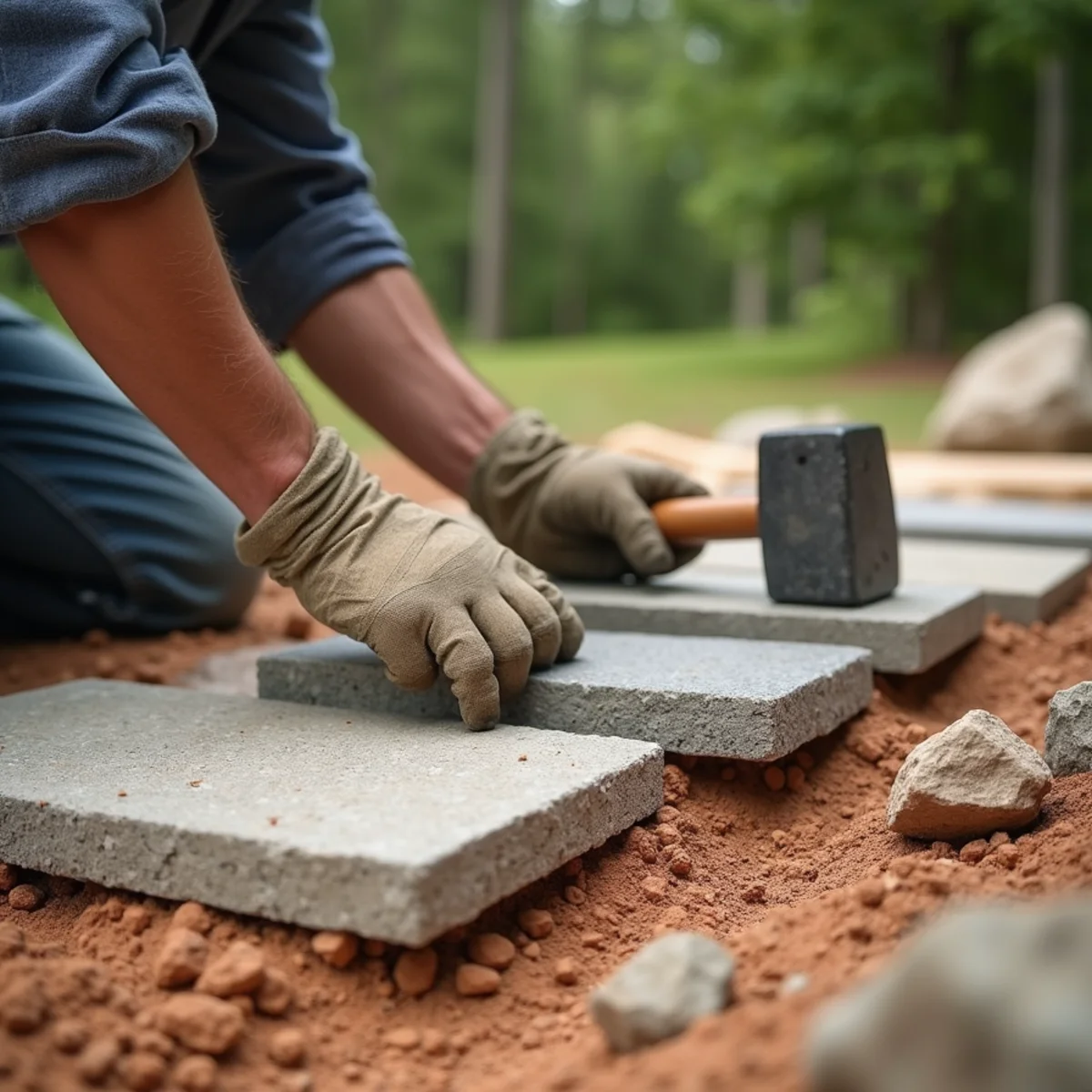
Flagstone failures almost always trace back to the base, not the stone. We excavate below the finished grade to remove topsoil and organic material entirely, since roots and decomposing matter under a patio create voids that show up as settling a year or two later. In their place we compact crushed stone in lifts with a plate compactor, building a base thick enough to handle red clay's expansion and contraction through the freeze-thaw cycles common in the Blue Ridge foothills, with a slight pitch built in so water sheets off the surface instead of pooling.
For a dry-laid flagstone patio, we set stone into a screeded bedding layer of stone dust or sand, fitting irregular natural stone edges tightly and leveling each piece individually with a rubber mallet before joints are packed with polymeric sand or fine gravel. For a mortared patio on a concrete or compacted paver base, joints are struck and cleaned before the mortar cures. Either method depends entirely on that compacted base holding its shape underneath, which is also why we will not shortcut it to hit a lower price.
- Full excavation of topsoil and organics below the patio footprint
- Compacted crushed-stone base built in lifts with a plate compactor
- Pitch built into the base so water sheets away from the finished surface
- Dry-laid or mortared flagstone set and leveled stone by stone
Building a Fire Pit That Is Actually Safe to Use
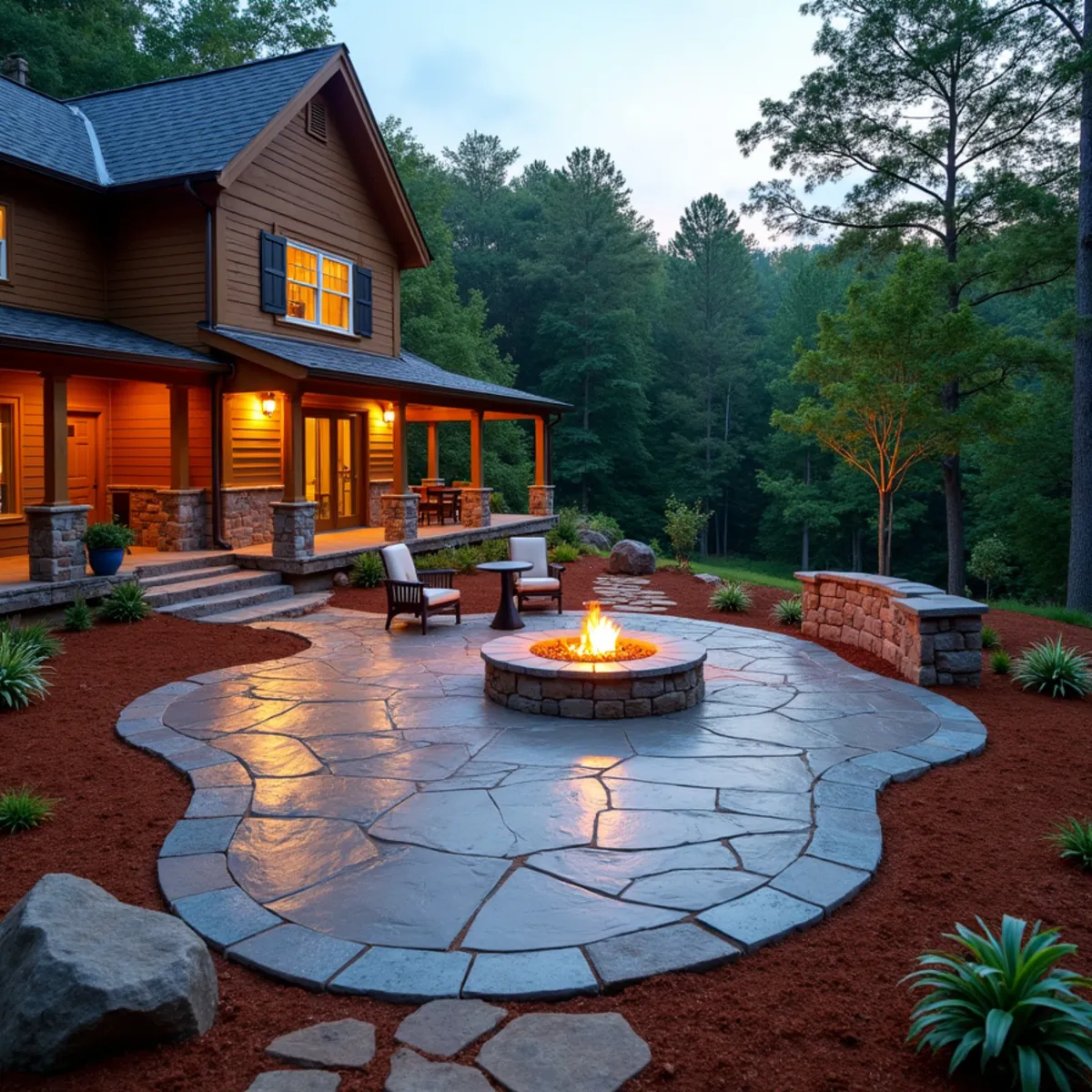
A fire pit sits on the same compacted base principles as a patio, but adds heat-specific details: a non-combustible base of compacted gravel or paver stone extending well beyond the fire ring, and a stacked or mortared stone wall using dense granite or fieldstone that will not spall or crack from repeated heat cycling the way some porous or wet-set stones do. We size the interior diameter and wall height for real use - enough room for a grate or wood stack without radiant heat crowding seating - and keep the pit set back from structures, fences, and overhanging branches per typical local fire-safety clearance practice.
Fire pits and flagstone patios are frequently built together with seating walls, and pair naturally with low-voltage landscape lighting for evening use and with native mountain planting around the perimeter to soften the hardscape. We build these features for homes throughout Cornelia and the surrounding foothills, where evening gatherings around a stone fire pit are as much a part of mountain living as the view.
- Non-combustible compacted gravel base extending beyond the fire ring
- Dense granite or fieldstone selected to resist heat spalling
- Interior sizing based on real use, not a generic template
- Clearance from structures, fencing, and overhanging trees
Base Depth, Stone Thickness, and Fire Ring Details
Base depth is not a guess - we build 6 to 8 inches of compacted crushed stone under a dry-laid flagstone patio, and closer to 8 to 10 inches under a mortared patio or one that will see vehicle or heavy furniture load, compacted in 2-inch lifts rather than one deep pass so the whole base densifies evenly rather than just the top few inches. Flagstone itself is selected in 1.5 to 2.5 inch thickness for stepping-stone use and patios, since thinner stone flexes and cracks under point loads like a chair leg or grill wheel over time.
For a fire pit, we typically use a steel fire ring liner set inside the stacked or mortared stone wall to protect the masonry from direct flame contact and radiant heat cycling, extending the functional life of the stonework significantly versus stone alone taking repeated high heat. Mortar, where used, is a Type S masonry mix chosen for its higher compressive strength and better resistance to freeze-thaw cracking than a standard Type N mix, which matters on any exterior masonry that sees the freeze-thaw cycles typical of Habersham County winters.
- 6 to 8 inches of compacted base for dry-laid work, 8 to 10 inches under mortared or heavy-load patios
- Crushed stone base compacted in 2-inch lifts for even density throughout
- Flagstone thickness of 1.5 to 2.5 inches selected to resist cracking under point loads
- Steel fire ring liner protecting stacked or mortared stone from direct flame and heat cycling
Our Process
- 1
Site Layout & Design
We walk the space, discuss size and stone style, and lay out the patio or fire pit footprint on site.
- 2
Excavation
We remove topsoil and organic material to the depth needed for a proper compacted base.
- 3
Base Compaction
Crushed stone is placed and compacted in lifts with the correct pitch built in for drainage.
- 4
Stone Setting
Flagstone is set and leveled piece by piece, or fire pit walls are stacked and mortared as designed.
- 5
Joints & Finish
Joints are packed or struck, the area is cleaned, and surrounding grading and planting are finished.
Materials & Equipment
- Natural flagstone in Tennessee and Georgia stone varieties
- Dense granite and fieldstone for fire pit walls
- Crushed stone for compacted base construction
- Polymeric sand or stone dust for joint packing
- Plate compactors and mini excavators
What Affects Your Price
Every mountain and lakefront project is different. These are the factors we weigh in a free on-site estimate — no fixed price fits every property.
- Total patio square footage or fire pit diameter
- Stone type and sourcing - flagstone variety and thickness
- Depth of excavation required for a proper compacted base
- Dry-laid versus mortared installation method
- Site access for material delivery and excavation equipment
- Add-ons such as seating walls, lighting, or planting beds
Why Choose Kipps Kustom Landscapes for Stone Fire Pits & Flagstone Patios
Every Base Compacted the Same Way, Every Time
We do not vary our base compaction method to hit a lower bid; every patio and fire pit gets the same 6 to 10 inches of compacted crushed stone in lifts, which is why our work still sits flat years after installation.
15+ Years of Stonework Across the Foothills
Since founding the company in 2010 we have built flagstone and fire pit projects throughout Habersham County using the same base-first principles, so the patios we built early on are still holding up as proof of the method.
In-House Excavation and Masonry - One Accountable Crew
The same crew that excavates and compacts your base sets the stone, so there is no finger-pointing between a grading sub and a mason if something needs adjusting mid-project.
Free On-Site Design Consultation
We walk the space with you, discuss stone style and fire pit sizing, and provide a written line-item estimate before any excavation begins.
Frequently Asked Questions
- Almost always an inadequate or organic-laden base underneath. Without a properly excavated, compacted, and pitched gravel base, freeze-thaw movement and settling soil will crack any surface set on top of it, flagstone included.