
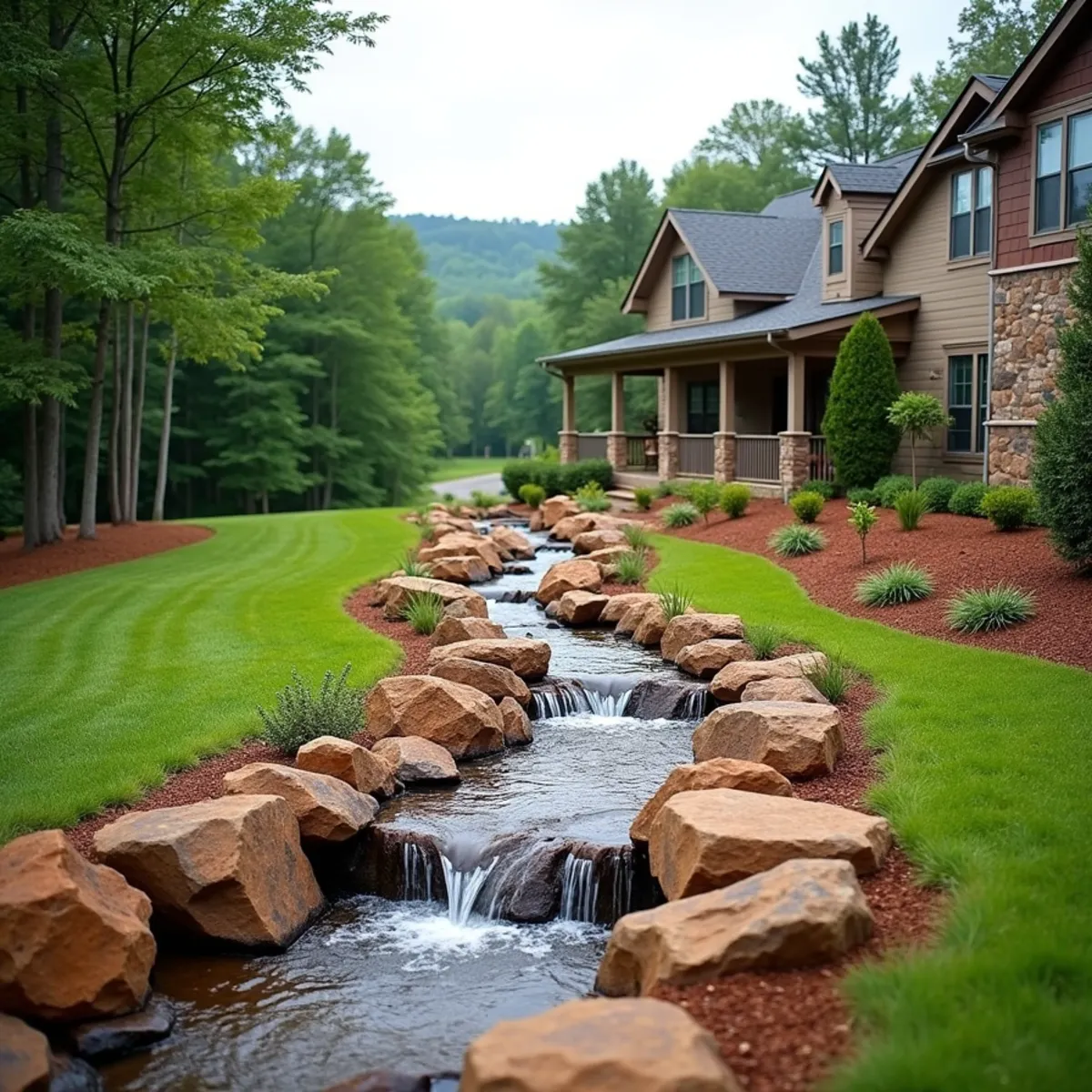
Signs You Have a Red Clay Drainage Problem
- Standing water in the yard for a day or more after rain stops
- A soggy, spongy lawn area that never fully dries out
- Water sheeting across a driveway or path during storms
- A basement, crawlspace, or foundation wall with recurring moisture
- Mulch or gravel migrating downhill after every rain event
- A neighbor's runoff crossing onto your property with nowhere to go
Diagnosing Where the Water Actually Comes From
Red clay behaves like poorly fired pottery - it seals itself under compaction and sheds water across the surface instead of absorbing it, which is why the same yard can flood in one spot and stay bone dry ten feet away. Before digging anything we walk the property during or right after a rain when possible, tracing the actual flow path from roofline, driveway, and upslope grade down to where it collects. Roof downspouts, driveway sheet flow, and neighboring lot runoff are three separate water sources that often get lumped together and mis-diagnosed, which is why DIY drain attempts frequently fail even when the pipe itself is installed correctly.
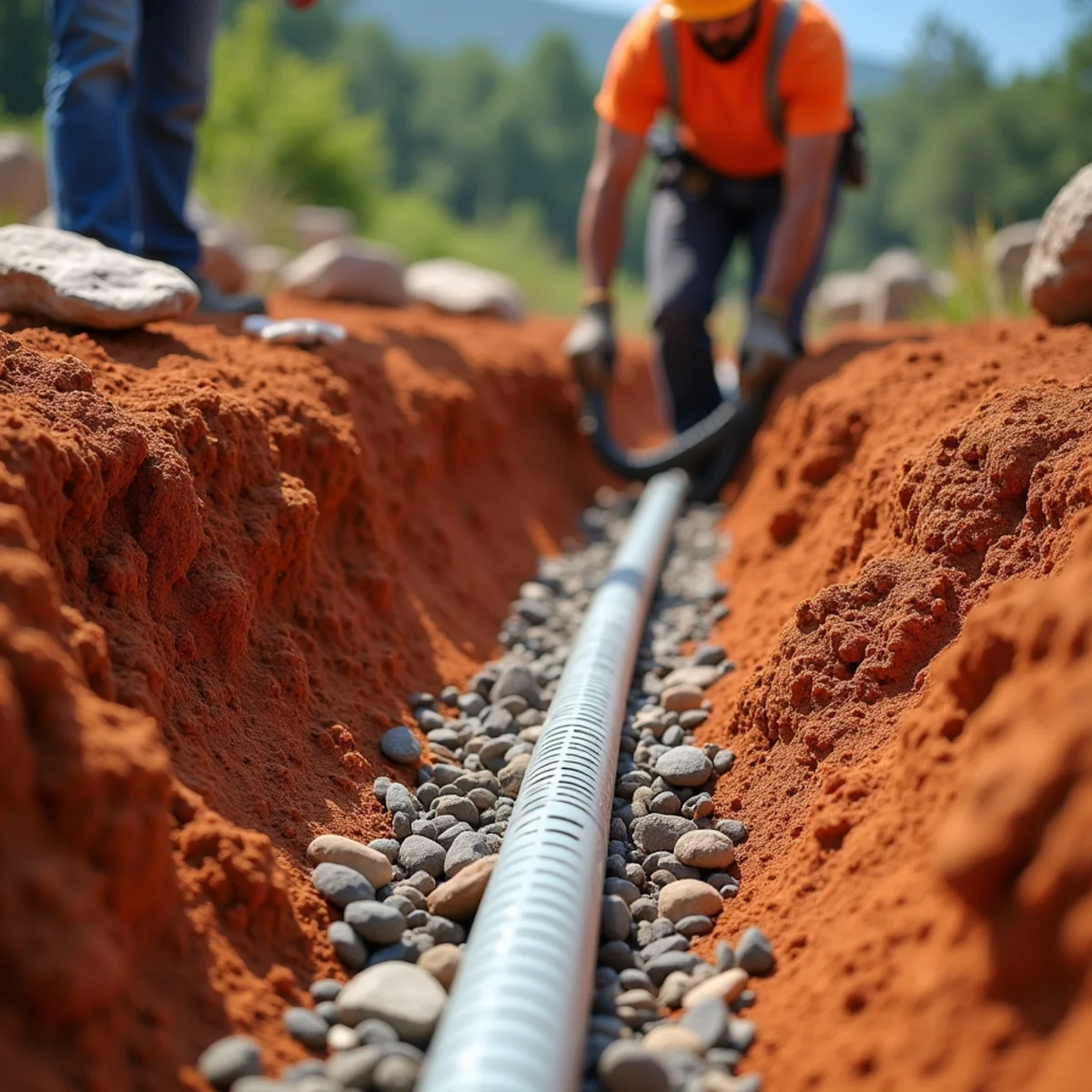
Once the source is mapped, we design the system to match: subsurface French drains for water moving through the soil profile, open surface swales for high-volume storm sheet flow, and culverts where water has to cross under a driveway or path. A trench for a French drain is cut to a consistent fall - never flat - lined with non-woven geotextile fabric, filled with clean washed stone, wrapped around a perforated pipe, and daylighted to a safe outlet point rather than dumped at a property line to become someone else's problem.
- On-site tracing of roof, driveway, and upslope runoff as separate water sources
- French drains cut to consistent fall with fabric, washed stone, and perforated pipe
- Open surface swales sized for storm sheet flow across lawns and beds
- Culverts sized to carry water safely under driveways and paths
Building Systems That Hold Up in Clay Soil
Clay's low permeability means a drain has to be oversized relative to what a sandy-soil system would need, because the surrounding soil will not help move water laterally into the pipe the way looser soil does. We compensate with wider stone envelopes and, where volume is high, add catch basins and pop-up emitters at the daylight point so water disperses instead of eroding a new gully at the outlet - a failure mode we see constantly on hillside lots that also feeds into emergency hillside washout repair calls after a bad storm.
On steeper mountain lots, drainage design has to work hand in hand with grading and any retaining structure on site, which is why this work is planned together with boulder retaining wall and full-property design projects rather than bid as an isolated trench. We serve red clay drainage problems throughout Clarkesville and the surrounding Habersham County foothills, where the same soil and slope conditions repeat lot after lot.
- Wide stone envelopes sized for clay's low lateral permeability
- Catch basins and pop-up emitters at outlet points to prevent new erosion
- Drainage coordinated with grading and retaining wall design on sloped lots
- Outlet points confirmed to daylight safely without impacting neighboring property
Trench Specifications and Testing Before We Call It Done
Every French drain trench is cut to a minimum consistent fall of one to two percent - roughly an eighth to a quarter inch of drop per foot of run - which we verify with a laser level rather than eyeballing it, since a trench that looks fine by sight can still have a low spot that traps water and turns the pipe into a stagnant reservoir instead of a moving drain. Trench depth typically runs 18 to 24 inches for a standard residential French drain, deeper where the water table or a specific problem calls for it, with a minimum four-inch perforated pipe used on most residential runs and larger diameter pipe specified where volume calculations from roof and hardscape square footage call for it.
Before backfilling, we run water through the system with a hose at the highest point and confirm it exits cleanly at the outlet, which catches a kinked pipe, a fabric fold blocking flow, or a low spot in the trench while it is still open and correctable. This on-site test is a step a lot of drainage installs skip, and it is exactly what separates a French drain that works from one that looks right in a photo and fails the first hard rain.
- Minimum one to two percent consistent fall verified with a laser level, not by eye
- Trench depth of 18 to 24 inches standard, deeper where volume or water table requires it
- Minimum four-inch perforated pipe, sized larger where roof and hardscape volume calls for it
- Hose test through the completed system before backfilling to confirm clean flow to outlet
Our Process
- 1
Water Tracing Site Visit
We walk the property, ideally during or after rain, to trace the real source and path of the water problem.
- 2
Drainage System Design
We choose the right mix of French drain, swale, and culvert based on volume, soil, and slope.
- 3
Trenching & Excavation
Trenches are cut to consistent fall using equipment sized to the site's access and soil conditions.
- 4
Pipe, Stone & Fabric Installation
We install fabric, washed stone, and perforated pipe, then confirm fall with a level before backfilling.
- 5
Outlet & Surface Restoration
We finish the outlet point, restore sod or beds, and confirm the system flows during the next rain.
Materials & Equipment
- Perforated corrugated and solid PVC drain pipe
- Clean washed drainage stone in multiple gradations
- Non-woven geotextile filter fabric
- Catch basins and pop-up emitter outlets
- Mini excavators and trenchers sized to site access
What Affects Your Price
Every mountain and lakefront project is different. These are the factors we weigh in a free on-site estimate — no fixed price fits every property.
- Linear feet of drain, swale, or culvert required
- Depth of trenching and volume of soil to be excavated and hauled
- Number of water sources being managed (roof, driveway, upslope, neighboring lot)
- Whether catch basins or pop-up emitters are needed at outlet points
- Site access for excavation equipment
- Coordination with grading or retaining wall work on the same lot
Why Choose Kipps Kustom Landscapes for Red Clay Drainage & French Drains
We Test Every Drain Before We Backfill It
We run water through every French drain system with a hose before covering the trench, catching a kinked pipe or low spot while it is still fixable instead of finding out during the next storm.
15+ Years Solving This Exact Soil Problem
Since founding the company in 2010 we have diagnosed and fixed red clay drainage problems throughout Habersham County, which means we have already seen how this specific clay behaves on hundreds of lots before we ever walk onto yours.
Rated 4.9 Stars for Getting Water Off the Ground
Drainage complaints are one of the most common reasons homeowners call us, and our 4.9-star rating across 47 local reviews reflects systems that are still working seasons later, not just on installation day.
Free Site Visit, Ideally During or After Rain
We will walk your property during active rain when scheduling allows, because tracing water while it is actually moving tells us more than a dry-day guess, and the resulting written scope reflects what we actually saw.
Frequently Asked Questions
- The most common cause is a trench dug flat instead of on a consistent fall, or fabric and stone sized too small for how little clay lets water move sideways into the pipe. We size every system for actual clay conditions, not a generic drain kit.