
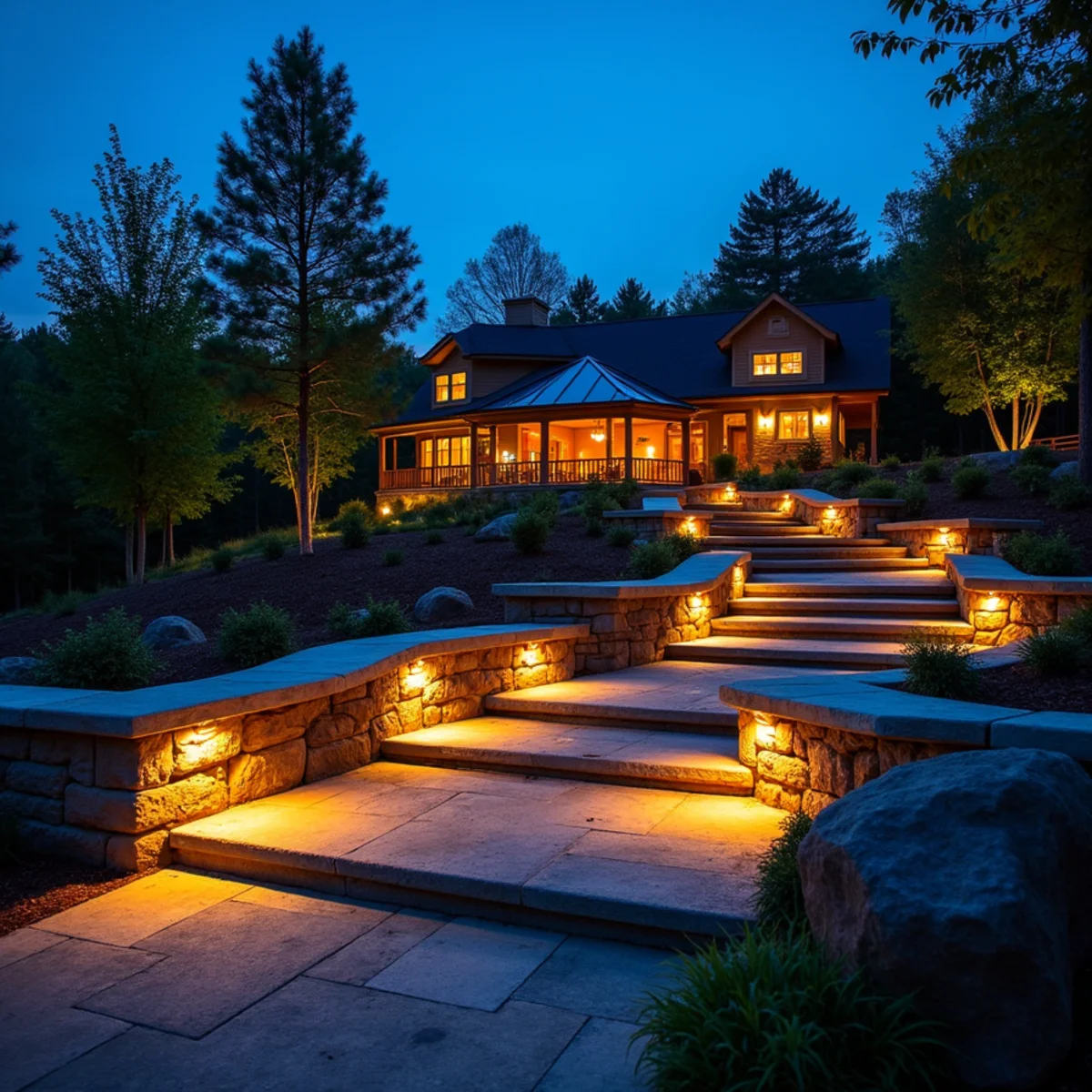
Signs Your Property Needs a Real Lighting Design
- Steps, paths, or a driveway that are genuinely hard to see safely at night
- A boulder wall, patio, or specimen tree that disappears entirely after dark
- Existing lighting that glares or looks like a runway instead of natural moonlight
- Plastic fixtures that have already faded, cracked, or corroded within a couple of seasons
- A fire pit or patio area with no lighting for evening use
- A transformer or wiring system that no longer powers all the fixtures reliably
Designing Light, Not Just Placing Fixtures
Good landscape lighting layers three effects: path lighting low to the ground for safe footing, uplighting on features like boulder retaining walls and specimen trees to create depth and shadow, and moonlighting - fixtures mounted high in a tree canopy and aimed down - to cast a soft, natural-looking wash across a lawn or patio. We design the layout around how the property is actually used at night, walking it after dark during the design phase whenever possible to see real shadows and sightlines rather than guessing from a daytime photo.
Every system runs on 12-volt low-voltage current from a transformer sized with headroom above the connected fixture wattage, since running a transformer at its rated limit shortens its life and can cause voltage drop that dims fixtures at the far end of a long run. Wire gauge is selected based on run length and total load for the same reason - undersized wire on a long run is one of the most common causes of landscape lighting that looks great near the transformer and dim or flickering at the property's far corners.
- Layered design: path lighting, feature uplighting, and canopy moonlighting
- Night walk-through during design to confirm real shadows and sightlines
- Transformer sized with headroom above total connected fixture wattage
- Wire gauge selected by run length and load to prevent voltage drop
Installation That Holds Up Outdoors for Years
We install solid brass and copper fixtures rather than cast aluminum or plastic, because brass does not corrode or crack under UV exposure and develops a natural patina over time that actually improves the look of the fixture rather than degrading it. Wire is buried below typical landscaping disturbance depth and routed to avoid future conflict with plant bed maintenance or seasonal digging, with waterproof connectors at every splice rather than twist-and-tape connections that fail within a season of ground moisture exposure.
Lighting pairs naturally with flagstone patios and fire pits for evening entertaining and with native mountain planting beds that benefit from soft uplighting rather than harsh floodlighting. We install and service these systems for properties throughout Clarkesville, including photocell and timer controls so the system turns on and off automatically without you thinking about it.
- Solid brass and copper fixtures for long-term outdoor durability
- Wire buried below typical disturbance depth with waterproof splice connectors
- Photocell and timer controls for automatic operation
- System designed to integrate with existing patios, walls, and planting beds
Voltage Drop Math and Fixture Specifications
Voltage drop across a wire run is a function of wire gauge, run length, and total amperage draw, and a system that loses more than about 10 percent of its rated voltage by the last fixture on a run will visibly dim compared to fixtures near the transformer. As a practical guide, 12-gauge cable handles moderate loads over runs up to roughly 100 feet before drop becomes noticeable, while longer runs or heavier connected loads call for 10-gauge cable or a second home run from the transformer rather than daisy-chaining everything off one line - we calculate this per system rather than defaulting to one wire gauge across the whole property.
LED lamps are specified in the 2700 to 3000 Kelvin color temperature range for most residential work, which reads as a warm, natural light close to firelight or moonlight rather than the cooler, bluer light common in commercial fixtures - color temperature matters as much as brightness for a landscape lighting system that is supposed to look natural rather than institutional. Wire splices use waterproof, gel-filled connectors rated for direct burial, since a twist-and-tape connection left in contact with damp Georgia clay corrodes and fails within one wet season.
- Voltage drop calculated per run - held under roughly 10 percent of rated voltage at the last fixture
- 12-gauge cable for moderate loads under 100 feet, 10-gauge or a second home run for longer or heavier circuits
- LED color temperature specified at 2700 to 3000 Kelvin for a warm, natural residential look
- Waterproof, gel-filled connectors rated for direct burial at every splice
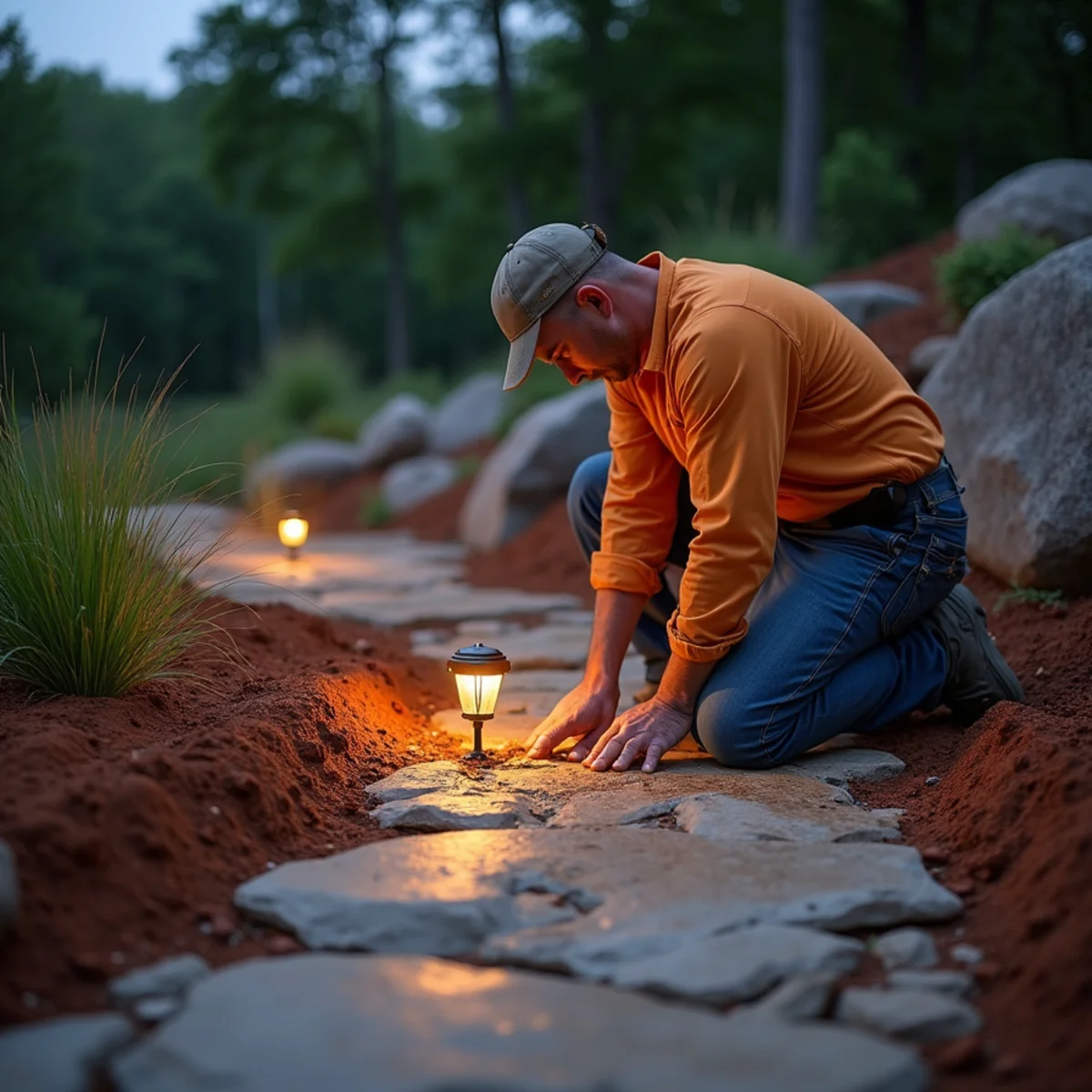
Our Process
- 1
Night Walk-Through & Design
We walk the property after dark where possible to design a layout based on real shadows and use.
- 2
Fixture & Transformer Selection
We select brass fixtures and size the transformer and wire gauge to the full connected load.
- 3
Wire Layout & Burial
Low-voltage wire is run and buried below typical disturbance depth with waterproof connections.
- 4
Fixture Installation & Aiming
Fixtures are installed and aimed at night to fine-tune the actual lighting effect on site.
- 5
Controls Setup & Walkthrough
We set up photocell or timer controls and walk the finished system with you after dark.
Materials & Equipment
- Solid brass and copper low-voltage fixtures
- LED lamps sized for path, uplighting, and moonlighting effects
- Low-voltage transformers sized with load headroom
- Direct-burial low-voltage wire and waterproof connectors
- Photocell and timer control units
What Affects Your Price
Every mountain and lakefront project is different. These are the factors we weigh in a free on-site estimate — no fixed price fits every property.
- Total number of fixtures and property area covered
- Transformer size and wire gauge needed for the full system load
- Fixture type - path, uplighting, or specimen moonlighting
- Wire burial length and complexity around existing beds or hardscape
- Integration with existing patios, walls, or planting areas
- Control options such as photocell, timer, or app-based systems
Why Choose Kipps Kustom Landscapes for Low-Voltage Mountain Lighting
We Calculate Voltage Drop, Not Guess at Wire Gauge
Every system's wire gauge and transformer size is calculated against the actual connected load and run length, so fixtures at the far end of the property stay as bright as the ones near the transformer.
15+ Years Lighting Boulder Walls and Mountain Terrain
Since founding the company in 2010 we have designed lighting layouts around the exact features we also build - boulder walls, flagstone patios, and native plantings - so we know how to light our own stonework correctly.
Brass Fixtures Backed by a Licensed, Insured Local Business
All lighting work is performed under Miller Landscaping Group LLC, licensed and insured, using solid brass fixtures we stand behind rather than a big-box lighting kit.
Free Night Walk-Through as Part of the Estimate
Where scheduling allows, we walk your property after dark before finalizing the design, so the layout in your written estimate reflects what the space actually looks like at night, not a daytime guess.
Frequently Asked Questions
- This is almost always voltage drop from undersized wire gauge on a long run, or a transformer running at or above its rated capacity. We size both correctly during design so every fixture gets consistent output.