Service Comparisons, ROI & Material Selection
Pine Straw vs Hardwood Mulch for North Georgia Mountain Properties
The Southern Tradition of Longleaf Pine Straw
Pine straw grips slopes better, resists washing away in mountain rain, and slowly acidifies soil for azaleas and laurels, while hardwood mulch suits flat beds, neutral-pH plantings, and holds up better under foot traffic. On steep North Georgia beds, pine straw is generally the better choice.
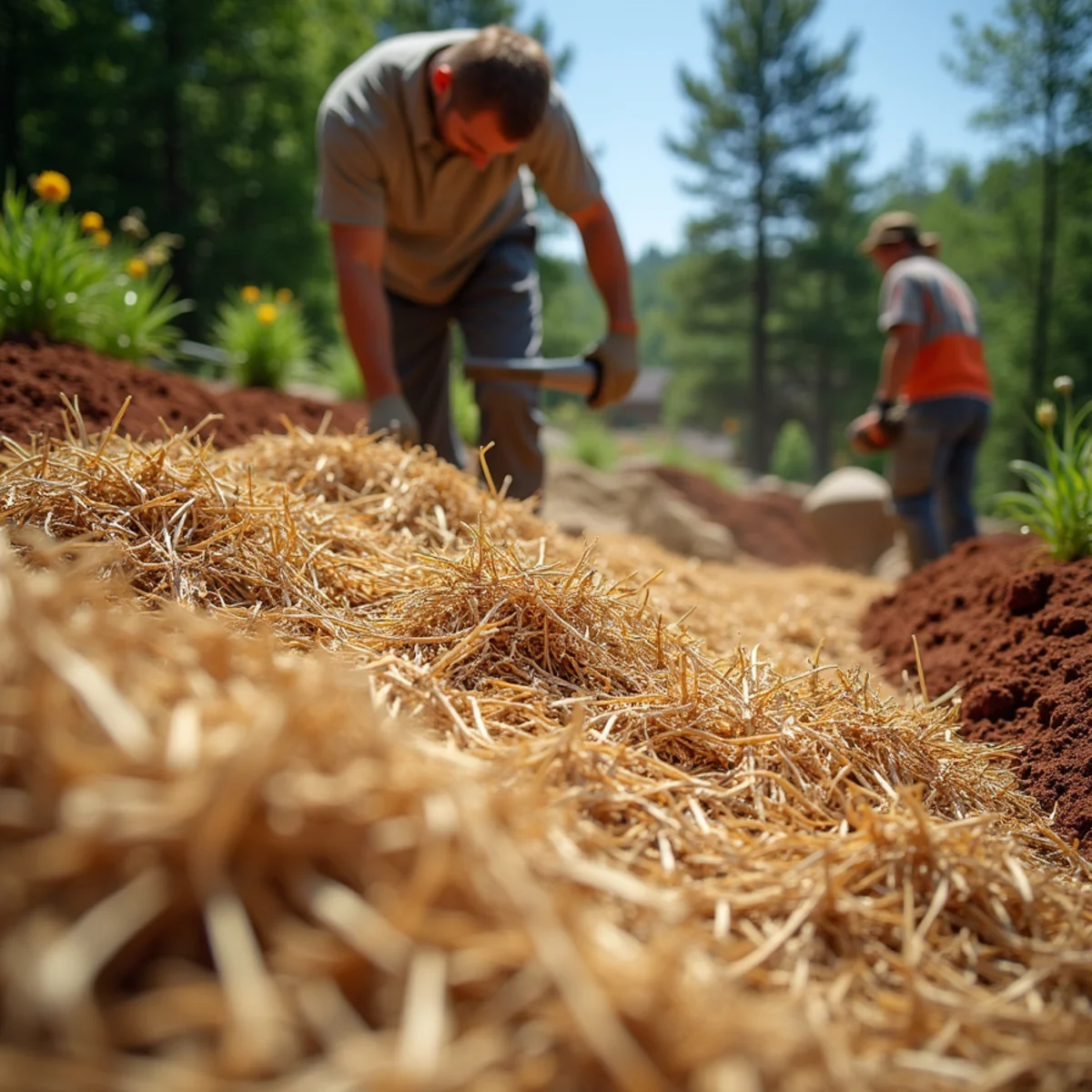
Long-needle pine straw, mostly baled longleaf and loblolly pine needles trucked up from South Georgia, has covered planting beds across the North Georgia foothills for generations, and it is still the default mulch choice on most estate properties we manage.
Part of that is tradition and look. The reddish-brown, fine-textured straw reads as more natural against a mountain backdrop than dyed hardwood chips.
Part of it is practical. Pine straw is light to handle, easy to fluff and top-dress without disturbing plant roots, and it breaks down slower than people expect, typically needing a full refresh only once a year.
Most of what we install is baled in South Georgia and comes up the interstate in flatbed loads throughout the fall and early spring, so availability and pricing shift seasonally. Ordering ahead of the first frost, rather than waiting until beds already look bare, keeps a property on a predictable refresh schedule instead of scrambling when supply tightens.
A single bale, roughly ten square feet at a 2 to 3 inch depth, covers noticeably less ground than the same volume of bagged hardwood mulch, which surprises first-time buyers pricing straw by the bale against mulch by the cubic yard.
Quality varies by cutting and baling practice as much as by species. Straw baled promptly after raking and kept dry in storage holds its color and needle length far better than straw that sat wet in a field, which is why we source from growers we have used for years rather than buying whatever load happens to be cheapest that week.
We schedule delivery in coordination with bed prep so straw goes down within a day or two of arrival rather than sitting stacked on a driveway, which keeps it from compressing or graying out before it ever reaches the bed.
Slope Adhesion: Why Pine Straw Knits Together
The long needles interlock with each other as they settle, forming a mat that grips a slope far better than loose hardwood chips, which is exactly why we favor it on the graded beds we install as part of a mountain landscape design-build project.
On a bed with any real pitch, and most beds around Cornelia and Demorest have some, hardwood mulch will migrate downhill in the first hard rain, ending up in a mat over the lawn edge or storm drain.
Pine straw's mat structure also slows surface water enough to let it infiltrate rather than sheet off, which matters on red clay soils that already shed water fast once saturated.
We still stake or edge the top of steep beds before laying straw, because no mulch fully replaces a proper drainage plan on a real slope.
On the steepest cut banks, we sometimes double up: a base layer of straw laid first to knit against the soil, then a second top-dress layer laid in the opposite direction of the slope's natural water path, which further slows the sheet flow that would otherwise carry loose material downhill in the first storm after installation.
We also lay straw against the grade rather than simply dumping and spreading, working from the bottom of a slope upward so each course overlaps the one below it the way roof shingles do, shedding water down and off the bed surface instead of letting it channel straight through to bare soil underneath.
Soil Acidification for Azaleas, Camellias & Laurels
As pine straw breaks down it releases mild organic acids that nudge soil pH downward over time, which happens to be exactly what azaleas, camellias, and mountain laurel want.
These acid-loving shrubs are the backbone of most North Georgia foundation and border plantings, and a pine straw bed essentially fertilizes their preferred soil chemistry for free every season.
The effect is gradual, not dramatic, so it works as a maintenance tool rather than a fast correction, which is why our estate grounds maintenance and pruning crews re-test bed soil periodically rather than guessing.
This is also why we caution against pine straw around plants that actually prefer neutral to alkaline soil, like boxwood or many perennial herbs. Layering acidifying mulch on a plant fighting the wrong pH for years is a slow way to stunt something that should otherwise be thriving.
We pull a soil sample from any new bed before deciding on mulch type, since starting pH varies a surprising amount even within the same yard depending on how close a spot sits to an existing pine stand versus an open, previously graded area with mostly clay subsoil exposed.
Double-Shredded Hardwood Mulch Best Uses
Hardwood mulch still earns its place on flat beds, foundation plantings around perennials that prefer a more neutral pH, and anywhere a client wants a darker, more uniform commercial look.
Double-shredded hardwood knits together better than single-shred and resists floating away in moderate rain, though it will not out-perform pine straw on a real grade.
It also breaks down faster and feeds more organic matter into the topsoil per season, which benefits vegetable beds and annual color beds that get reworked yearly anyway.
Color-enhanced hardwood mulches, dyed black or dark brown, hold their tone through a full season and are popular for front foundation beds where a uniform commercial look is the priority over a natural mountain aesthetic. We source undyed, naturally aged double-shredded hardwood for clients who want the organic benefit without the dye additive.
Hardwood also holds up better than pine straw in a bed that gets regular foot traffic, like a path edge or a spot kids and pets cross often, since the chunkier fragments compress and rebound rather than matting flat and thinning out the way straw does under repeated compression.
Termite and Moisture Considerations Near Foundations
Any wood mulch piled against a foundation wall creates a moist, hidden pathway that subterranean termites can use to bridge from soil to wood framing without crossing an exposed treated sill.
The fix is not to avoid mulch entirely, it is to keep a 4 to 6 inch gap of bare ground or gravel between the mulch bed and the foundation, and to never let mulch depth exceed 3 inches against the house.
Pine straw poses a somewhat lower moisture-retention risk right against the foundation than heavy hardwood mulch because it does not compact into a dense, soggy layer the same way, but the same clearance rule still applies either way.
We also grade mulch beds against the foundation to shed water away from the crawlspace or slab rather than trap it, since a mulch bed sitting in a shallow depression next to the house will hold moisture against the sill plate regardless of which material fills it.
- Keep a 4 to 6 inch gap of bare ground or gravel between mulch and the foundation
- Never let mulch depth exceed 3 inches against the house
- Grade mulch beds to shed water away from the crawlspace or slab, not toward it
- Pine straw carries a somewhat lower moisture-retention risk than heavy hardwood right against the house
- Recheck the clearance gap each time beds are refreshed, since mulch migrates back toward the foundation over a season
Order Premium Pine Straw Installation
We source, deliver, and install pine straw and hardwood mulch across Clarkesville, Cornelia, and Demorest every fall and spring, matching the material to the slope, the plant palette, and the look of the house.
Standing seasonal orders keep beds refreshed on schedule instead of waiting for straw to look thin, which matters most on the steep display beds along a mountain driveway or entrance.
Call (323) 606-0255 to schedule a bed refresh before the next heavy rain washes out whatever is down there now.
Frequently Asked Questions
- Most beds need a full refresh once a year, though heavily sloped or high-traffic beds may need a partial top-dress mid-season.
Get Expert Help on Your North Georgia Property
Kipps Kustom Landscapes has spent 15+ years solving exactly these challenges across the Blue Ridge foothills. Call for a free on-site estimate.
Call (323) 606-0255
Written by
Hunter Kipps — Owner & Lead Craftsman
Hunter Kipps has spent 15+ years building and repairing mountain and lakefront landscapes across Northeast Georgia — boulder retaining walls, shoreline riprap, red-clay drainage, and estate stonework. He personally runs the heavy equipment and walks every site before quoting it.