Service Comparisons, ROI & Material Selection
Natural Boulder Walls vs Segmental Concrete Blocks in Mountain Homes
Aesthetic Harmony with the Blue Ridge Forest
Boulder retaining walls cost more in labor but offer superior looks, a near-unlimited lifespan, and easy single-stone repairs on North Georgia's red clay slopes, while segmental concrete block installs faster and can be more economical under 4 feet with easy machine access. Steep, tall, or highly visible walls generally favor natural stone.
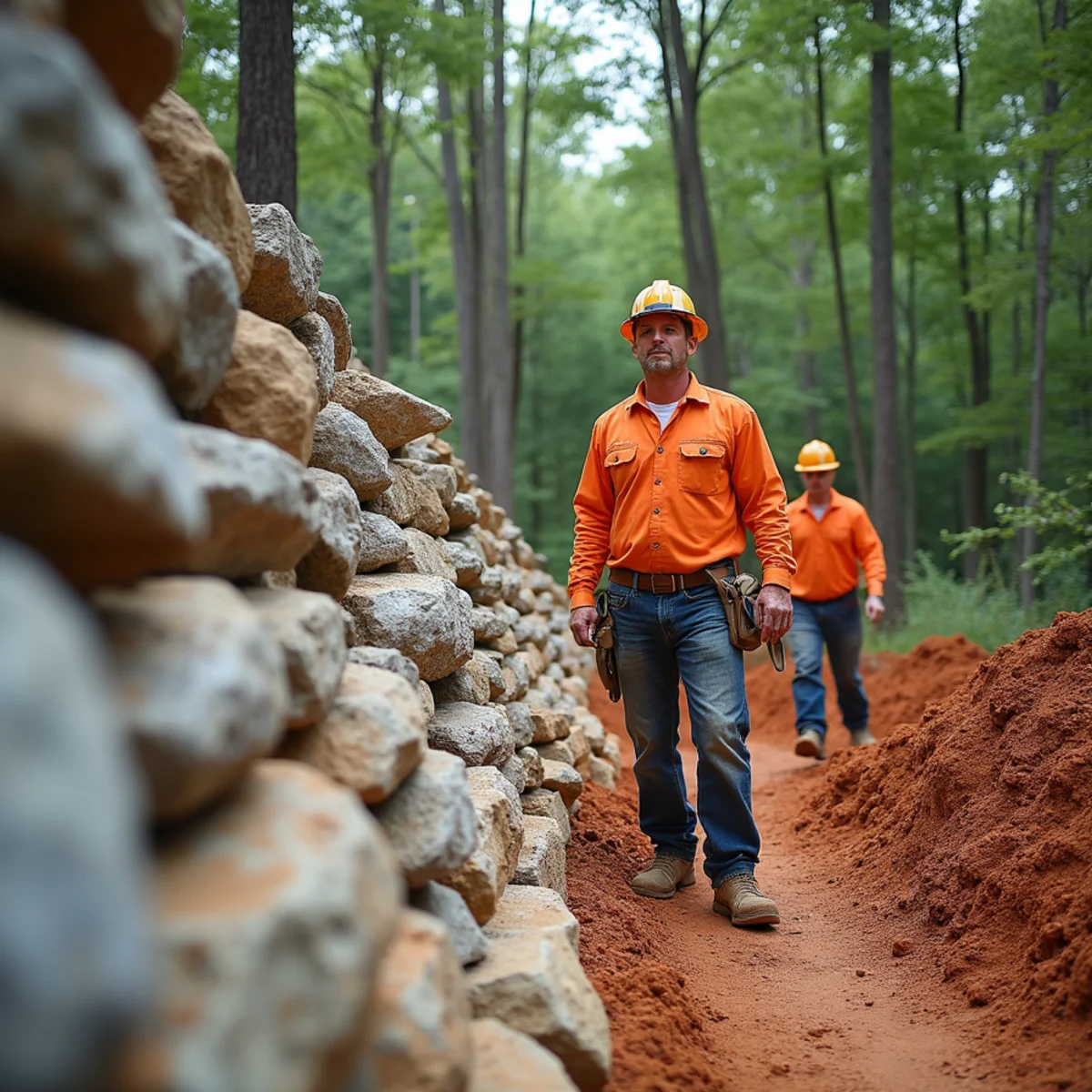
A stack of raw granite boulders sitting against a hillside of hardwoods and rhododendron looks like it grew there. That visual honesty is the single biggest reason estate owners around Clayton and Dahlonega choose natural stone over manufactured block for a mountain retaining wall.
Segmental concrete block, even the better textured lines, reads as a built product with consistent color, a repeating pattern, and sharp corners against a backdrop of native fieldstone, laurel, and pine.
Boulder walls also let us match stone that is already present on the lot. The same gray-brown granite showing in outcrops or streambeds gets pulled into the wall face, so the structure looks like an extension of the mountain rather than an addition to it.
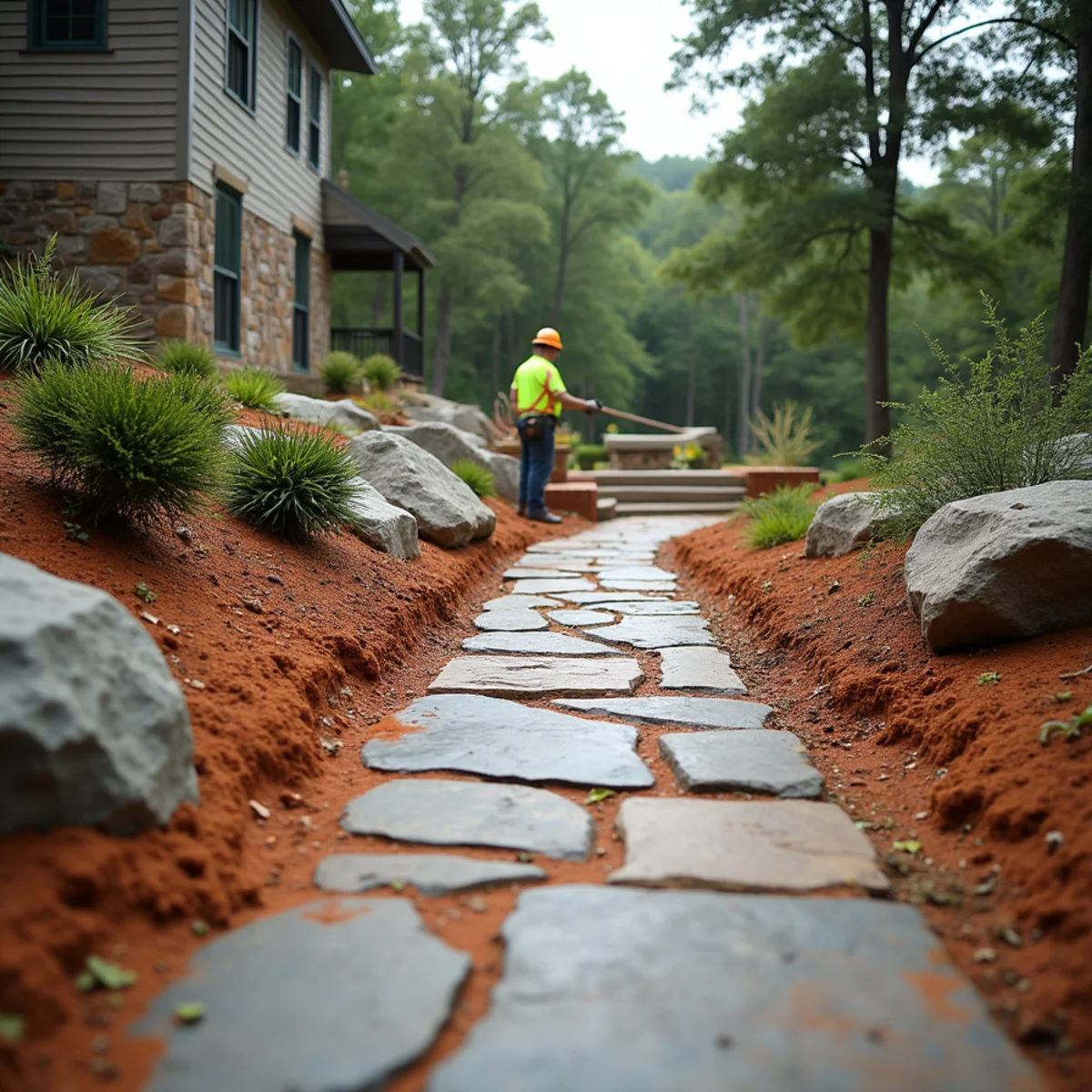
For properties that pair a wall with a stone fire pit and flagstone patio, carrying the same boulder and flagstone palette through both hardscapes ties the whole outdoor space together instead of looking like two separate contractors worked the yard.
Color match matters more on visible walls near an entrance or a primary view line than it does on a utility wall behind a garage, so we source stone differently depending on where the wall sits. A wall facing the main approach to a Dahlonega estate gets hand-selected face stone, while a retaining wall along a back service drive can use a broader range of tonnage without hurting the overall design.
Structural Longevity: Gravity Boulder Tonnage vs Engineered Pins
A boulder wall holds a slope through sheer mass and friction. Stones in the 1,000 to 3,000 pound range are set with a batter, typically 2 inches of setback per foot of rise, so gravity locks each course against the one below it and against the hillside itself.
There is no pin, no clip, and no adhesive holding the structure together, which means there is also nothing to fail. A properly built boulder wall can stand for 75 years or more with no maintenance beyond occasional drainage checks.
Segmental block walls rely on an engineered system: interlocking lips or fiberglass pins between courses, plus geogrid fabric extending back into the reinforced soil zone on anything over about 3 to 4 feet.
That system works well when installed to spec, but every connection point, the pin, the geogrid tie-in, and the block-to-block interlock, is a potential failure point if the base is not compacted correctly or if drainage behind the wall is inadequate.
Drainage behind either wall type is non-negotiable, but the consequences of getting it wrong differ. A boulder wall with weak drainage will weep and stain but rarely fail catastrophically because the mass is still doing the holding. A block wall with saturated backfill loses the friction the geogrid depends on and can bulge or fail along an entire panel at once.
Freeze-thaw cycling in the North Georgia foothills, while milder than higher elevations, still happens dozens of times each winter as temperatures swing across freezing overnight and back above it by afternoon. Each cycle works at any weak point in a wall system, which is another reason a mass-gravity boulder structure with fewer connection points tends to outlast an engineered system over multiple decades of mountain weather.
Cost Differences
Boulder walls carry almost no material unit cost. You are paying for stone tonnage, delivery by tri-axle dump truck, and the excavator time and skilled operator hours to place each stone individually.
Block walls have a predictable per-square-foot material cost from the manufacturer, but that number climbs quickly once a wall exceeds 4 feet and requires geogrid, because geogrid adds both material and the excavation width needed to bury it properly into the slope.
On a straightforward wall under 3 feet with good machine access, block can come in lighter on cost. On a taller, more technical mountain wall with limited access, the machinery efficiency of moving large boulders often closes that gap or reverses it.
We give directional ranges on-site after seeing slope, access, and stone sourcing, because a generic per-foot number for either system is close to meaningless on a mountain lot.
Access is often the hidden cost driver on both systems. A lot where a tri-axle truck and excavator can reach the wall footprint directly keeps boulder pricing efficient, while a backyard that requires hand-carrying block or running a smaller machine through a gate can erase the material savings block would otherwise offer.
Repairability and Resistance to Clay Movement
North Georgia's red clay is high in kaolinite and expands and contracts noticeably with moisture swings, putting slow, constant pressure on anything built into a slope.
A boulder wall shrugs this off because each stone is independently massive enough to resist movement, and if one stone does settle or shift, we can reset that single stone with an excavator without touching the rest of the wall.
A block wall depends on every course staying aligned. If clay heave or poor drainage shifts one course, the interlock geometry above it is compromised, and repair often means disassembling and rebuilding the wall face above the failure point.
This is the practical reason boulder walls dominate on the steepest, wettest lots around Rabun and Lumpkin county lake and mountain properties, while block does fine on gentler residential slopes with good drainage.
We have reset individual boulders on 20-year-old walls in an afternoon after a heavy freeze-thaw winter shifted a stone slightly out of plane, work that would have meant tearing down and rebuilding several courses of a comparable block wall to reach the same repair.
Which Wall System Fits Your Estate
The right choice comes down to slope angle, wall height, machine access, and the look you want. Walls under 3 feet on a gentle grade with easy truck access are reasonable candidates for either system.
Anything over 4 feet, on a steep grade, or holding back a driveway or structure leans hard toward a boulder retaining wall or an engineered block system with full geogrid and a stamped design, depending on soil and load.
Estate properties that want the wall to disappear into the landscape almost always choose stone, while properties prioritizing a clean, uniform modern look sometimes prefer block, particularly near a house with contemporary architecture.
We also factor in future changes. A boulder wall can be extended or tied into later without a perfect batch match, since natural variation already exists stone to stone, while a block wall extension years later may show a visible seam if the manufacturer has discontinued that exact color or texture run.
Homeowners association guidelines occasionally weigh in on this decision too. Some mountain communities specify natural stone for any visible retaining structure along a shared road frontage, which effectively settles the material question before cost or preference ever enters the conversation, so we check any applicable covenant early in the design process.
Resale appraisers in this market generally treat a well-built boulder wall as a stronger value-add than an equivalent block wall, since the stone reads as a permanent site feature rather than a manufactured product with an implied replacement cycle, particularly on estate-tier mountain and lakefront listings.
- Wall under 3 feet with easy truck access - either system is a reasonable candidate
- Wall over 4 feet, steep grade, or holding back a driveway - favors boulder or a fully engineered block system
- Want the wall to disappear into the landscape - choose natural stone
- Prioritize a clean, uniform, contemporary look - block is often the better fit
- HOA or covenant restrictions on visible retaining structures - confirm before committing to a material
- Planning a future extension - boulder blends more forgivingly than a discontinued block color run
View Boulder Wall Case Studies
We have built and repaired both systems across Habersham, Rabun, and Lumpkin counties, from small garden terraces to estate walls holding back entire driveways.
Every quote includes photos of comparable walls we have built nearby, so you can see the stone tone, the batter, and the finished scale before committing to either system for your own slope.
Call (323) 606-0255 to walk your slope with us in Clarkesville or the surrounding foothills, and we will tell you honestly which wall system fits your soil, your budget, and your view.
Frequently Asked Questions
- Most jurisdictions in Habersham and Rabun counties require a permit and engineered design once a wall exceeds 4 feet in height, regardless of whether it is boulder or block. We confirm the requirement before quoting.
Get Expert Help on Your North Georgia Property
Kipps Kustom Landscapes has spent 15+ years solving exactly these challenges across the Blue Ridge foothills. Call for a free on-site estimate.
Call (323) 606-0255
Written by
Hunter Kipps — Owner & Lead Craftsman
Hunter Kipps has spent 15+ years building and repairing mountain and lakefront landscapes across Northeast Georgia — boulder retaining walls, shoreline riprap, red-clay drainage, and estate stonework. He personally runs the heavy equipment and walks every site before quoting it.