Service Comparisons, ROI & Material Selection
Retaining Wall Materials Compared for Mountain Homes

The Four Materials Worth Considering
The main retaining wall materials for North Georgia mountain homes are natural boulder, segmental concrete block, pressure-treated timber, and poured or stamped concrete. Boulder generally offers the longest lifespan and best clay resistance, block balances cost and structure well under 4 feet, timber is the least durable in wet clay, and poured concrete works best for engineered structural loads.
Every one of these systems can hold a slope correctly if it is engineered and built to spec. The differences that actually matter for a homeowner are lifespan, repairability, appearance, and how each one responds to the specific stress North Georgia's soil puts on a wall, which is different from what a retaining wall faces in most of the country.
We build all four here, and we will talk a homeowner out of the wrong material for their site rather than defaulting to whichever one we happen to have crew capacity for that month.
Natural Boulder: Mass, Longevity, and Repairability
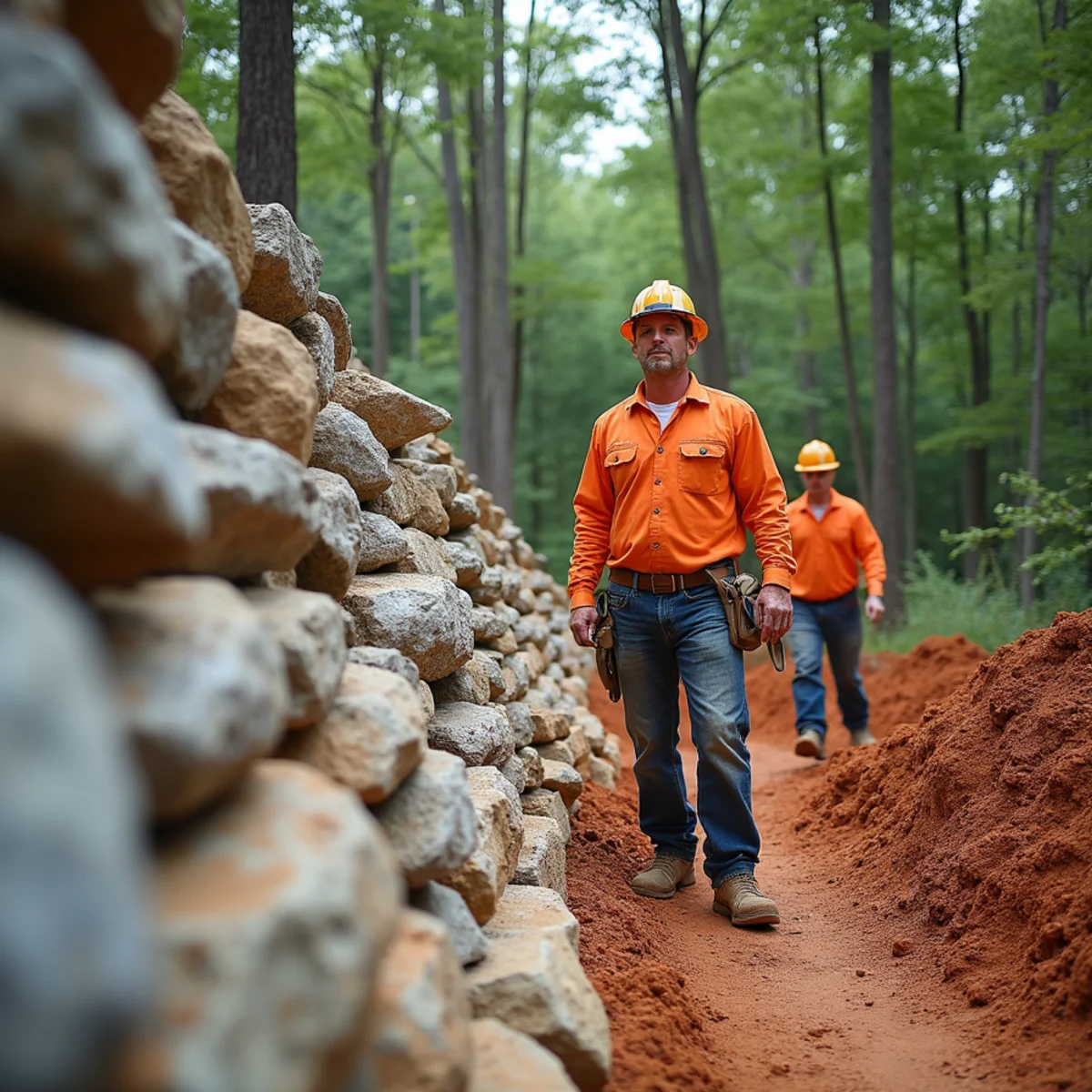
A boulder retaining wall holds back a slope through sheer mass and friction rather than an engineered connection system. Stones typically in the 1,000 to 3,000 pound range are set with a batter, generally 2 inches of setback per foot of rise, so gravity locks each course against the one beneath it.
There is no pin, clip, or adhesive to fail, which is a genuine structural advantage on a material like North Georgia red clay that swells and contracts noticeably with moisture and puts slow, constant pressure on anything built into a slope. A well-built boulder wall can last 75 years or more with occasional drainage checks as the only real maintenance.
Repairability is the other major advantage. If clay movement or poor drainage shifts a single stone, we can reset that one boulder with an excavator without disturbing the rest of the wall, a repair that often takes an afternoon.
The tradeoff is upfront labor cost and the visual footprint. Boulder walls need equipment access for placement and read as a substantial hardscape feature, which fits an estate property but can feel oversized on a small residential lot.
Segmental Concrete Block: Predictable Cost, Engineered System
Segmental block relies on an engineered system of interlocking units, sometimes with fiberglass pins, plus geogrid fabric extending back into the reinforced soil zone on anything over roughly 3 to 4 feet in height.
That system delivers predictable per-square-foot material cost and a clean, uniform look that some homeowners prefer over the more rustic natural stone appearance, particularly near contemporary architecture.
The tradeoff is that every connection point, the pin, the geogrid tie-in, the block-to-block interlock, is a potential failure point if the base compaction or drainage behind the wall is not done correctly. A block wall with saturated backfill loses the friction the system depends on and can bulge or fail along an entire panel rather than at a single point.
Block performs well on walls under about 4 feet with good access and correct installation, and for a full breakdown of how it compares directly against boulder on cost, looks, and clay resistance, see our boulder walls vs concrete block comparison.
Pressure-Treated Timber: Lowest Upfront Cost, Shortest Lifespan
Timber walls, built from pressure-treated 6x6 or landscape timbers pinned with rebar, carry the lowest material cost of the four systems and install quickly on smaller, lower-height applications.
Wood, even treated wood, is fighting a losing battle against constant soil moisture in North Georgia's clay. Ground contact with saturated clay accelerates decay at the base of each timber course well before the treated lumber's rated lifespan on paper, and we routinely find timber walls failing at the bottom course within 12 to 18 years, sometimes sooner on a poorly drained site.
Timber also offers essentially no single-point repairability. Once a bottom course starts to rot, the wall above it loses its foundation, and repair usually means rebuilding the affected section from the ground up rather than resetting one piece.
We still install timber on select low-height, low-budget applications, typically under 2 feet holding back a garden bed rather than a structural load, but we are direct with homeowners that it is the shortest-lived of the four options and generally the wrong choice for anything holding back a driveway, patio, or structure.
Poured and Stamped Concrete: Engineered Structural Loads
Poured concrete, reinforced with rebar and engineered as a cantilevered or gravity structure, is the right call when a wall needs to carry genuine structural load, holding back a driveway cut, supporting a foundation, or managing a very tall or heavily loaded slope where boulder or block would need to be oversized to compensate.
It requires a stamped engineering design for anything of real height, formwork, and cure time, which makes it the slowest and typically most expensive system to install per linear foot on a straightforward residential application.
Concrete does resist clay's shrink-swell movement well once cured and properly reinforced, though a poorly designed footing or inadequate drainage behind the wall can still crack a poured structure over time, the same way it damages any of the other three systems if drainage is skipped.
We generally reserve poured concrete for walls where an engineer has specified it, or where the load, height, or site constraints rule out the other three systems, rather than defaulting to it for a standard residential landscape wall.
Drainage: The Variable That Determines Every Wall's Real Lifespan
No material on this list survives long-term if drainage behind the wall is wrong. Hydrostatic pressure from saturated, undrained backfill is the leading cause of retaining wall failure in North Georgia regardless of which of these four systems is holding back the slope.
Every wall we build includes a drainage plan behind the face, typically a perforated pipe in a washed gravel column wrapped in non-woven geotextile fabric, with weep holes or a daylighted outlet so water pressure never has a chance to build against the structure.
If you already have a wall showing signs of leaning, bulging, or cracking regardless of its material, that is almost always a drainage failure rather than a material failure, and our retaining wall structural shoring service addresses the drainage cause, not just the visible symptom.
- Boulder: highest lifespan and repairability, higher labor cost, best clay resistance, largest visual footprint
- Segmental block: predictable cost, clean uniform look, good under 4 feet with correct installation and geogrid
- Timber: lowest cost, shortest realistic lifespan in wet clay, no single-point repairability, best limited to low garden walls
- Poured concrete: best for engineered structural loads, slowest and often costliest install, requires stamped design at height
- Drainage behind the wall determines real-world lifespan more than material choice alone across all four systems
Get a Material Recommendation for Your Slope
We walk your specific slope in Clarkesville, Cornelia, or Clayton and recommend the material that actually fits your height, load, budget, and the look you want, not just whichever system is easiest for us to install that week.
Call (323) 606-0255 for an honest, on-site material recommendation before you commit to a wall system.
Frequently Asked Questions
- A properly built natural boulder wall generally lasts the longest, 75 years or more, because it relies on stone mass rather than mechanical connections that can fail under clay movement or poor drainage.
Get Expert Help on Your North Georgia Property
Kipps Kustom Landscapes has spent 15+ years solving exactly these challenges across the Blue Ridge foothills. Call for a free on-site estimate.
Call (323) 606-0255
Written by
Hunter Kipps — Owner & Lead Craftsman
Hunter Kipps has spent 15+ years building and repairing mountain and lakefront landscapes across Northeast Georgia — boulder retaining walls, shoreline riprap, red-clay drainage, and estate stonework. He personally runs the heavy equipment and walks every site before quoting it.