Problem Diagnosis, Soil Health & Seasonal Recovery
Taming Georgia Red Clay: Fixing Soil Compaction and Poor Drainage
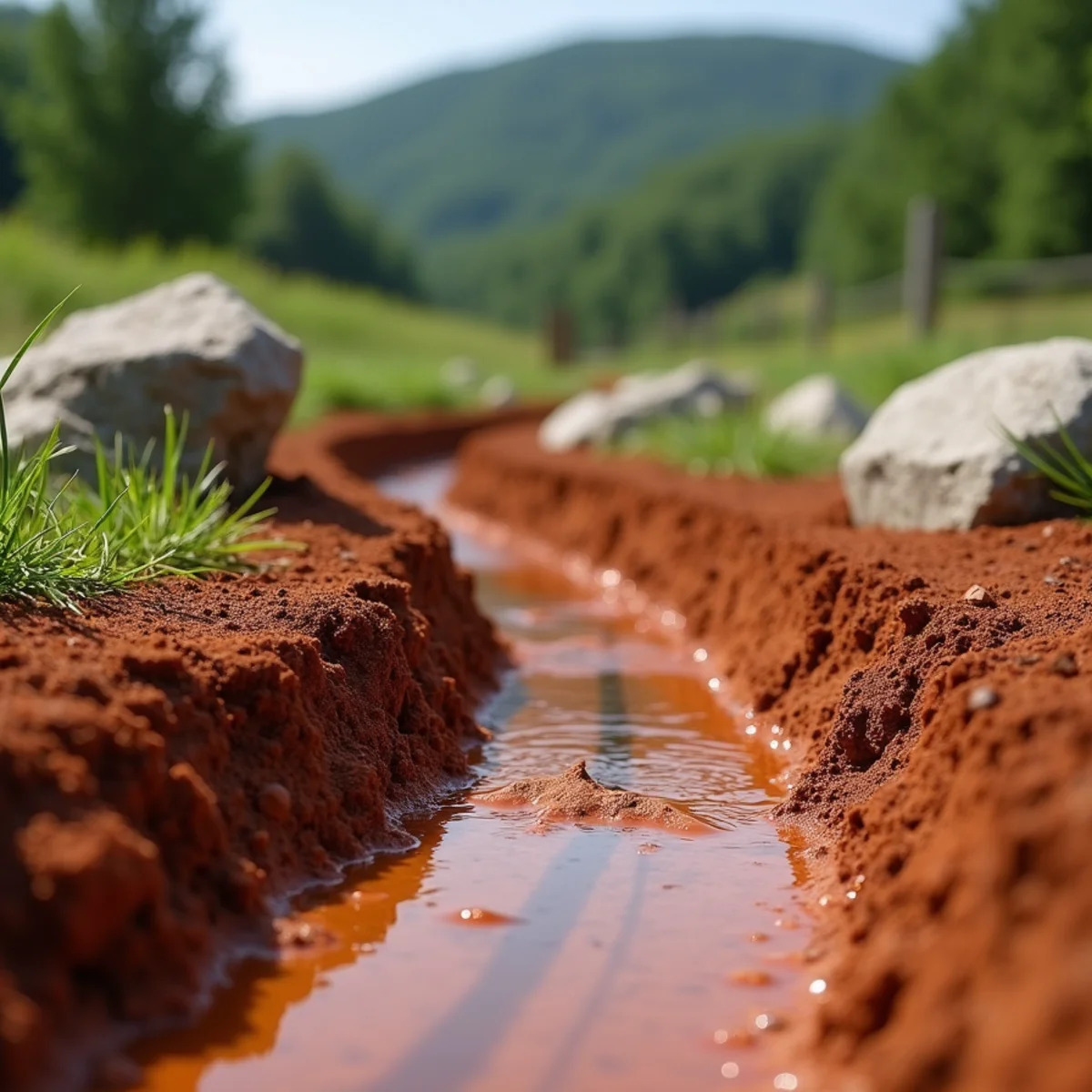
The Science of Cecil Red Clay
Fixing compacted, poorly draining Georgia red clay takes a soil test to check pH and compaction depth, then agricultural lime to correct acidity, core aeration or deep subsoil ripping to physically open pore space, and, where water is actively pooling, a properly sloped French drain or catch basin to carry it away instead of letting it suffocate roots.
Most of the soil across Habersham and the surrounding foothill counties belongs to the Cecil, Pacolet, or Madison soil series, all fine, kaolinitic clays formed from weathered granite and gneiss bedrock. The particles in these clays are extremely small and plate-like, which gives the soil its characteristic red color from iron oxide content, and also gives it very small pore spaces between particles once compacted.
Those small pore spaces are the root of most red clay problems. Water moves through well-structured soil by percolating through connected pore spaces, but compacted clay has so few of them that water simply cannot infiltrate at a meaningful rate - often less than a quarter inch per hour on badly compacted sites, compared to an inch or more per hour in healthy loam.
Bulk density is a useful way to think about the practical difference. Healthy, uncompacted soil typically has a bulk density in the range of 1.0 to 1.3 grams per cubic centimeter, with enough pore space for roots and water to move freely. Compacted Cecil clay on a graded building lot can measure considerably denser, often exceeding 1.6 grams per cubic centimeter, a level at which root penetration becomes physically difficult for most turfgrass and landscape plant roots regardless of how much fertilizer or water is applied above it.
Why Standing Water Suffocates Grass Roots
Grass roots need oxygen in the soil pore spaces as much as they need water. When compacted clay holds water at the surface after rain instead of letting it drain, it displaces that soil oxygen, and roots sitting in saturated, oxygen-starved clay begin to suffocate and die back within days, not weeks, during a wet stretch.
This is why lawns on compacted clay often show a frustrating pattern: they look fine during dry weeks, then develop yellowing, thinning patches specifically after heavy rain, which is the opposite of what most homeowners expect and often leads to over-watering a problem that is actually caused by too much standing water already.
This oxygen deficit also changes soil chemistry in ways that compound the problem. Waterlogged, low-oxygen clay shifts toward anaerobic microbial activity, which can produce compounds that stress root tissue and slows the breakdown of organic matter and thatch that would otherwise improve soil structure over time, meaning a poorly drained lawn does not just struggle - it actively resists getting better on its own.
Agricultural Lime: Raising Acidic Soil pH
Beyond compaction, Cecil and Pacolet clays are naturally acidic, commonly testing in the 4.5 to 5.5 pH range. Most turfgrass species need soil pH closer to 6.0 to 6.5 to efficiently take up nitrogen, phosphorus, and potassium from fertilizer, which means a lawn on unlimed acidic clay can be fertilized regularly and still look pale and thin because the plant cannot access those nutrients.
A proper soil test, not a guess, should determine lime application rate, since over-liming can push pH too high and create its own nutrient lockout problems. We test before recommending lime rates as part of any red clay drainage and soil correction project.
Lime takes time to fully react with soil, typically several months to move pH meaningfully, since agricultural lime dissolves gradually rather than working instantly. This is one reason lime application is best planned well ahead of a sod installation or major overseeding rather than as a same-week fix, and why a soil test taken today should inform a liming plan measured in a season, not a weekend.
Organic Matter and Gypsum: Amending Clay Structure for the Long Term
Lime corrects pH, but it does not change the physical structure of clay - the small, plate-like particles that limit pore space stay the same regardless of pH. Incorporating organic matter, such as compost tilled into the top several inches of soil before sodding or seeding, works differently: it physically wedges between clay particles and feeds soil microbial life that, over time, builds the crumbly aggregate structure that creates larger, more connected pore spaces than raw clay has on its own.
Gypsum (calcium sulfate) is sometimes recommended for clay soil structure, and it can help flocculate, or clump, fine clay particles in soils where sodium is part of the compaction problem, but it is not a universal fix for every red clay drainage issue, since much of North Georgia's clay compaction is mechanical, from grading and traffic, rather than sodium-driven. A soil test that specifically evaluates sodium and calcium levels, not just pH, is the right way to determine whether gypsum will actually help a given site before spending money on it.
Core Aeration vs Deep Subsoil Ripping
Standard core aeration, which pulls small plugs of soil to relieve surface compaction, helps established lawns on moderately compacted clay but only affects the top few inches of soil. On severely compacted sites, especially areas that were driven over or graded during construction, compaction can extend a foot or more deep, well beyond what core aeration reaches - which is often the same compaction we correct before a sod installation and soil remediation project.
For these more severe cases, deep subsoil ripping with a specialized attachment fractures compacted clay at depth before new sod or seed goes down, giving roots a real chance to penetrate rather than spreading laterally across a compacted layer just below the surface. Choosing between the two depends on how deep the compaction actually runs, which we assess with a soil probe rather than assuming.
A soil probe pushed into the ground at several points across the affected area is the fastest way to map how deep compaction actually runs before recommending a method, since compaction depth is rarely perfectly uniform across a lot - areas that saw heavy equipment traffic during construction are often compacted much deeper than areas that were left undisturbed.
French Drains That Cut Below the Clay
When the problem is not just compaction but water actively collecting and pooling in a low area or against a foundation, surface aeration alone will not solve it. A properly installed French drain - a gravel-filled trench with perforated pipe, wrapped in geotextile fabric to keep clay fines from clogging it, sloped to a safe daylight or catch basin outlet - intercepts subsurface water before it reaches the problem area.
Depth and slope matter enormously here: a French drain that is too shallow or lacks adequate fall will simply become another clogged clay trench within a season or two. We calculate trench depth and slope based on the actual grade and water source on your property around Cornelia and Baldwin rather than using a one-size-fits-all trench design.
The gravel backfill in a French drain trench is typically a clean, angular aggregate similar to the #57 stone used behind retaining walls, chosen for the same reason: open void space that lets water move freely rather than fine material that packs down and reduces the trench's capacity over time. A general rule of thumb for slope is a minimum fall of about 1 percent, roughly an eighth of an inch of drop per foot of pipe run, though a steeper fall where grade allows moves water more reliably and reduces the chance of sediment settling in the pipe.
- Perforated pipe (corrugated or Schedule 40 PVC) wrapped in geotextile fabric
- Clean #57 washed stone backfill for open void space
- Minimum 1 percent slope (about 1/8 inch of drop per foot of pipe run)
- A safe daylight outlet or catch basin, not a dead-end trench
- Trench depth set below the water source, not just below the lawn surface
- Fabric wrap sized to keep clay fines from clogging the gravel over time
Dry Wells, Catch Basins, and Downspout Management
Not every drainage problem needs a full French drain system. Where the water source is concentrated - a downspout dumping roof runoff at a single point, for example - a properly sized catch basin connected to solid, non-perforated pipe routed to a safe daylight point can resolve a localized problem more simply than a long perimeter drain. Downspouts tied directly into the lawn's surface grading, rather than piped away from the foundation, are a surprisingly common and easily corrected contributor to soggy lawn areas near a house.
Dry wells - buried gravel- or chamber-filled pits that accept concentrated runoff and let it infiltrate into surrounding soil - can work as a component of a broader system, but they need soil that will actually accept and disperse that water over time, which compacted red clay often will not do without amendment nearby. We evaluate infiltration capacity before recommending a dry well rather than installing one on clay that will simply hold the water in an underground pit instead of a surface puddle.
Schedule a Soil and Drainage Audit
Red clay problems compound over time: compaction worsens, acidity persists, and drainage issues erode more soil with every heavy rain. A proper diagnosis starts with a soil probe and a walk of the property to trace where water actually comes from and where it collects.
Call (323) 606-0255 to schedule a soil and drainage audit for your Habersham County property. We will identify whether you are dealing with compaction, pH, standing water, or some combination of all three before recommending a fix.
Frequently Asked Questions
- Compacted red clay holds water at the surface and displaces the oxygen grass roots need, which can cause roots to suffocate and die back specifically after heavy rain rather than during dry weather.
Get Expert Help on Your North Georgia Property
Kipps Kustom Landscapes has spent 15+ years solving exactly these challenges across the Blue Ridge foothills. Call for a free on-site estimate.
Call (323) 606-0255
Written by
Hunter Kipps — Owner & Lead Craftsman
Hunter Kipps has spent 15+ years building and repairing mountain and lakefront landscapes across Northeast Georgia — boulder retaining walls, shoreline riprap, red-clay drainage, and estate stonework. He personally runs the heavy equipment and walks every site before quoting it.