Problem Diagnosis, Soil Health & Seasonal Recovery
Why Retaining Walls Lean in North Georgia: Hydrostatic Pressure
What Is Hydrostatic Pressure and Why Red Clay Is Destructive
Retaining walls in North Georgia lean because saturated red clay behind the wall builds hydrostatic pressure that the wall was never designed to resist - almost always because the drainage stone, fabric, and outlet pipe that should carry that water away were skipped, undersized, or have clogged with fine clay particles over time.
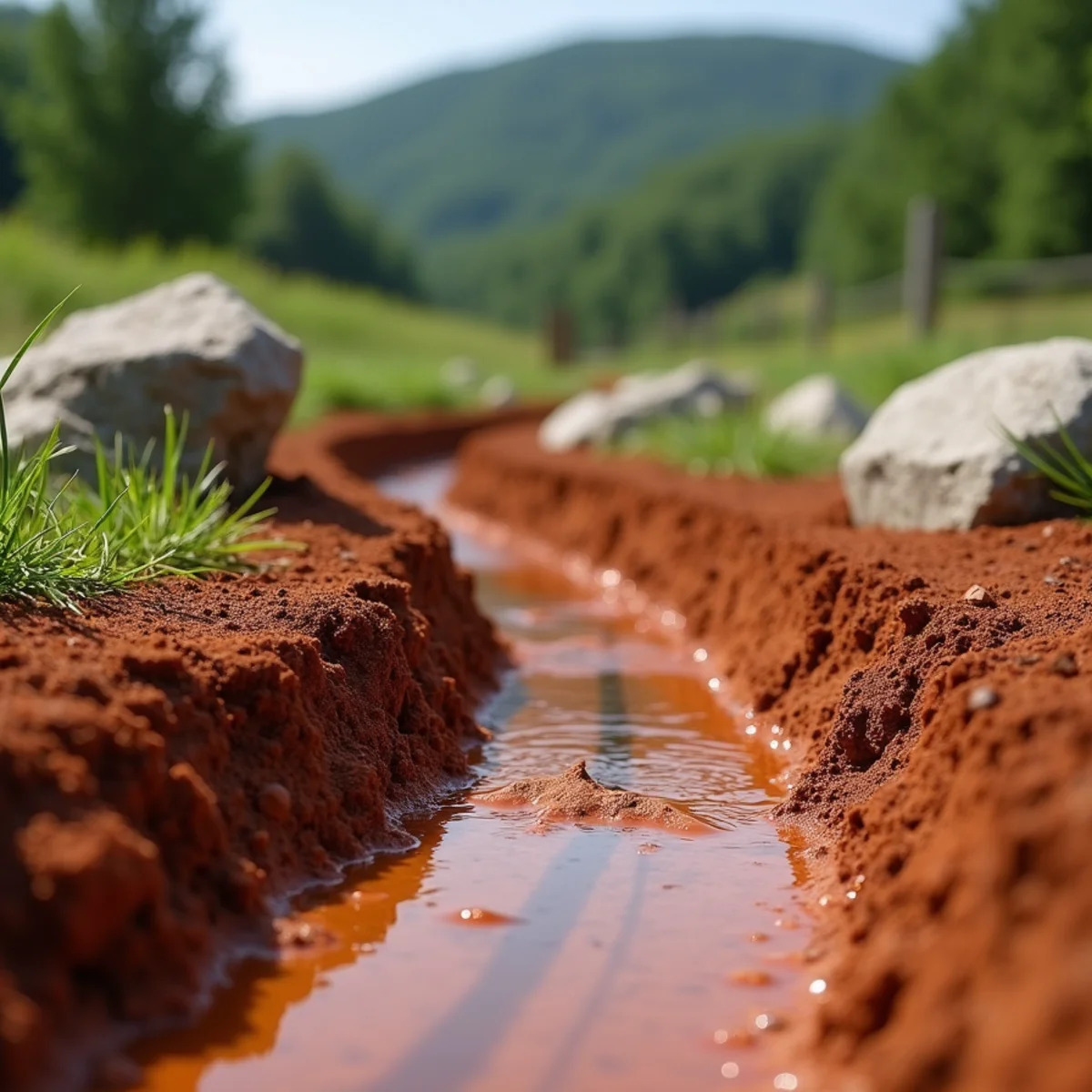
Hydrostatic pressure is the outward force exerted by water trapped in saturated soil pressing against anything holding that soil back, and it increases directly with the depth and saturation level of the soil column behind a wall. Unlike well-draining sandy soil, which sheds water quickly and rarely builds significant pressure, red clay holds water in its fine pore structure and can stay saturated for days after rainfall.
That combination - clay that holds water and a wall built to hold back clay - creates exactly the conditions where hydrostatic pressure builds fastest. A wall engineered without accounting for this reality is essentially designed for the wrong soil, which is a common problem with walls built by crews unfamiliar with North Georgia's clay-heavy geology.
Engineers typically distinguish between the pressure that comes from the weight and internal friction of dry or moist, but not saturated, soil, called active earth pressure, and the additional pressure contributed specifically by water in the soil, which is unrelieved hydrostatic pressure. A wall properly designed and drained only has to resist active earth pressure, which is a fraction of what it would face if water is allowed to accumulate and add its own force on top of the soil's.
How Wet Clay Pushes Against Block Walls
When rain saturates the clay behind a retaining wall and that water cannot drain away, the pressure acts perpendicular to the wall face across its entire saturated height, and the force involved scales dramatically with wall height - a wall twice as tall does not experience twice the pressure at its base, it experiences roughly four times as much due to the way hydrostatic pressure increases with depth.
Segmental block walls resist this force primarily through their mass and the friction between courses, reinforced by geogrid on taller walls. When pressure exceeds what that friction and mass can resist, the wall begins to shift forward incrementally with each saturation cycle, and that shift is rarely visible after just one wet season - it accumulates over several years before becoming obviously visible as a lean.
This is also why walls that survive several dry years without visible problems can suddenly show distress after one unusually wet season - the wall was never actually designed to handle the added hydrostatic component, and an extended saturated period simply exposes a drainage deficiency that milder weather had been masking.
The Role of Clean #57 Backfill and Weep Holes
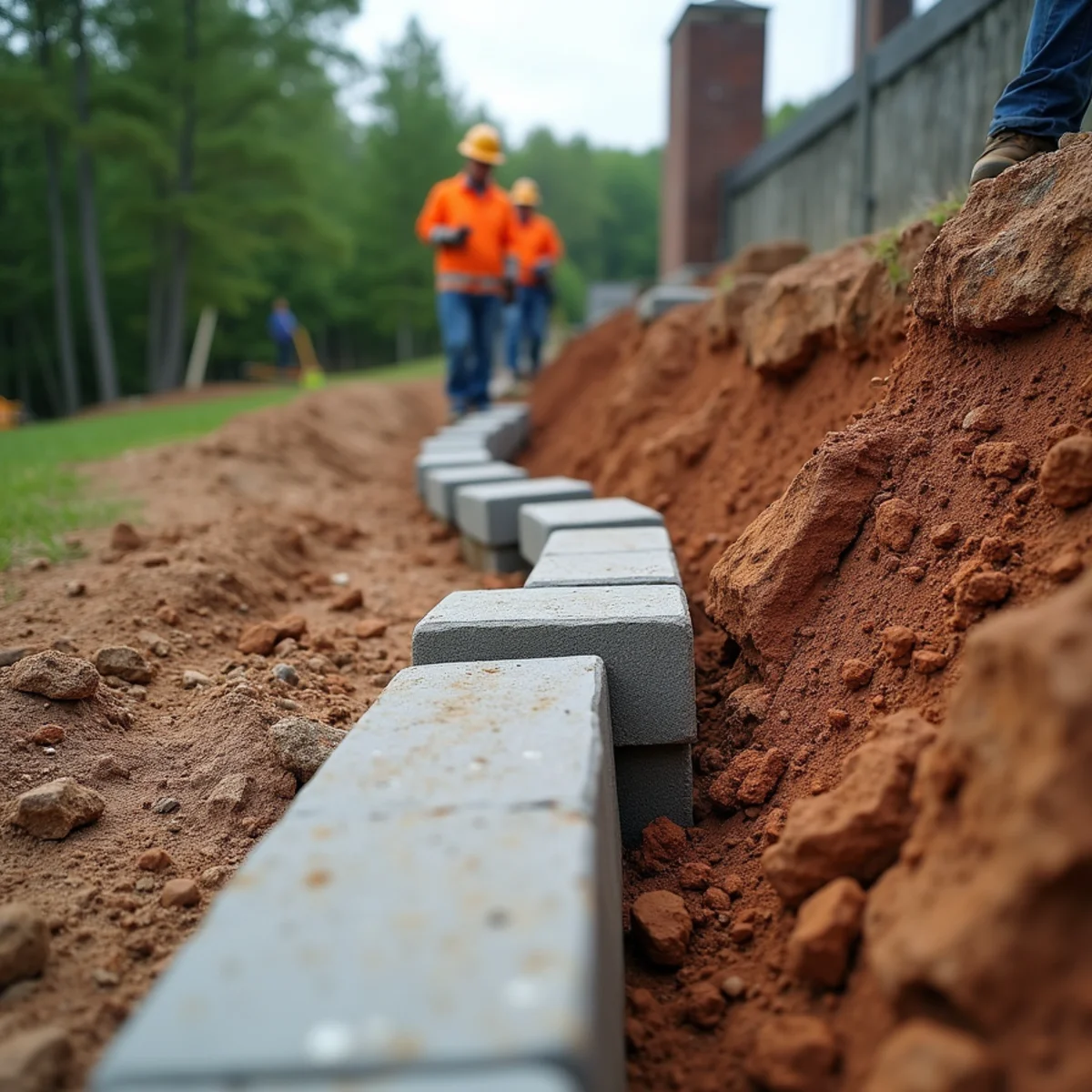
The entire point of clean, angular #57 washed stone backfill behind a retaining wall is to give water a low-resistance path to drain away instead of building pressure against the wall. Backfilling with on-site red clay instead of proper drainage stone, a shortcut some crews take to save on hauling and material cost, essentially guarantees hydrostatic pressure will build because the clay backfill has the same poor drainage characteristics as the native soil the wall is holding back.
Weep holes or a drain pipe daylighted at the base of the wall complete the system by giving that collected water somewhere to actually exit. A wall with proper #57 backfill but no functioning outlet for the water it collects can still develop pressure at the base, which is why both elements have to work together, not just one or the other.
Clean #57 stone is specified rather than any crushed gravel because its angular shape and consistent particle size, roughly three-quarters of an inch down to a No. 4 sieve, create reliable void space between individual stones, whereas a mixed or dirty aggregate can pack down and lose much of its drainage capacity over time, quietly reintroducing the same pressure problem the drainage zone was meant to prevent.
Active Earth Pressure vs Hydrostatic Pressure: The Engineering Difference
Understanding the distinction between these two forces explains why drainage, not wall thickness alone, is usually the real fix for a leaning wall. Active earth pressure depends on the soil's internal friction angle and unit weight, and for a properly compacted, well-drained backfill, engineers can calculate it fairly reliably using standard soil mechanics formulas, then design a wall with adequate mass or reinforcement to resist it with a reasonable safety margin.
Hydrostatic pressure, by contrast, is essentially unbounded if water is allowed to fully saturate the backfill without an escape path - the force keeps climbing as the water table behind the wall rises, and no gravity wall of reasonable size can be built heavy enough to reliably resist fully saturated clay pushing against it indefinitely. This is precisely why drainage design - the #57 stone, the fabric, the outlet pipe - is treated as a structural element of the wall itself in proper engineering practice, not an optional finishing touch, and it is the same principle we build into every new boulder retaining wall from the start rather than adding it after a failure.
Diagnosing Forward Tilt, Block Separation and Step Cracks
The visible signs of hydrostatic pressure damage follow a predictable progression. Early stage failure often shows as a slight forward lean visible when sighting down the wall face, sometimes accompanied by small horizontal gaps opening between block or stone courses near the base. As pressure continues, step cracks can appear in mortar joints or between blocks, and in severe cases, entire sections of wall can bulge outward or topple.
We inspect walls around Demorest and Toccoa regularly for exactly this progression, since catching a wall at the early lean stage versus the bulging stage makes a significant difference in whether it can be corrected in place or needs a full rebuild.
- Slight forward lean visible when sighting down the wall face
- Small horizontal gaps opening between block or stone courses near the base
- Step cracks appearing in mortar joints or between blocks
- Sections of wall bulging outward
- Visible shifting or settling at the base of the wall
Can a Leaning Wall Be Saved or Rebuilt?
A wall caught with a minor lean and intact structural integrity can sometimes be saved by excavating behind it, correcting or adding proper drainage stone and an outlet pipe, and in some cases resetting the top courses without a full teardown. This is the more affordable outcome, but it is only possible if the wall has not progressed too far structurally.
A wall that has bulged significantly, separated at multiple courses, or shows signs of the base shifting has usually lost too much structural capacity to correct without a rebuild. Our structural retaining wall shoring and repair evaluation determines which category a given wall falls into before recommending a repair path, since attempting a partial fix on a structurally compromised wall can waste money on a wall that fails again regardless.
The decision between correction and rebuild also depends on what the wall is protecting. A wall holding back a driveway or sitting near a home foundation gets a more conservative recommendation than a similar wall in an open side yard, since the consequences of a delayed or incomplete repair are higher when a structure or vehicle load is involved.
Frost Heave and Freeze-Thaw Damage at Elevation
North Georgia's mountain elevations see meaningfully more freeze-thaw cycling through winter than the Piedmont below, and repeated freezing of saturated soil behind a wall adds a mechanical stress on top of hydrostatic pressure. Water expands roughly 9 percent in volume as it freezes, and when that freezing occurs in saturated clay pressed against a wall face, the expansion adds an additional outward push with every hard freeze, then a settling or void-forming effect as the ice thaws and the soil relaxes.
Over many freeze-thaw cycles, this repeated expansion and contraction can loosen joints between blocks or stones even on a wall that might otherwise resist steady hydrostatic pressure alone, which is one more reason proper drainage - keeping the backfill from staying saturated through freezing temperatures in the first place - matters even more at higher mountain elevations than it would on an identical wall built at lower elevation with a milder winter.
Get an Honest Retaining Wall Inspection
If a wall on your property has developed a visible lean, gaps between blocks, or cracking, it is worth an inspection before the problem progresses further, since early intervention is almost always less expensive than waiting for a full structural failure.
Call (323) 606-0255 to schedule a retaining wall inspection. We will give you an honest assessment of whether the wall can be corrected in place or needs to be rebuilt, with the drainage detailing that should have been there from the start.
Frequently Asked Questions
- Sometimes. A wall caught early with a minor lean and no significant structural separation can occasionally be corrected by excavating behind it, adding proper drainage, and resetting upper courses. More advanced failures usually require a rebuild.
Get Expert Help on Your North Georgia Property
Kipps Kustom Landscapes has spent 15+ years solving exactly these challenges across the Blue Ridge foothills. Call for a free on-site estimate.
Call (323) 606-0255
Written by
Hunter Kipps — Owner & Lead Craftsman
Hunter Kipps has spent 15+ years building and repairing mountain and lakefront landscapes across Northeast Georgia — boulder retaining walls, shoreline riprap, red-clay drainage, and estate stonework. He personally runs the heavy equipment and walks every site before quoting it.