DIY vs Professional Risks & Safety Standards
Why DIY Red Clay Drainage Projects Almost Always Fail
Mistake 1: Shallow Trenches Filling with Clay Slurry
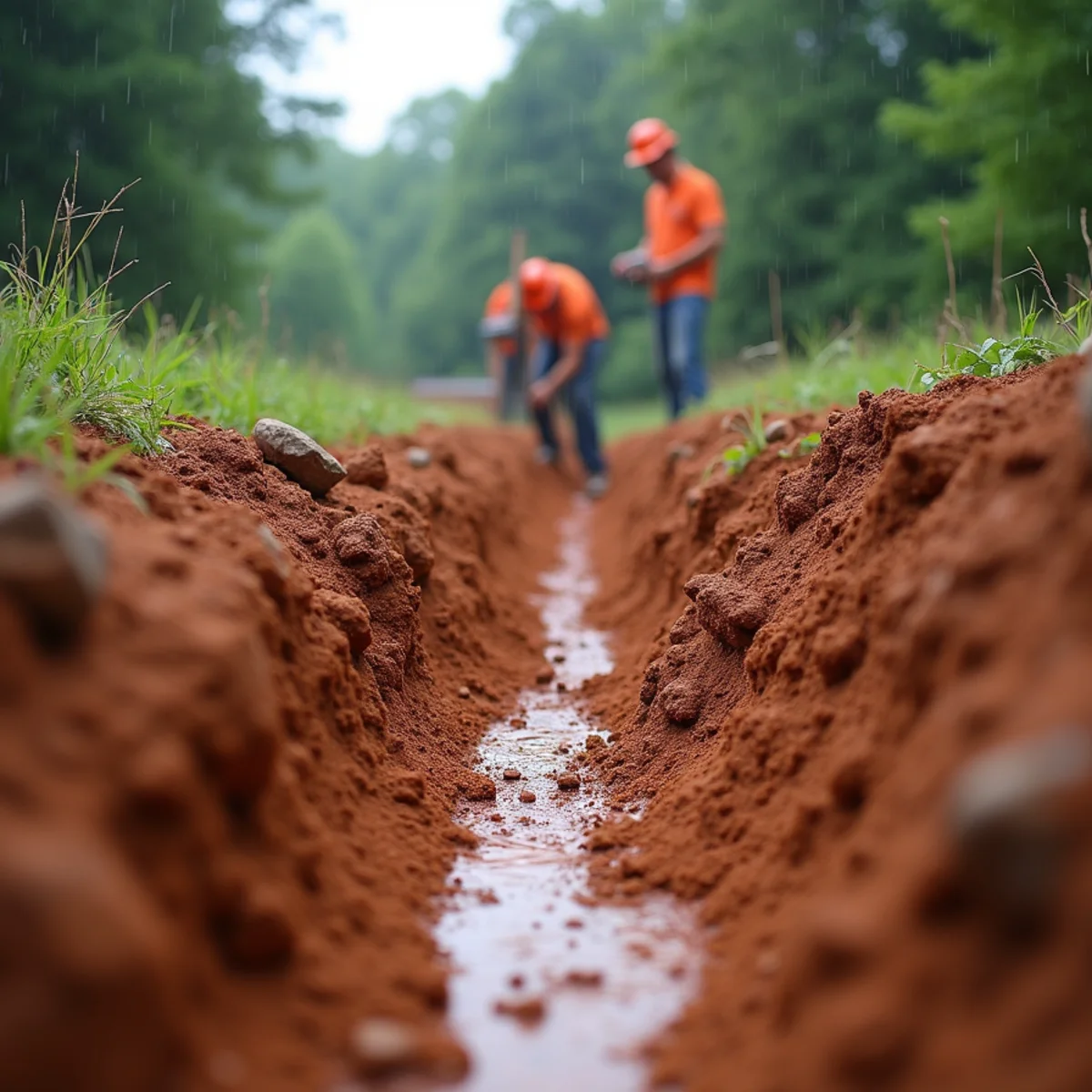
DIY french drains in North Georgia clay usually fail from four compounding mistakes: trenches dug too shallow, skipped geotextile fabric, cheap pipe that crushes under load, and illegal or unplanned discharge points. Any one of these turns a drain into a clay-clogged bathtub within a season or two.
Most DIY french drains around Clarkesville and Cornelia get dug 12 to 18 inches deep with a rented trencher, which sounds reasonable until you remember that our red clay subsoil starts right under a thin topsoil layer and does not drain, it sheds.
A shallow trench through clay does not create a drainage path, it creates a bathtub. Water enters the gravel, has nowhere to go because the trench walls are impermeable clay, and the whole system fills with a clay slurry that seals the gravel within one or two seasons.
Effective drainage in this soil usually needs a trench 24 inches or deeper with positive fall the entire run, engineered around the actual grade of the lot rather than dug to whatever depth a rented trencher happens to reach.
We see this mistake constantly on properties near Toccoa, where a homeowner's french drain worked for one dry summer and then backed up and resurfaced at the first real storm.
The giveaway when we get called out is almost always the same: water resurfacing a few feet downhill of where the original trench ended, because the pipe simply ran out of capacity to move water through clay that never had a real outlet in the first place.
A shallow trench also freezes and thaws differently than a deeper one, and repeated freeze-thaw movement near the surface can heave the gravel and pipe out of alignment over a few winters even before the clay slurry problem fully sets in, compounding the failure from two directions at once across the whole drainage run.
Mistake 2: Skipping Non-Woven Geotextile Fabric
Non-woven geotextile fabric wraps the gravel and pipe to keep clay fines from migrating in from the trench walls while still letting water pass through. It is the single most skipped step in DIY drainage.
Without it, silt-fine red clay particles work their way into the gravel voids over a few wet seasons and clog the system from the outside in, the same slurry problem as a shallow trench but arriving later.
The fabric has to wrap fully around the gravel burrito-style, overlapping at the top, not just line the trench bottom, a detail that gets missed even by homeowners who know to buy the fabric in the first place.
We use a heavier, non-woven fabric rated for a higher flow rate rather than the lightest woven landscape fabric sold at most hardware stores, since the cheaper woven products tend to blind over, meaning their pores clog with fine clay particles, faster than a properly specified non-woven geotextile.
We also size the washed gravel to the fabric's opening size rather than grabbing whatever aggregate is cheapest by the ton. Gravel that is too fine can migrate through the fabric weave over time, while gravel that is too coarse leaves oversized voids that reduce the system's effective flow capacity for its trench footprint.
Mistake 3: Cheap Corrugated Pipe That Crushes
Big box corrugated drain pipe is cheap and easy to cut, which is exactly why it fails under a driveway or beneath several feet of backfill on a mountain lot. It crushes and ovals out under load, killing flow capacity right where you need it most.
We spec SDR-35 solid PVC or heavy-wall corrugated pipe rated for the actual load it will carry, sized by the drainage area's calculated runoff volume rather than whatever diameter happened to be in stock.
A crushed pipe section is invisible from the surface until the drain backs up, and by then the fix requires re-excavating the entire run rather than a quick patch.
Perforation pattern matters too. Pipe with slots or holes only along the top half is designed to collect surface water while keeping the bottom intact for flow, and installing it upside down, a common DIY error, lets water leak straight back out into the surrounding clay instead of carrying it to the outlet.
Joint quality is another spot where cheap materials fail quietly. Snap-together corrugated fittings that are not solvent-welded or properly gasketed can separate slightly as backfill settles, opening a gap that lets soil and silt into the pipe interior from below, gradually choking flow from the inside long before anyone sees standing water at the surface of the yard.
Mistake 4: Illegally Discharging onto Neighbors/Roads
Where the water goes at the outlet end is a legal question, not just a design one. Directing a french drain or gully repair outlet onto a neighboring property, into a road ditch, or across a right-of-way without permission can violate local stormwater ordinances and create real liability if it erodes a neighbor's land.
Georgia's Erosion and Sedimentation Act framework, enforced locally by county and city codes, expects concentrated stormwater discharge to be handled responsibly, and a homeowner who redirects a drainage problem onto someone else's property can be held liable for the resulting damage.
We design outlets to daylight into an approved drainage easement, a properly rip-rapped natural swale, or back into a detention feature on the same property, not just wherever the trench happened to end.
A daylighted outlet also needs its own erosion protection, typically a small riprap apron or splash pad, so the concentrated flow leaving the pipe does not simply carve a new gully at the exact point it exits the ground.
We have walked properties around Cornelia where a neighbor's DIY drain outlet was quietly dumping onto the adjoining lot for years before anyone traced the recurring wet spot back to its source, which is exactly the kind of dispute a documented, properly routed outlet avoids entirely from day one.
Why Professional Laser-Guided Trenching Works
A functioning drainage system depends on positive fall over its entire length, typically a minimum of 1 percent slope and more on longer runs, which is nearly impossible to verify by eye on a rolling mountain lot.
We run laser grade levels through the trench before pipe ever goes in, confirming fall foot by foot so there are no low spots where sediment can settle and stall flow.
Combined with correct trench depth, wrapped gravel, and properly sized drainage and french drain pipe, that grade control is what separates a system that moves water for 20 years from one that fails in two.
We also size the system to the actual contributing drainage area, calculating the square footage of roof, driveway, and graded lawn that will feed into the trench, rather than guessing at a pipe diameter. Undersizing the pipe for the real runoff volume is a quieter failure mode than a crushed pipe, but it produces the same result during a heavy storm.
- Trench depth of 24 inches or more with positive fall over the entire run
- Laser-verified grade control confirming fall foot by foot, with no low spots
- Non-woven geotextile fabric wrapped fully around the gravel and pipe
- Pipe sized to the drainage area's calculated runoff volume, not whatever is in stock
- A daylighted outlet routed to an approved easement, swale, or detention feature
Trust Us for Guaranteed Drainage
We have re-dug more failed DIY french drains around Clarkesville, Cornelia, and Toccoa than we can count, almost always because of one of these four mistakes.
Every drainage system we install comes with as-built documentation showing trench depth, pipe route, and outlet location, so a future homeowner or contractor is not left guessing where the system runs the way most DIY drains leave no record at all.
Call (323) 606-0255 for a drainage assessment before you rent a trencher and repeat the same failure.
Frequently Asked Questions
- Most effective mountain drains run 24 inches or deeper with positive fall the entire length, well beyond the 12 to 18 inches a rented trencher typically manages.
Get Expert Help on Your North Georgia Property
Kipps Kustom Landscapes has spent 15+ years solving exactly these challenges across the Blue Ridge foothills. Call for a free on-site estimate.
Call (323) 606-0255
Written by
Hunter Kipps — Owner & Lead Craftsman
Hunter Kipps has spent 15+ years building and repairing mountain and lakefront landscapes across Northeast Georgia — boulder retaining walls, shoreline riprap, red-clay drainage, and estate stonework. He personally runs the heavy equipment and walks every site before quoting it.