Cost, Estimates & Pricing Guides
How Much Do Boulder Retaining Walls Cost in North Georgia?
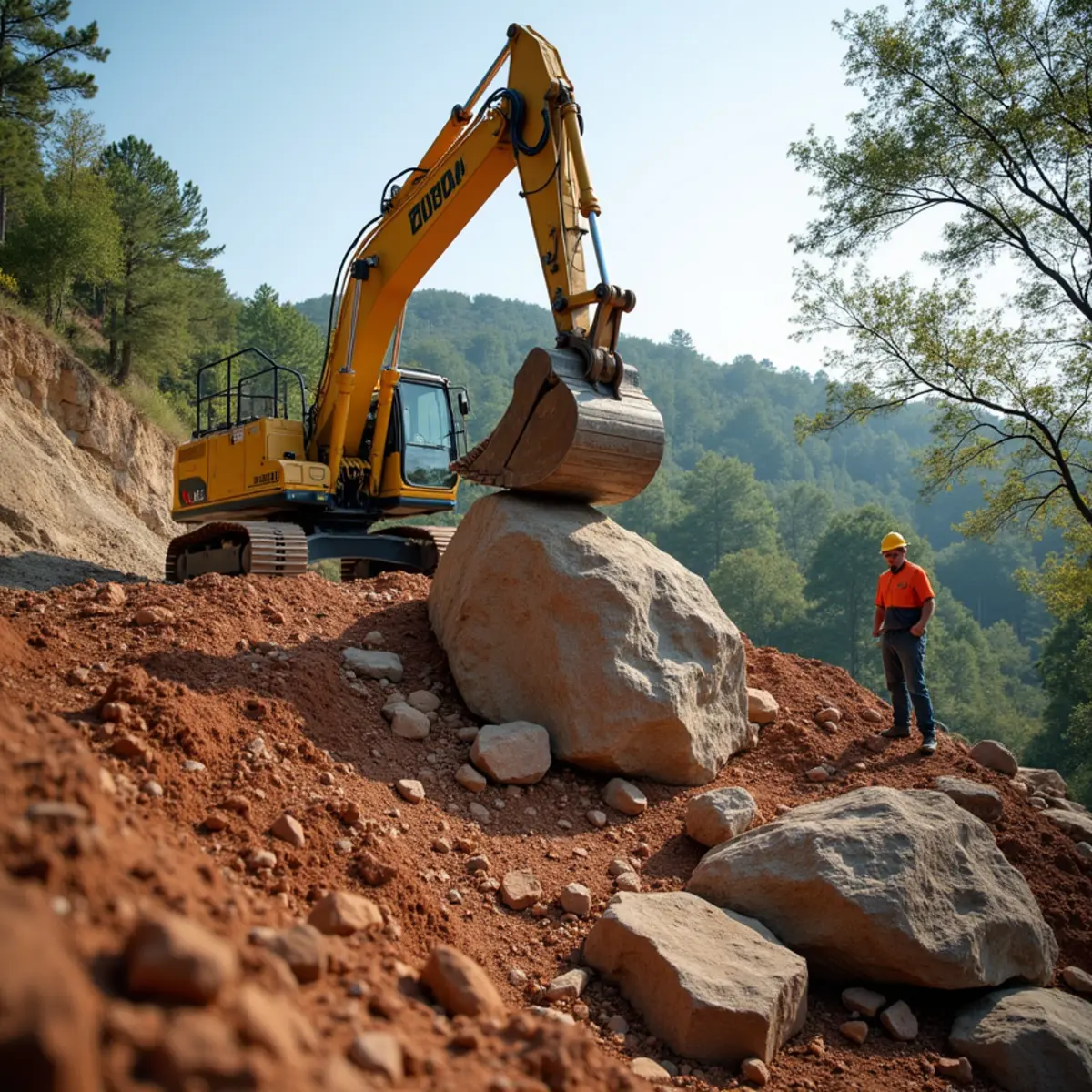
Why North Georgia Mountain Slopes Require Heavy Boulder Walls
Boulder retaining wall costs in North Georgia typically run from the low hundreds to well over a thousand dollars per linear foot, driven primarily by stone tonnage, excavator size needed for site access, and how much drainage stone and pipe the wall requires - a short, easy-access wall prices far below a tall cut on a steep, narrow mountain driveway.
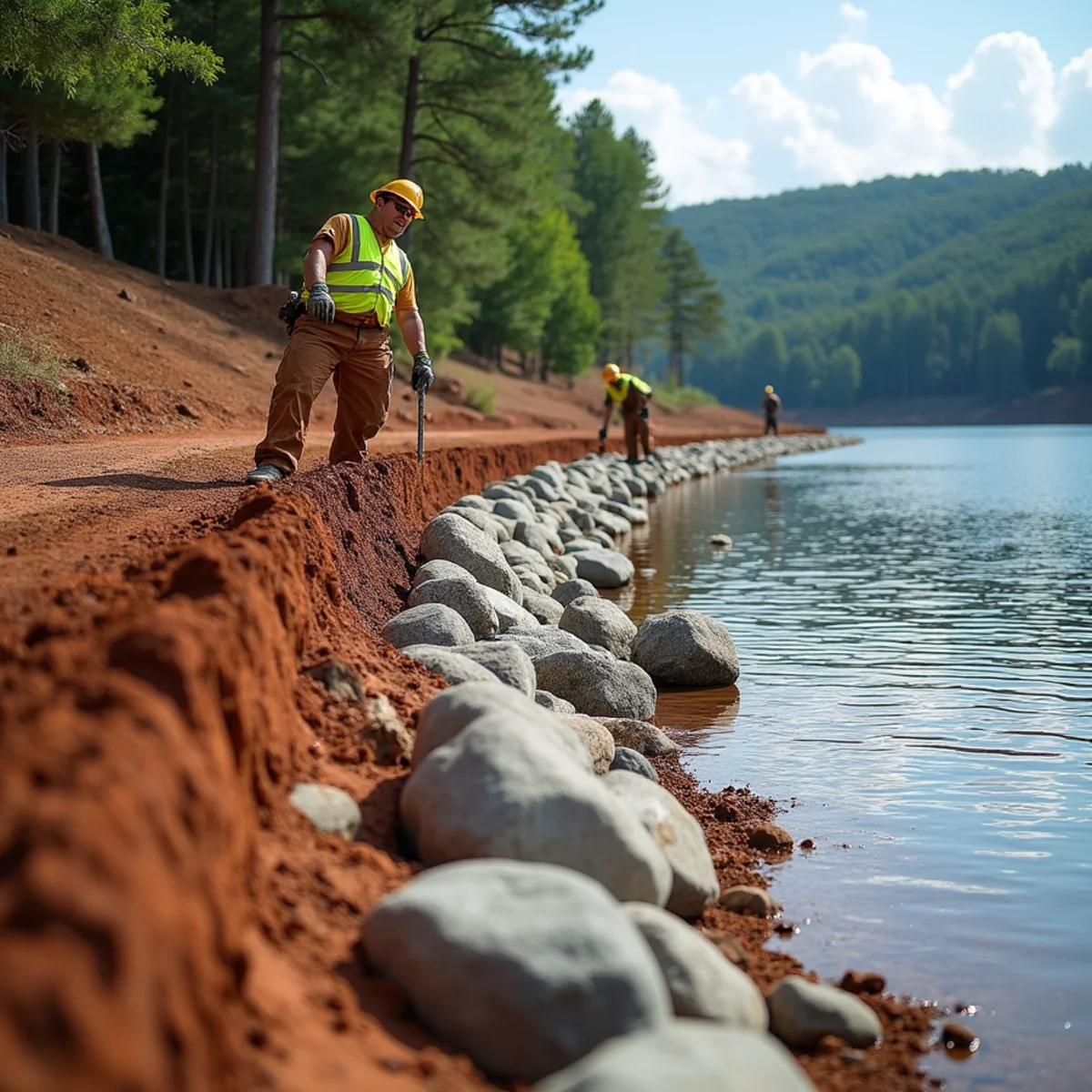
On the steep, red-clay slopes of the Blue Ridge foothills, a retaining wall is not decorative - it is structural insurance against the hillside sliding toward your home. That is why so many mountain properties turn to natural boulder retaining walls: massive gravity structures that hold saturated clay through sheer mass rather than mechanical fasteners or engineered geogrid alone. A gravity wall works on a straightforward principle: the weight of the stacked stone has to exceed the outward push of the soil behind it, which is why boulder walls are typically built with a base width equal to roughly half to two-thirds of the exposed wall height and a slight rearward batter of about one horizontal unit for every four to six units of rise.
Habersham, White, and Rabun counties see 60 to 70 inches of rain a year, well above the state average, and that water has to go somewhere. On a 25 to 40 percent grade, saturated Cecil and Pacolet series clay behaves almost like wet concrete under load, pushing outward with real hydrostatic force. Saturated clay can weigh 110 to 130 pounds per cubic foot, considerably more than the same soil dry, and that added weight translates directly into higher lateral pressure against anything holding it back. A wall built light for a flat suburban lot in Atlanta simply will not survive a wet January on a Habersham County ridge.
We see this most often on new builds around Cleveland and Clayton, where builders cut a level pad into a mountainside and are left with an 8 to 15 foot raw clay cut that has to be held back permanently. That is exactly the scenario boulder walls were built for, and it is also where cost questions come up fastest, since an 8-foot cut and a 15-foot cut are entirely different engineering problems even on the same street.
Elevation matters too. Many North Georgia mountain lots sit at 1,500 to 2,500 feet, where the frost line can run deeper than in the Piedmont below, and repeated freeze-thaw cycling through a raw clay cut face accelerates surface sloughing if left unprotected. Footings for taller boulder walls are set below the local frost depth on undisturbed or properly compacted subgrade, since a wall founded on soft ground can settle unevenly even if the stonework above is built correctly.
Cost Factors: Machine Sizing, Granite Sourcing & Tonnage
Boulder wall pricing is driven first by tonnage, not linear footage. A 4-foot wall built with 1 to 2 ton boulders uses far less stone than the same wall built with 3 to 5 ton boulders for a more massive, fewer-joint look. As a directional range, expect stone material alone to run from the low hundreds to over a thousand dollars per ton once quarrying, sorting for face and shape, and delivery are factored in - actual numbers vary by quarry distance and stone class, so treat any number here as a planning range, not a quote.
As a rough planning benchmark, a 4-foot-tall, 50-foot-long gravity wall built with 2 to 3 ton facing boulders backed by smaller core stone can require somewhere in the neighborhood of 80 to 130 tons of total material once base rock, facing stone, and drainage aggregate are counted. Double the wall height and tonnage does not simply double - it climbs faster, since a taller wall needs a proportionally wider base and more stone per linear foot.
Machine sizing is the second major driver. Small residential walls under 4 feet can sometimes be built with a compact track loader or mini-excavator with a thumb attachment. Taller walls, or walls using boulders in the 4,000 to 12,000 pound class, require a full-size excavator (20 to 35 ton) with a hydraulic thumb or grapple, and that machine costs more per day to mobilize, especially on a mountain job with limited staging area.
Sourcing matters too. Much of the granite and gneiss boulder stock used in North Georgia mountain walls comes from quarries in the Toccoa, Elberton, and Cornelia corridor. Trucking heavy stone up steep, curvy mountain roads adds real fuel and time cost compared to a flat delivery, which is one reason two walls of identical size can price differently depending on which ridge they sit on.
- Stone tonnage and boulder size class (1-2 ton vs 3-5 ton facing stone)
- Excavator size required to reach and place the boulders (mini-excavator vs 20-35 ton machine)
- Site access - narrow gravel driveways and switchbacks add labor hours
- Quarry distance and hauling difficulty up steep mountain roads
- Drainage system - geotextile fabric, #57 stone, and outlet pipe
- Permitting and engineering once wall height exceeds the local threshold
Segmental Concrete Blocks vs Natural Mountain Boulders: Price Comparison
Segmental retaining wall (SRW) block systems price on a per-square-foot-of-face basis and, for walls under about 4 feet, are often the lower up-front cost option in flat terrain. Once a wall exceeds roughly 4 feet, most jurisdictions require an engineered design with geogrid reinforcement, and that engineering fee narrows the gap between block and boulder pricing considerably.
Natural boulder walls trade manufactured uniformity for mass and drainage. Because boulders are stacked with open voids rather than tight mortar joints, water moves through the wall face instead of building pressure behind it, which is a real advantage on a red-clay mountain lot where drainage failure is the number one cause of wall collapse. For height, for rugged aesthetics that match a mountain setting, and for sites where equipment access already favors an excavator over a skid steer, boulders frequently win on total value even when material cost per ton looks higher on paper.
The honest answer for most homeowners comparing the two: block systems make sense for short, straight garden walls near a driveway or patio, while boulder walls make more sense for tall cuts, curving hillside terraces, and anywhere the wall needs to look like it belongs on a mountainside rather than in a subdivision.
Site Access Challenges on Steep Blue Ridge Hillsides
Access is where mountain boulder wall estimates diverge most from a flatland quote. Many Rabun and Habersham County driveways are narrow, gravel, and switch back sharply, which limits the size of the excavator and dump truck that can reach the work area. On tight lots we sometimes have to walk stone in with a smaller machine over multiple trips rather than run one large excavator the whole job, which adds labor hours even though the wall itself is not unusually large.
On the steepest lots around Clayton and the ridgelines above Lake Burton, there is not always room for the excavator to sit level while reaching the wall face, which can require building a temporary cut-and-fill work pad or, in rare cases, setting boulders with a small crane. Every one of these access complications is exactly why a phone quote for a boulder wall is close to useless - the terrain has to be walked before tonnage and machine time can be estimated honestly.
Property setbacks and existing landscaping also factor in. A wall tucked behind mature rhododendron or against a septic field boundary takes longer to build carefully than the same wall on an open cleared lot. Utility lines - underground power, septic lines, or a shared well line - also have to be located and flagged before excavation starts, and re-routing around a conflict can add both time and material to a project that looked straightforward on paper.
When a work pad has to be cut into the hillside just to give equipment a level place to operate, that temporary grading is itself a cost line, even though it will be removed or planted over once the wall is finished.
Permit Thresholds and Engineering Requirements in Habersham, White & Rabun Counties
Most North Georgia jurisdictions, including Habersham, White, and Rabun counties, require a building permit and a stamped engineered design once a retaining wall exceeds 4 feet in height measured from the bottom of the footing to the top of the wall, or whenever the wall supports a surcharge such as a driveway or structure within a horizontal distance roughly equal to the wall's height. A wall under that threshold, built on stable ground with no surcharge, is often installed without a formal engineering stamp.
Tiered wall designs - a series of shorter walls stepped back from one another rather than one tall wall - can sometimes keep each tier under the 4-foot engineering threshold, provided the horizontal setback between tiers meets code. This can reduce permitting complexity on a tall cut, but only works where there is enough lot depth for the terraced footprint.
Plan review timelines vary by county, and inspectors typically require a footing inspection before backfill begins on an engineered wall. We handle the permit application and coordinate inspections as part of any wall project that crosses the engineering threshold.
Hidden Essentials: Geotextile Fabric, Drainage Stone & Pipe Costs
The boulders themselves are only part of a properly built wall. Behind every wall we build, a non-woven, needle-punched geotextile fabric - typically in the 4 to 8 ounce per square yard weight range - separates the native red clay from a zone of clean #57 washed drainage stone, which keeps fine clay particles from migrating into the drainage zone and clogging it over years of freeze-thaw and heavy rain. Clean #57 stone is a specific gradation, roughly three-quarters of an inch down to a No. 4 sieve, chosen because it has enough void space to let water move through freely.
A perforated drain pipe, typically 4-inch corrugated pipe or Schedule 40 PVC, sloped and daylighted to a safe outlet point below the wall, carries collected water away instead of letting it build up as hydrostatic pressure against the back of the stone. Skipping the pipe to save money is one of the most common reasons we get called out later for a retaining wall inspection on a wall built by someone else that is only a few years old and already bulging.
Fabric, drainage stone, and pipe typically add a meaningful percentage to total project cost, but they are the cheapest insurance available against a total wall rebuild five or ten years down the road. Any estimate that does not itemize these components separately is not a complete estimate, and we recommend asking directly whether a competing quote includes a drainage system at all before comparing it to ours on price alone.
How to Get an Accurate On-Site Estimate
Because tonnage, access, and drainage needs vary so much lot to lot, an accurate number requires walking the actual hillside. We measure wall length, height, and batter angle, probe the existing soil with a hand auger or T-probe to understand how saturated the clay already is and how deep the topsoil layer runs before reaching stable subgrade, and check truck and excavator access before ever discussing stone quantities.
If your project also involves broader hillside grading, terracing, or a full mountain landscape design-build around the new wall, bundling that scope into one mobilization often saves money compared to bringing equipment back a second time. We serve mountain and lakefront properties throughout Habersham, White, and Rabun counties, including regular work around Clarkesville, Cleveland, and Clayton.
Call (323) 606-0255 to schedule a free on-site evaluation. We will walk the slope with you, explain what is driving the tonnage and machine requirements on your specific lot, and put together a written estimate you can actually plan a budget around.
Frequently Asked Questions
- Not always. Boulder walls save on manufactured materials but require heavier machinery and skilled operators. On rugged mountain sites they often deliver better long-term value because they last for generations and drain freely, closing the cost gap with engineered block walls once a wall exceeds about 4 feet.
Get Expert Help on Your North Georgia Property
Kipps Kustom Landscapes has spent 15+ years solving exactly these challenges across the Blue Ridge foothills. Call for a free on-site estimate.
Call (323) 606-0255
Written by
Hunter Kipps — Owner & Lead Craftsman
Hunter Kipps has spent 15+ years building and repairing mountain and lakefront landscapes across Northeast Georgia — boulder retaining walls, shoreline riprap, red-clay drainage, and estate stonework. He personally runs the heavy equipment and walks every site before quoting it.