
Building on Rabun County's Steepest Ground
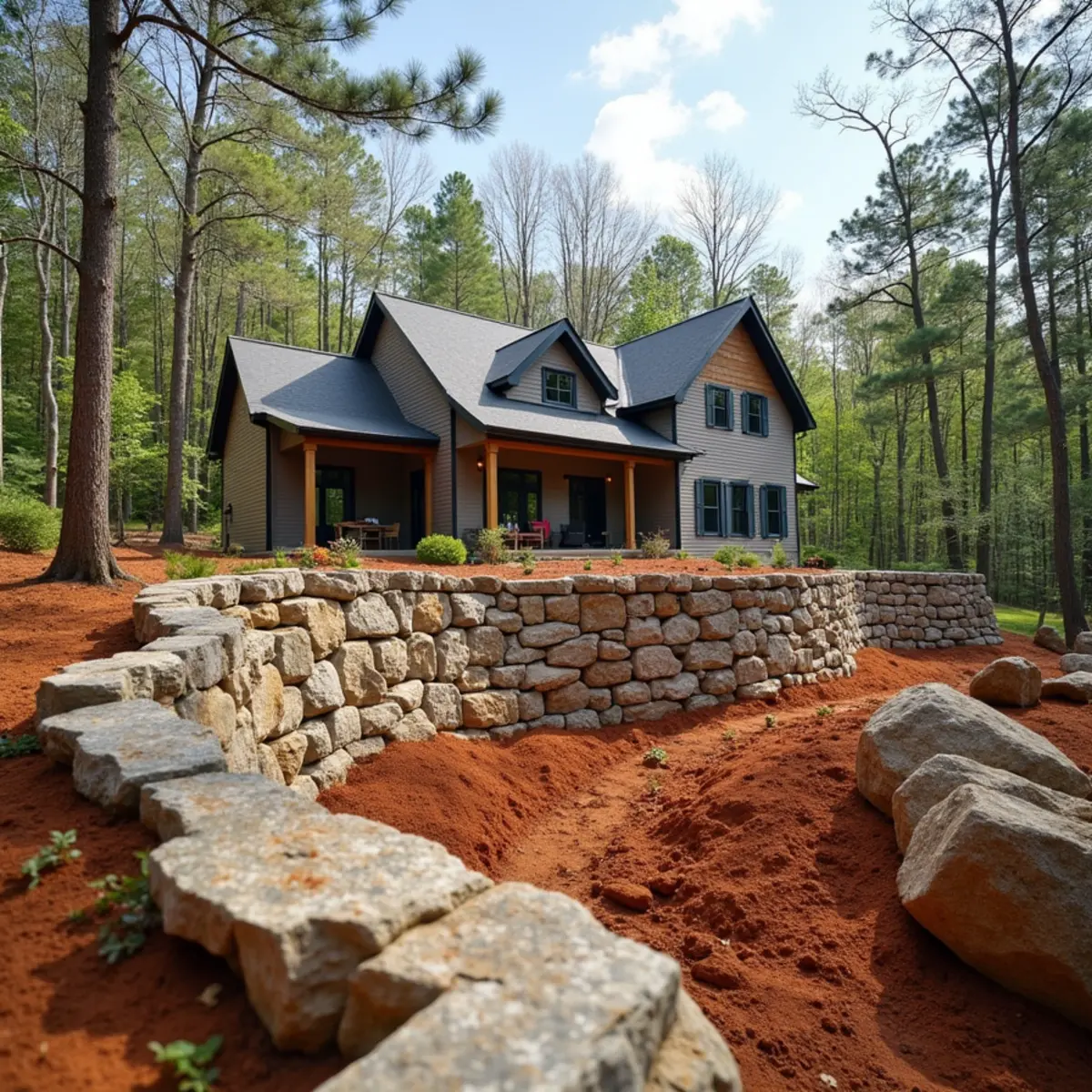
Clayton sits at roughly 1,900 feet and the terrain around US 441 and Warwoman Road climbs and drops fast, which means estate homesites often require significant cut-and-fill just to get a level building pad. We build boulder retaining walls using large native stone pulled or sourced locally, set on footings dug below frost depth and battered into the hill, because a mountain estate wall is holding back far more soil mass than a typical suburban lot ever would.
National forest borders much of the county, which means a lot of Clayton estate lots back directly onto undeveloped, steeply wooded land. Retaining walls along that boundary have to account for surface water coming off forest service land during heavy rain, since that runoff arrives with no upstream development to slow it down first.
Defensible Space Is Not Just Clearing Trees
Wildfire risk in the Chattahoochee National Forest corridor is real, particularly during dry autumn stretches when leaf litter and downed pine build up fast on wooded lots. Creating defensible space around a Clayton estate home means more than dropping trees close to the house, it means thinning selectively to break up fuel continuity, limbing up remaining trees so fire cannot climb from ground litter into the canopy, and clearing understory brush in the critical zone within the first thirty feet of the structure.
We coordinate this work with the property owner's broader landscape goals rather than clear-cutting indiscriminately, since a mountain estate's value is tied directly to its tree canopy and privacy. Selective thinning that meets defensible space guidelines while preserving the specimen hardwoods and mature rhododendron that make these lots desirable takes real forestry judgment, not just a chainsaw crew working fast.
Drainage on Estate-Scale Lots
Larger Clayton properties often have multiple drainage zones, a driveway culvert crossing, a spring-fed wet weather stream, and graded areas around outbuildings, all needing to work together. We design French drain systems that account for the whole property's water movement rather than patching one wet spot at a time, which matters on estate lots where a fix in one corner can just push the problem to another part of the property if it is not planned holistically.
Clayton as a Rabun County Hub
Clayton anchors work we do throughout Rabun County, including nearby Tiger, Mountain City, and the Lake Rabun communities toward Lakemont. For a full estate build we often combine retaining wall structure, defensible clearing, and a broader mountain landscape design and build scope into a single phased project, which keeps equipment mobilization costs down for the homeowner compared to hiring separate contractors for each piece.
Keeping Defensible Space Effective Year After Year
Defensible space around a Clayton estate is not a one-time project, forest-edge lots near Warwoman Creek and the national forest boundary regrow understory brush and drop pine straw fast enough that a clearing job done once and never revisited loses most of its wildfire benefit within two or three growing seasons. We offer recurring estate grounds maintenance and pruning specifically scoped to keep the thirty-foot critical zone clear, limb up regrowth before it reconnects ground fuel to the canopy, and manage the pine straw litter that builds up fast under the mixed hardwood-pine stands common on Rabun County ridgelines.
On slopes we have cleared and stabilized, we replant with native ferns, wild ginger, and low rhododendron rather than leaving bare disturbed soil exposed to the area's heavy thunderstorm rainfall, since exposed clay on a freshly cleared national-forest-adjacent slope erodes fast without some root structure holding it. That combination of maintained defensible space, stabilized retaining structure, and a forest-appropriate planting palette is what keeps a Clayton estate looking intentional rather than like a construction site that never got finished. We schedule this maintenance work alongside jobs near Black Rock Mountain State Park and the Lake Rabun communities toward Lakemont, so Clayton estate clients get consistent crews who already know the property's history rather than a new team relearning the site every visit.
Seasonal Landscaping and the Clayton Microclimate
Clayton's roughly 1,900-foot elevation and its position ringed by Chattahoochee National Forest give it a noticeably cooler, wetter microclimate than towns down in the Piedmont, with heavier and more frequent rainfall off the surrounding ridges and a shorter reliable growing season for warm-season turf and ornamentals. Estate lots along Warwoman Road see real temperature swings between shaded, north-facing slopes and open, south-facing building pads, sometimes within the same property.
We match planting and turf choices to that actual microclimate rather than a statewide default, favoring cold-hardy fescue blends and native rhododendron and mountain laurel on the shaded, forest-edge sections of Rabun County estate lots, and reserving warm-season options for the sunnier, better-drained pads. Timing matters just as much as species selection at this elevation, and we build seasonal planting windows around Clayton's real frost dates into any mountain landscape design and build plan.
What a Typical Clayton Estate Project Looks Like
A typical call from a Clayton estate property starts with a homesite that needs real cut-and-fill to get a level pad on ground bordering national forest land, plus a wildfire defensible space concern the owner has been meaning to address. We walk the whole lot together, mapping where the boulder retaining wall structure needs to go to hold the cut, where drainage from adjacent forest service land will hit the property hardest, and how far the thirty-foot critical zone around the structure actually needs clearing.
From there the project usually sequences as one phased job: grading and wall footings first, then targeted French drain runs tied into the wall's drainage, then defensible space thinning and planting last so freshly disturbed soil is not left bare through a Rabun County storm season. Estate clients near Tiger and the Lake Rabun communities often fold recurring maintenance into the same plan from day one.
Larger Clayton estates sometimes add a phase we have not mentioned yet, a gravel or paved access road improvement running from the county road up to the building pad, since a road cut into steep Rabun County ground needs the same drainage discipline as the house site itself. We grade and crown these access roads with culverts at any drainage crossing, tying that runoff into the same French drain and wall system already planned for the homesite, so the driveway does not become the one piece of the project that washes out first.
Our Services in Clayton
Every core Kipps Kustom Landscapes service is available to Clayton property owners:
Why Clayton Residents Choose Kipps Kustom
Equipment Sized for Estate-Scale Cut and Fill
We own the excavators and grading equipment estate-scale Clayton lots actually require, so a homesite carved out of Rabun County's steepest ground does not stall waiting on rented machinery.
Forestry Judgment, Not Just a Chainsaw Crew
Defensible space clearing near the national forest boundary takes real judgment about which trees to thin and which specimen hardwoods to keep. We plan that work rather than clear-cutting for speed.
20 Miles From Our Habersham County Base
Clayton sits close enough to Clarkesville that we anchor regular work throughout Rabun County here, including Tiger, Mountain City, and the Lake Rabun communities on the same trip.
15+ Years, 4.9 Stars, 47 Reviews
Licensed and insured under Miller Landscaping Group LLC, with a track record North Georgia estate owners have rated 4.9 stars across 47 reviews, not a new crew learning Rabun County terrain for the first time.
Clayton Landscaping FAQs
- It means selectively thinning trees and brush to break up continuous fuel, limbing up remaining trees so ground fire cannot reach the canopy, and clearing dense understory within about thirty feet of the structure, while preserving the specimen trees that give the lot its value.