
A Gateway Town With Real Grade
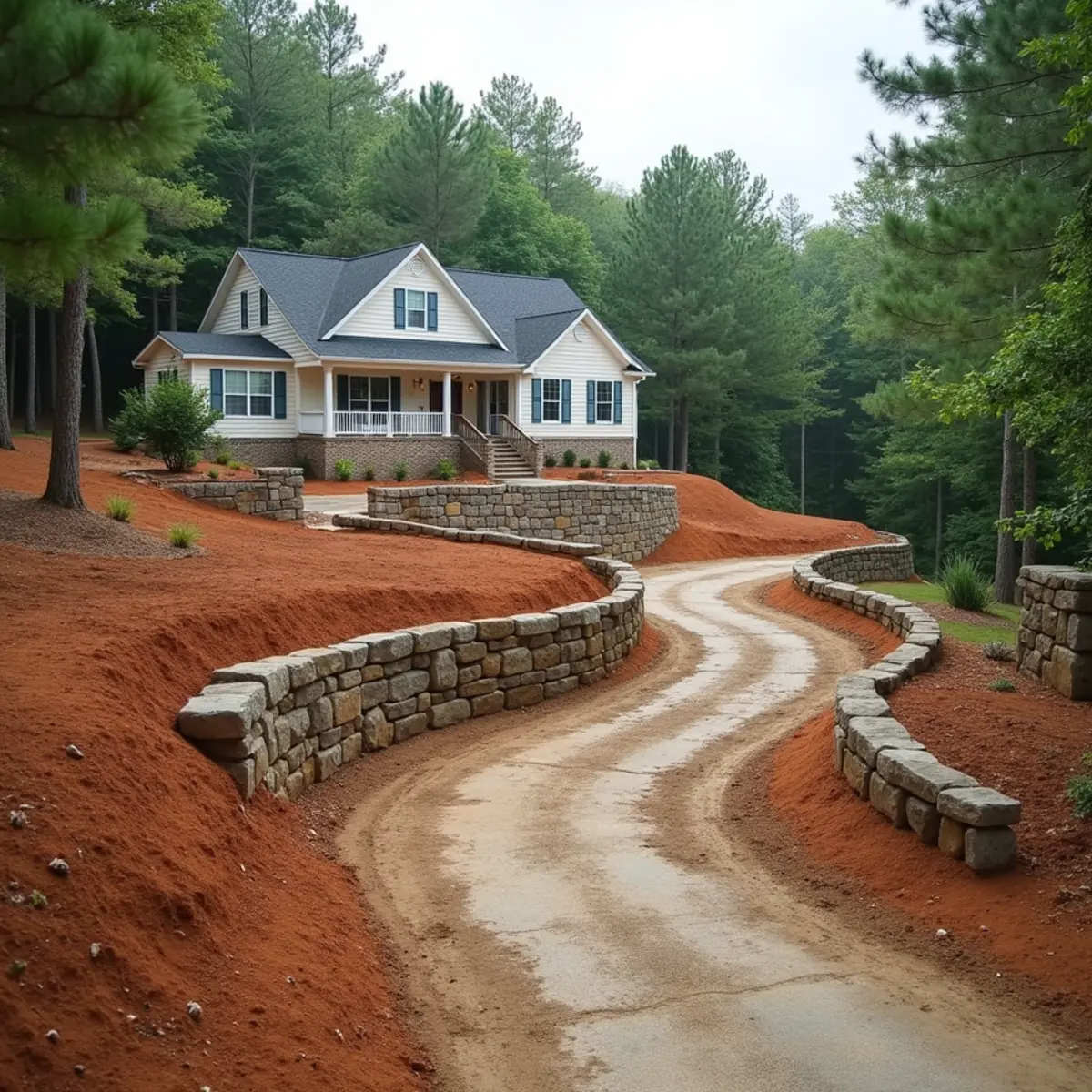
Cleveland's elevation climbs quickly as you head north toward Helen and the Chattahoochee headwaters, and that same lift means driveways and building pads cut into hillsides all over White County. A lot of homes here were graded decades ago with a simple cut-and-fill approach and no real retaining structure, just a bank of exposed clay held up by whatever roots happened to still be in the ground. That works until a wet winter saturates the slope and the driveway edge starts slumping toward the ditch line.
We see this constantly on properties off Old Highway 441 and up toward the Yonah Mountain foothills, where a driveway that looked stable for fifteen years suddenly drops six inches after a week of steady rain. Once clay reaches saturation it loses most of its shear strength, and an unsupported cut bank simply cannot hold its own weight anymore.
Why Rainfall Volume Changes the Engineering
White County sits in a rain shadow pattern where orographic lift off the approaching Blue Ridge squeezes noticeably more precipitation out of storm systems than towns twenty miles south. That extra water has to go somewhere, and if a retaining wall is not paired with real drainage behind it, hydrostatic pressure builds up and pushes the wall out regardless of how heavy the stone facing looks from the road.
Every boulder retaining wall we build in Cleveland gets a perforated drain pipe wrapped in filter fabric set at the base of the wall, backfilled with washed gravel rather than the native clay that was dug out. That gravel column gives water a path to daylight instead of letting it pool against the back of the wall and slowly walk the whole structure downhill over a few rainy seasons.
Protecting Driveways and Building Pads
A collapsed driveway shoulder is not just cosmetic, it is often the first visible sign of a slope failure that will eventually threaten the pad underneath a garage or the foundation of the house itself. We evaluate the full slope above and below a driveway cut before recommending a wall height and footing depth, because undersizing a wall to save cost on a Cleveland hillside usually means rebuilding it within a few years once the real load becomes clear.
For new construction sites we also install French drains upslope of the driveway cut to intercept sheet flow before it ever reaches the retaining wall, which takes real pressure off the wall itself and keeps the gravel driveway surface from washing out every time a thunderstorm rolls through.
Cleveland and the Surrounding Foothills
Cleveland sits close enough to Helen and Clarkesville that many of our clients here also own weekend property or family land in those towns, and we handle projects across all three without treating any of them as an afterthought. We are also a short run from Sautee-Nacoochee, and understand how the valley floor there drains differently than the ridge terrain right around the Cleveland town square.
Whether the job is a full driveway rebuild with engineered walls or a targeted fix for a single slumping shoulder, we quote Cleveland jobs based on the actual soil and slope in front of us, not a flat per-foot number that ignores the extra rainfall this gateway location gets.
Turf Disease Pressure From Extra Moisture
The same orographic rainfall that stresses retaining walls in Cleveland also changes what grows well in the lawn itself. Tall fescue planted in low-lying yards near US 129 and Town Creek holds moisture at the crown longer than it would in drier towns further south, which raises the risk of brown patch and other fungal disease during the humid stretches of a White County summer. We space seeding rates to promote airflow through the turf canopy rather than a dense monoculture stand, and we time fungicide and fertilizer applications around the wetter weather pattern rather than a generic statewide calendar, since a program built for Atlanta's drier Piedmont climate under-treats Cleveland's actual disease pressure.
On the foothill lots climbing toward Yonah Mountain, we also watch for chronic wet spots where a lawn simply will not establish no matter how it is seeded, usually a sign that subsurface water is surfacing rather than a turf problem at all. Where that is the case we recommend a proper cure with a French drain run instead of repeatedly reseeding the same failing patch, and for clients planning a full property build in this corridor, we scope Cleveland projects as a complete mountain landscape design and build from the driveway wall down to the finished lawn so drainage and turf decisions get made together instead of in isolation.
Permits, Codes and Compliance in White County
Any retaining wall in White County that climbs much past about four feet of exposed face height typically needs an engineered stamp before the county will sign off, and Cleveland's driveway-cut hillsides push past that threshold more often than flatter towns do. We size our boulder retaining walls to stay within what a standard footing detail can support where the grade allows, and when a cut genuinely calls for a taller structure, we bring in the engineering rather than guessing at a footing depth and hoping an inspector agrees. Always confirm the exact wall-height threshold and any grading permit requirement with the White County building department before work starts, since local interpretation can vary by project.
Grading disturbance over an acre in Georgia also triggers Georgia EPD erosion and sediment control requirements, which matters on the larger hillside lots common off Old Highway 441 and toward the Yonah Mountain foothills. We install silt fencing and other sediment control measures as a matter of course on Cleveland jobs of that scale, both because it is the right way to protect Town Creek and other downstream drainage, and because an inspector finding an uncontrolled site mid-project can shut work down until it is corrected.
Seasonal Landscaping and the Cleveland Microclimate
Cleveland's elevation gain heading north toward Helen means the growing season here runs noticeably shorter than towns closer to the Piedmont fall line, with a later average last frost in spring and an earlier first frost in fall. That window matters for anything we plant, since installing warm-season sod or tender ornamentals too early in a Cleveland spring risks a late cold snap that a lower-elevation Cornelia yard would rarely see.
We lean on a native mountain palette suited to this shorter season and heavier rainfall pattern: mountain laurel and rhododendron in shaded pockets, and cold-tolerant fescue on lawns that see real winter exposure along the US 129 corridor. For clients wanting a recurring program built around this actual seasonal window rather than a generic statewide calendar, we offer estate grounds maintenance and pruning timed to Cleveland's real frost dates.
Our Services in Cleveland
Every core Kipps Kustom Landscapes service is available to Cleveland property owners:
Why Cleveland Residents Choose Kipps Kustom
We Design for White County's Extra Rainfall, Not Averages
Cleveland sits in a rain-shadow pattern that squeezes more precipitation out of storms than towns twenty miles south. Every wall we build here gets drainage sized for that reality, not a statewide default.
16 Miles Up US 129 From Our Habersham County Shop
Cleveland is close enough to Clarkesville that we route crews through regularly, which means a slumping driveway shoulder gets looked at fast instead of waiting on a distant contractor's schedule.
24/7 Response When a Slope Is Actively Moving
A saturated cut bank can drop six inches overnight. We answer emergency calls around the clock for Cleveland properties showing active slope failure, not just during business hours.
15 Years and a 4.9-Star Reputation Across the Foothills
We are licensed and insured under Miller Landscaping Group LLC, and 47 North Georgia homeowners have rated our work 4.9 stars, the kind of track record you can verify before we ever touch your driveway.
Cleveland Landscaping FAQs
- White County gets heavier rainfall than areas farther south because of its position at the base of the Blue Ridge. Older driveways cut into hillsides without a real retaining structure saturate during wet stretches and lose their shear strength, which causes the shoulder to slump.