
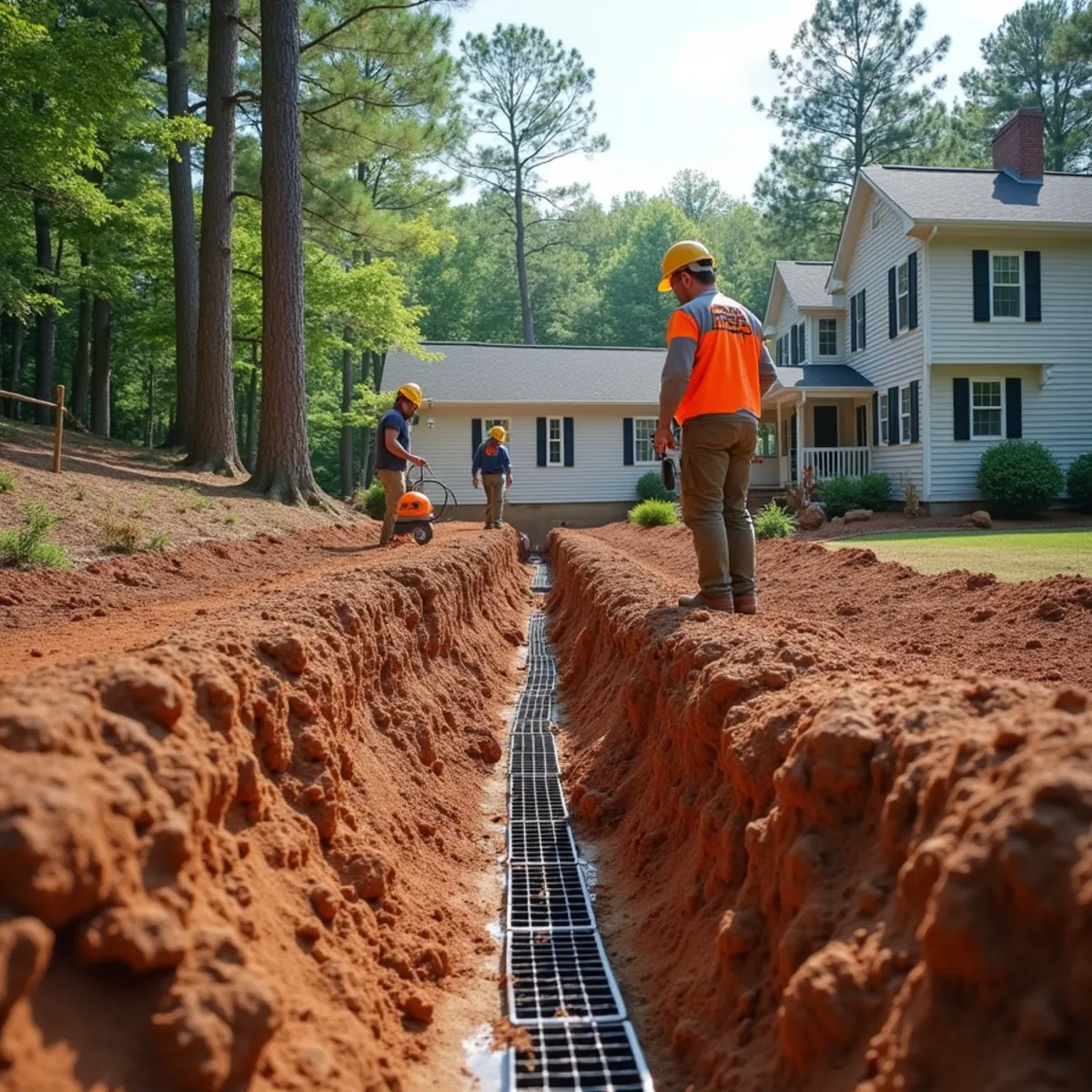
Why Auburn Slabs Fight Water More Than Most
Barrow County clay in the Auburn area is dense, poorly draining Cecil and Pacolet series soil typical of the Georgia Piedmont, and it does not absorb water the way sandier or loamier soil would. On a slab-on-grade home, that matters more than it would on a home with a crawlspace or basement, because there is no elevated framing to buffer the living space from ground moisture, water that sits against the slab perimeter has a much shorter path to becoming an interior humidity or moisture intrusion problem. Add in the flat-to-gently-sloped grading typical of Auburn's suburban subdivisions, built for efficient lot yield rather than aggressive drainage, and a lot of homes here end up with water sheeting toward the foundation instead of away from it during heavy rain.
French Drains Sized for Clay, Not Sand
A French drain that works in sandy coastal soil often underperforms in Auburn's clay unless it is designed differently. We cut trenches deep enough to get below the compacted clay layer near the surface, wrap perforated pipe in filter fabric, and bed it in clean washed gravel rather than relying on the surrounding clay to help move water, since clay simply will not let water migrate sideways into the drain the way sand does. Trench spacing and pitch matter more here too. We calculate a consistent fall to daylight or a dry well sized for the clay's slow infiltration rate, because red-clay-drainage-french-drains that were installed flat, or pitched the wrong direction, are one of the most common failed prior installs we get called to fix in Barrow County subdivisions.
For homes where water is pooling specifically at one corner or along one wall of the slab, we often combine a perimeter French drain with regrading immediately around the foundation, since even a well-built drain cannot fully compensate for negative grade actively pushing water toward the house.
Downspout and Surface Water Integration
Foundation drainage in Auburn is rarely just about the French drain itself. Gutter downspouts that discharge directly against the foundation are a major contributor to the moisture problems we see, and we tie downspout extensions into the same drainage system rather than leaving them to dump water six inches from the slab. We also address any low spots in the yard that collect water before it ever reaches the house, since a drain system fighting a yard that funnels water toward the foundation from multiple directions will always be working harder than it should.
Serving Auburn and the Barrow County I-85 Corridor
We regularly serve nearby Winder and Statham for the same slab-foundation drainage work, and we also handle boulder-retaining-walls for Auburn properties needing grade correction as part of a broader drainage fix.
Stormwater Detention Ponds and HOA Common Area Grading
Newer Auburn subdivisions built along the I-85 and Highway 211 corridor are required under Barrow County's stormwater ordinance to include detention ponds that temporarily hold runoff from the development before releasing it at a controlled rate, and those ponds and their surrounding buffers become an HOA maintenance responsibility the moment the developer turns the neighborhood over to residents. An overgrown or eroding detention pond buffer is one of the more common code violations we see cited in these newer Auburn communities, since a lot of HOAs are not equipped to handle the specialized grading and planting a stormwater facility actually needs.
We maintain and regrade detention pond buffers under estate-grounds-maintenance-pruning contracts for several Auburn HOAs, mowing on a schedule that keeps the buffer code-compliant without disturbing the erosion-control vegetation the pond depends on, and regrading the pond's inlet and outlet structures when sediment buildup starts reducing its holding capacity. For individual homeowners backing up to one of these ponds, we also address the same negative-grade and drainage issues that affect slab foundations elsewhere in Auburn, since a lot with a detention pond immediately downhill still needs its own foundation drainage handled independently of what the pond itself is designed to manage.
Sediment removal from a detention pond's forebay is typically needed every few years depending on how much upstream construction is still active nearby, and we inspect forebay capacity as part of our routine HOA service visits so an Auburn community is not caught off guard by a pond that has quietly lost most of its holding capacity to accumulated silt. Catching that buildup early is considerably less expensive than the excavation and disposal costs involved once a pond has been neglected for years past its expected maintenance cycle.
Neighborhoods & Areas We Serve in Auburn
Auburn's growth follows the I-85 and Highway 211 corridor, and the newer subdivisions right along that stretch are almost all slab-on-grade construction on the dense Cecil and Pacolet clay covered above, needing the same red-clay-drainage-french-drains approach detailed there. Older, in-town lots closer to Auburn's original center tend to have a mix of foundation types and more established trees, which changes how we approach French drain placement since mature root systems compete for the same trench space a straight subdivision lot would not have.
We also serve Auburn properties bordering Winder and Statham where the suburban grid gives way to larger, more rural parcels, and those jobs shift toward the driveway and hillside-excavation-slope-terracing work we cover in our Statham service area.
What a Typical Auburn Project Looks Like
A typical Auburn call starts with standing water at a slab foundation corner, and the fix usually combines a properly designed red-clay-drainage-french-drains system with downspout integration and, where needed, regrading around the perimeter, rather than any single element solving the problem on its own. HOA detention pond maintenance under our estate-grounds-maintenance-pruning contracts is the other recurring category of Auburn work, usually structured as an ongoing contract rather than a one-time visit.
At 49 miles out, we schedule Auburn drainage work to address the whole foundation perimeter and yard grading in one trip where possible, since a partial fix that only addresses the most visible wet corner often leaves another part of the slab exposed to the same clay drainage problem.
Our Services in Auburn
Every core Kipps Kustom Landscapes service is available to Auburn property owners:
Why Auburn Residents Choose Kipps Kustom
We Design Drains for Clay, Not Sand
Auburn's dense Cecil and Pacolet clay does not let water migrate sideways the way sandy soil does. Every French drain we cut here goes below the compacted clay layer with clean gravel bedding, sized for that specific soil, not a generic template.
49 Miles for Slab-Foundation Expertise
Auburn is about 49 miles from our Clarkesville base. Foundation drainage work at this scale, especially across whole subdivisions and HOA detention ponds, is the kind of higher-value job that justifies the drive.
24/7 Response for Active Water Intrusion
A slab foundation with water actively pooling against it cannot wait for a scheduled visit. We run 24/7 emergency response for Auburn homeowners dealing with active moisture intrusion, not just planned drainage installs.
Licensed and Insured for HOA Detention Pond Contracts
Our estate grounds maintenance work on Auburn HOA detention ponds runs through fully licensed and insured Miller Landscaping Group LLC, with proof of coverage available before any board signs off.
Auburn Landscaping FAQs
- Barrow County clay drains poorly, and even subtle negative grade on a flat-looking lot can direct water toward a slab foundation. On slab-on-grade construction that water has a shorter path to becoming an interior moisture problem than it would on a home with a crawlspace.