
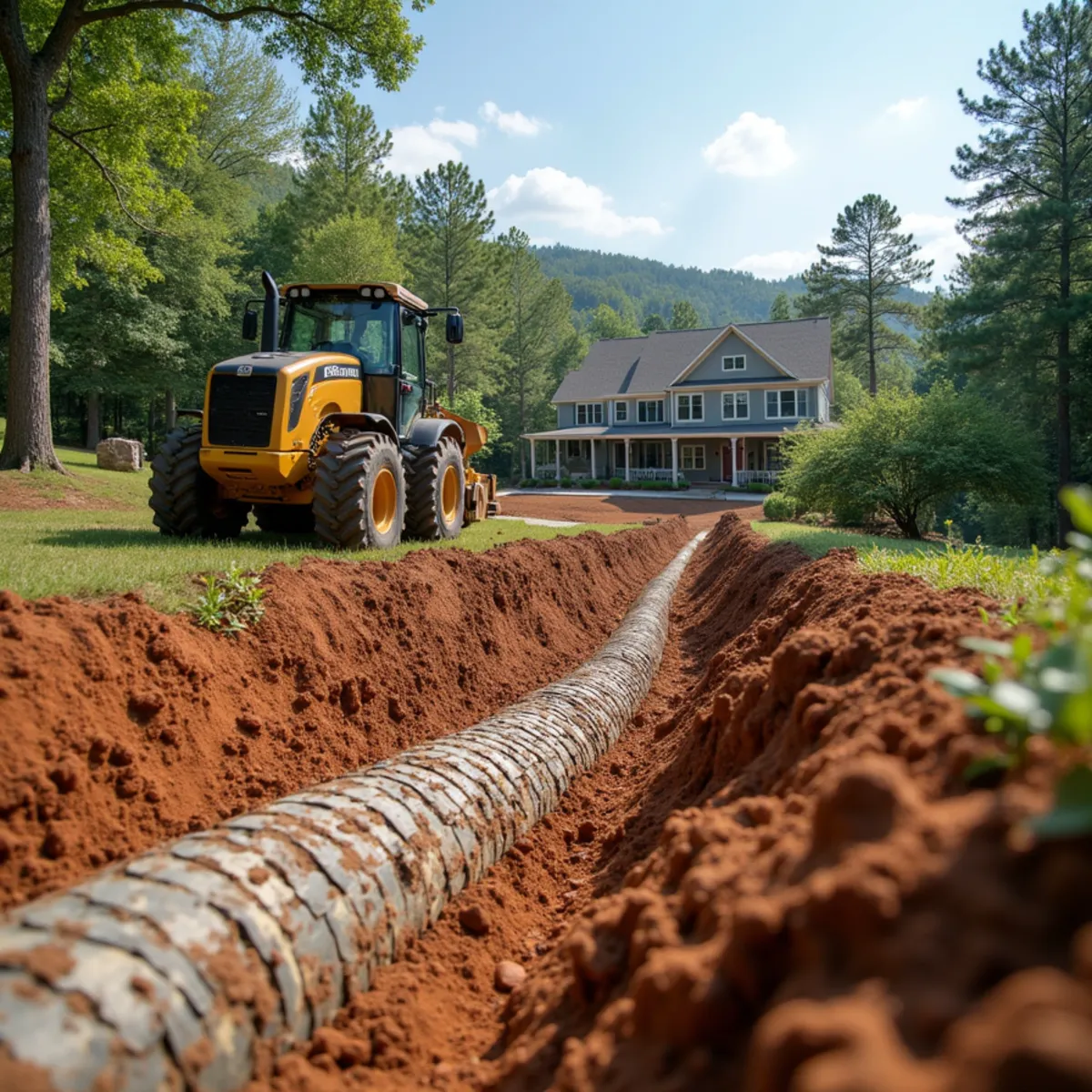
Pasture Country Is Not Flat Country
Banks County's rolling pastures around Homer look easy to build on compared to the steep grades further up toward Rabun County, but that gentle roll hides real drainage complexity. Pasture land has typically been shaped by decades of cattle grazing and informal grading, with low spots that hold water seasonally and old fence-line ditches that no longer drain where they were originally intended to. When a new home site gets carved out of former pasture, those old drainage patterns often have to be entirely rebuilt rather than simply reused.
We survey the existing water movement across a Homer pasture site before any grading begins, tracking where cattle ponds or wet-weather springs sit relative to the proposed building envelope, since a home pad set even slightly wrong relative to that old drainage pattern will fight standing water for the life of the house.
Culverts Built for Agricultural Volume
Driveways crossing pasture drainage in Banks County often need culvert pipe sized well beyond what a typical suburban residential crossing would require, because agricultural land upstream sheds water in volume during heavy rain, especially where adjacent fields have been cleared of the tree cover that would otherwise slow runoff. We size culvert diameter based on the actual watershed area draining toward the crossing, not a generic driveway culvert chart, and we set headwalls and rip-rap aprons to prevent the culvert ends from washing out during the kind of gully-washer thunderstorms that hit this part of Banks County every summer.
Undersized culverts are one of the most common repeat problems we get called out to fix in Homer, usually installed by a contractor working off a standard residential spec sheet without accounting for the pasture acreage actually draining through that single pipe.
Tractor Grading a New Home Site
New construction on former pasture requires a different grading approach than a wooded mountain lot. We use tractor-mounted box blades and grading equipment to establish a proper crown and pitch across what is often a much larger cleared footprint than a typical Habersham County wooded lot, making sure the finished grade sheds water away from the foundation in every direction rather than just toward the nearest visible low point.
Once rough grading is complete we address soil compaction from tractor traffic before any final landscaping goes in, since compacted subsoil under a future lawn area will not support healthy turf root development no matter how good the topsoil layer on top looks.
Homer and Southern Banks County
Homer sits close to Maysville and Gillsville, and we regularly combine trips through this part of Banks and Hall County. For projects that go beyond initial grading into full landscape development, we transition into red clay drainage and French drain work once the underlying clay layer is exposed below the pasture topsoil, and we can scope a complete mountain landscape design and build plan for new construction from the ground up.
Farm Pond Banks and Open Pasture Wind Exposure
A lot of Banks County pasture properties around Homer include an old farm pond, often dug decades ago for cattle watering, and those pond banks erode steadily as livestock traffic and wave action from wind across open pasture wear away unprotected soil at the waterline. We stabilize pond banks with boulder retaining walls and keyed stone at the most exposed sections, the same structural approach we use on lake shoreline work scaled down to a farm pond's size, which holds up far better than the informal riprap dumping we often find already attempted on these ponds.
Open pasture also means real wind exposure, without the tree cover found on wooded mountain lots further north, and that wind dries out newly graded soil fast and can stunt young tree plantings before they establish. Where a Homer property owner wants to break up that exposure, we plant windbreak rows of fast-growing native species along the windward fence line, positioned to protect both the home site and any newly graded pasture from wind-driven soil loss while the area re-establishes ground cover. We often combine this work with jobs near Baldwin, which shares similar open ridge-and-pasture exposure.
Neighborhoods and Terrain Around Homer
Homer's character changes depending on how close a property sits to the Banks County courthouse square versus out on the rolling pasture along GA 51 and GA 105. In-town lots tend to be smaller and already graded, with drainage concerns closer to what we would see on a typical residential job, while the pasture properties ringing town run to real acreage with the agricultural-scale culvert and grading needs we handle constantly out here.
We size equipment and scope differently depending on which of these two Homer property types we are walking onto. A courthouse-area lot might need a single French drain run and a lawn renovation, while a pasture property off GA 51 needs box-blade grading, culvert sizing for a real watershed, and pond bank stabilization, and we quote each type on its own terms rather than a flat countywide rate.
What a Typical Homer New-Construction Project Looks Like
New construction on former Banks County pasture around Homer almost always starts the same way: a cleared building envelope with old, informal cattle-era drainage that no longer functions correctly once a house pad, driveway, and lawn area get carved out of it. We survey the site's actual water movement first, then grade the pad to shed water in every direction rather than toward whatever low point happened to exist before.
From there the typical sequence runs tractor grading, then culvert sizing at any driveway crossing, then red clay drainage and French drain work once the underlying clay is exposed, and finally topsoil rebuilding and turf. Homer clients near Maysville and Baldwin often see the identical sequence, since Piedmont pasture ground behaves consistently across this stretch of Banks County.
Well placement is another decision that gets made early on a Homer new-construction site, and Banks County requires well setbacks from septic fields, property lines, and any existing water source that need to be confirmed with the county health department before drilling. We coordinate our grading plan around those confirmed setbacks rather than finalizing a pad location first and then discovering the well has to move, since regrading a finished pad to accommodate a relocated well adds real cost that proper sequencing avoids. Homer clients building new on pasture ground benefit most when this kind of utility and drainage planning happens together at the very start of a project.
Our Services in Homer
Every core Kipps Kustom Landscapes service is available to Homer property owners:
Why Homer Residents Choose Kipps Kustom
We Own the Tractors and Culvert Equipment Pasture Work Needs
Homer's agricultural-scale drainage calls for box blades and properly sized culvert pipe, not residential attachments. We own that equipment outright rather than renting it per job.
18 Miles South of Clarkesville
Homer sits close enough to our Habersham County shop that we combine trips through Banks County with nearby Maysville and Gillsville, keeping scheduling and mobilization costs down.
15+ Years Sizing Culverts for Real Watersheds
We calculate contributing drainage area across the whole pasture before recommending culvert size, a habit built over 15-plus years of fixing undersized crossings other contractors installed off a standard chart.
Licensed, Insured, 4.9 Stars From 47 Reviews
Every Homer project runs under Miller Landscaping Group LLC's license and insurance, backed by a 4.9-star rating from 47 North Georgia homeowners and farm property owners.
Homer Landscaping FAQs
- Pasture land upstream often sheds a large volume of water during heavy rain, especially where trees have been cleared. A culvert sized for a standard residential driveway rather than the actual watershed area will undersize and wash out.