Permits, Codes, HOA Regulations & Local Compliance
Land Clearing and Burning Regulations in Northeast Georgia Foothills
Georgia Forestry Commission Burn Ban Rules & Permits
Open burning of land-clearing debris in Georgia requires a same-day permit from the Georgia Forestry Commission and is banned outright during dry-season burn restrictions, with counties often adding further distance and timing rules. Forestry mulching sidesteps the permit and fire liability entirely by grinding debris in place instead of burning it.
Open burning of land-clearing debris in Georgia requires a burn permit from the Georgia Forestry Commission, obtained the same day as the burn, and is prohibited entirely during declared burn bans that typically hit during dry spring and fall stretches when humidity drops and wind picks up.
Even with a valid permit, county and some municipal governments layer on additional restrictions. Many areas around Cleveland and the broader White and Habersham county line prohibit burning within certain distances of structures, roads, and property lines regardless of the state permit.
A burn that escapes control, even briefly, can trigger liability for suppression costs and property damage on neighboring land, which is a real risk on wooded mountain lots where dry leaf litter carries fire fast.
Burn permits are also weather-dependent day by day, issued or denied based on wind speed and relative humidity at the time of the request, which means a homeowner working around a contractor's schedule may find the permit denied on the exact day the crew is on site and ready to burn a debris pile.
The Forestry Commission's fire danger rating shifts frequently during the fall leaf-drop season and again in early spring before green-up, the two windows when North Georgia sees most of its wildfire activity, and a burn permit obtained one morning can be effectively voided by an afternoon shift in the rating if conditions change.
Wind direction matters just as much as the permit itself on a mountain lot, since smoke and sparks moving upslope toward a neighboring structure create both a legal exposure and a genuine safety issue that a flat-lot burn simply does not present in the same way, especially on a tightly wooded ridge lot.
Why Forestry Mulching Is the Code-Compliant Alternative
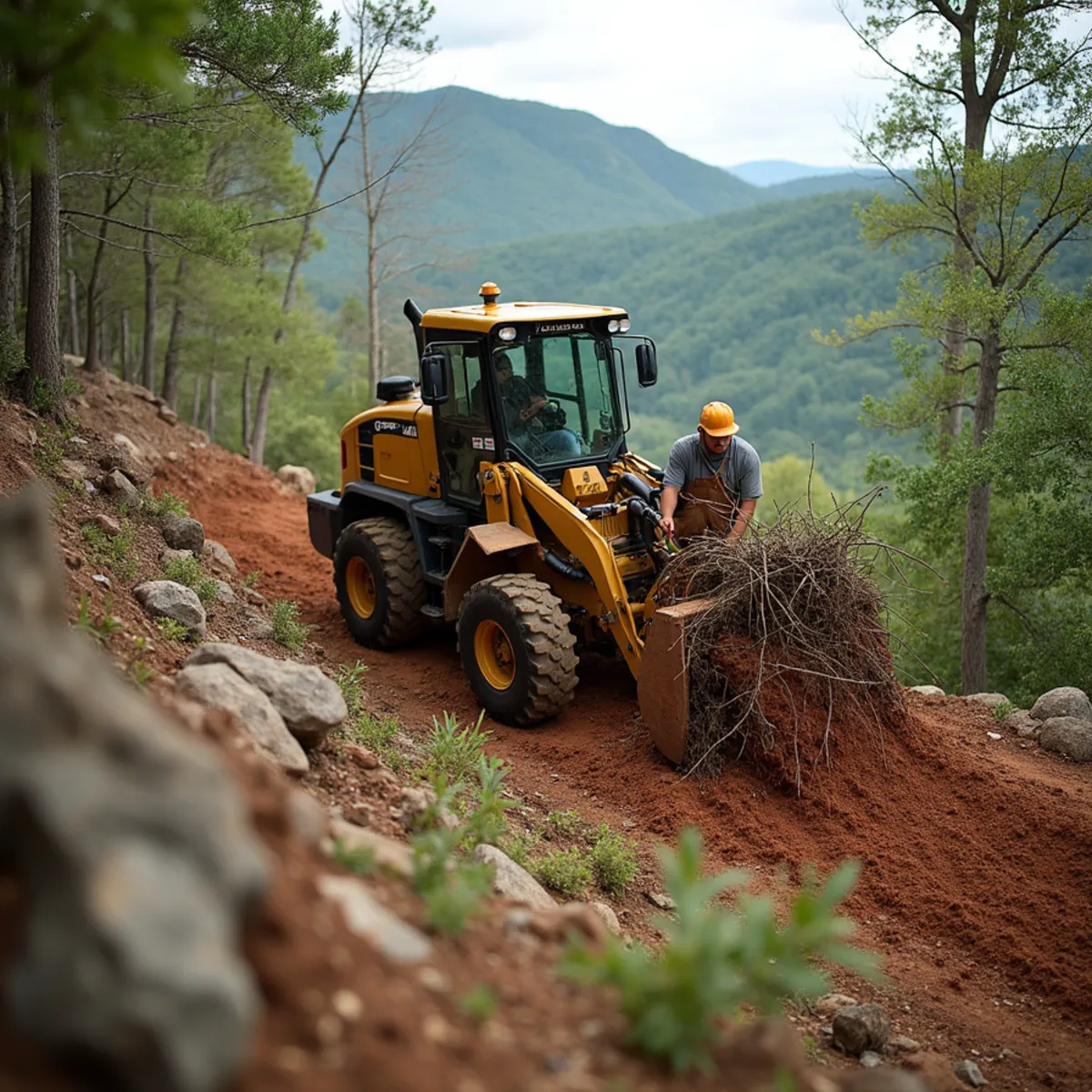
Forestry mulching grinds standing brush, small trees, and slash into a mulch layer in place using a tracked machine with a mulching head, eliminating the debris pile and the burn question entirely.
Because there is no open flame, no permit from the Forestry Commission is needed, and the work can proceed during burn bans when open burning is off the table but a clearing deadline still has to be met.
The resulting mulch layer also stays on site as ground cover, suppressing erosion on the freshly cleared soil instead of leaving bare dirt exposed the way burning or debris hauling does, which matters immediately on any slope.
We run forestry mulching and storm debris clearing as the default clearing method for exactly these reasons. It is faster than pile-and-burn, avoids the fire liability, and leaves the site in better condition to be graded or planted afterward.
The mulching head itself is a purpose-built attachment, not a standard excavator bucket, running carbide teeth at high rotational speed to shred material up to 6 or 8 inches in diameter in a single pass, which is why the work moves through several acres of overgrown understory in a fraction of the time hand-clearing and piling would take.
Selective mulching also lets us leave specimen trees and natural screening in place while clearing the invasive privet, brush, and small-diameter growth around them, giving a client usable, view-opening clearing without the all-or-nothing result of a bulldozer push or a burned lot stripped down to bare dirt and stumps.
Erosion & Sedimentation Control Plans for Clearing Over 1 Acre
Any land-disturbing activity affecting more than one acre in Georgia requires a formal erosion, sedimentation, and pollution control plan submitted to the local issuing authority before work begins, under the state Erosion and Sedimentation Act.
That plan has to specify best management practices, silt fence placement, sediment basins, stabilized construction entrances, and a timeline for permanent vegetation establishment, matched to the actual slope and drainage pattern of the site, not a generic template.
Clearing for a driveway, a building pad, or a hillside excavation and terracing project near Gainesville that crosses that one-acre threshold without an approved plan on file is a direct code violation, independent of whether burning is involved at all.
Even sites under an acre often benefit from the same planning discipline, since a small cleared area on a steep mountain lot can shed more sediment per square foot disturbed than a much larger flat site, and a local inspector responding to a downstream complaint will not care that the parcel technically fell under the state threshold.
The approved plan also has to name a person responsible for maintaining the erosion controls for the life of the project, not just installing them once, and that maintenance obligation continues until permanent vegetative cover is established across the disturbed area, which can extend well past the date the actual clearing work wraps up and equipment leaves the site.
- Silt fence placement along the downhill edge of the disturbed area
- Sediment basins sized to the site's actual slope and drainage pattern
- Stabilized construction entrances to keep mud off public roads
- A timeline for establishing permanent vegetation across the disturbed area
- A named person responsible for maintaining erosion controls for the life of the project
Protecting Mountain Streams from Silt
North Georgia's mountain streams are steep, fast, and unforgiving of sediment. A clearing project that lets silt reach a creek can smother trout spawning gravel and violate state water quality standards within a single storm event.
We hold back a vegetative buffer along any stream during clearing, stage silt fence below the disturbed area before the first tree comes down, and phase larger clearing jobs to limit how much bare soil is exposed at once.
On sites that drain toward designated trout streams feeding the Soque, Chattahoochee, or Tallulah systems, we treat buffer and sediment control as non-negotiable regardless of whether the county inspector has scheduled a site visit that week.
Forestry mulching helps here too, since the ground-level mulch mat left behind after grinding acts as an immediate, low-cost erosion control layer on the cleared surface, something an open-burned or hauled-clean site simply does not have until seed and straw or sod goes down separately.
We keep machinery out of defined stream channels entirely during clearing, routing equipment around wet-weather drainages rather than through them, since even a single pass of tracked equipment through a streambed can dislodge enough fine sediment to cloud water downstream for days after the crossing.
Where a driveway or utility crossing genuinely has to cross a stream, we coordinate a proper culvert installation permitted through the local issuing authority rather than a temporary equipment ford, which avoids repeated disturbance to the same stream section over the course of a multi-day clearing project.
Disposing of Stumps and Slash Responsibly
Stumps and heavy slash that mulching cannot fully process still need a disposal path, and burying large stumps on site is a common shortcut that causes settling problems for years afterward as the wood decomposes underground.
We haul merchantable timber and larger stumps to licensed processing or disposal facilities rather than burying or open-burning them, keeping the site's finished grade stable for whatever comes next, whether that is lawn, driveway, or a building pad.
Slash left in place as mulch is the exception, not the rule. That material is intentionally sized small enough to break down as ground cover rather than create a future settling void.
Where a client wants standing timber value recovered rather than mulched, we coordinate with licensed timber buyers before clearing begins, since merchantable pine and hardwood on a larger mountain tract can offset a meaningful portion of the clearing cost if it is identified and marked ahead of the mulching crew rather than ground up along with the brush.
Schedule Eco-Friendly Forestry Mulching
If you are clearing land in Clarkesville, Cleveland, or anywhere in the foothills, forestry mulching gets the job done without a burn permit, a burn ban delay, or a bare-dirt erosion problem waiting on the next storm.
We also serve clearing projects further out toward Gainesville, coordinating timber recovery, mulching, and erosion control as one planned sequence rather than three separate headaches.
Call (323) 606-0255 to schedule a site walk and find out whether mulching or a phased clearing plan fits your timeline and acreage.
Frequently Asked Questions
- Yes. Open burning requires a same-day permit from the Georgia Forestry Commission and is prohibited outright during declared burn bans, which commonly occur in dry spring and fall conditions.
Get Expert Help on Your North Georgia Property
Kipps Kustom Landscapes has spent 15+ years solving exactly these challenges across the Blue Ridge foothills. Call for a free on-site estimate.
Call (323) 606-0255
Written by
Hunter Kipps — Owner & Lead Craftsman
Hunter Kipps has spent 15+ years building and repairing mountain and lakefront landscapes across Northeast Georgia — boulder retaining walls, shoreline riprap, red-clay drainage, and estate stonework. He personally runs the heavy equipment and walks every site before quoting it.