
Commercial Growth Along the I-85 Corridor
The stretch of Commerce around exits 149 and 150, anchored by Tanger Outlets and the surrounding retail pad sites, sees a volume of foot and vehicle traffic that residential-grade landscaping simply cannot survive. Turf worn bare by cart traffic, mulch beds compacted by delivery trucks cutting corners, and irrigation lines crushed under construction equipment are common problems on properties that were graded and planted once and then left on a bare-minimum mow-and-blow contract. We approach commercial corridor properties differently, specifying turf varieties and groundcover that tolerate compaction and building maintenance schedules around actual wear patterns rather than a generic calendar.
Property managers along this corridor are also dealing with Jackson County stormwater detention requirements tied to the impervious surface added by every new building phase. Detention pond banks planted with the wrong groundcover erode within a year and start silting in the pond itself, which draws code enforcement attention fast. We plant and maintain detention basin slopes with root systems suited to periodic inundation, and we grade swales so water actually reaches the pond instead of channelizing across a parking field.
Paver Entrances That Handle Heavy Traffic
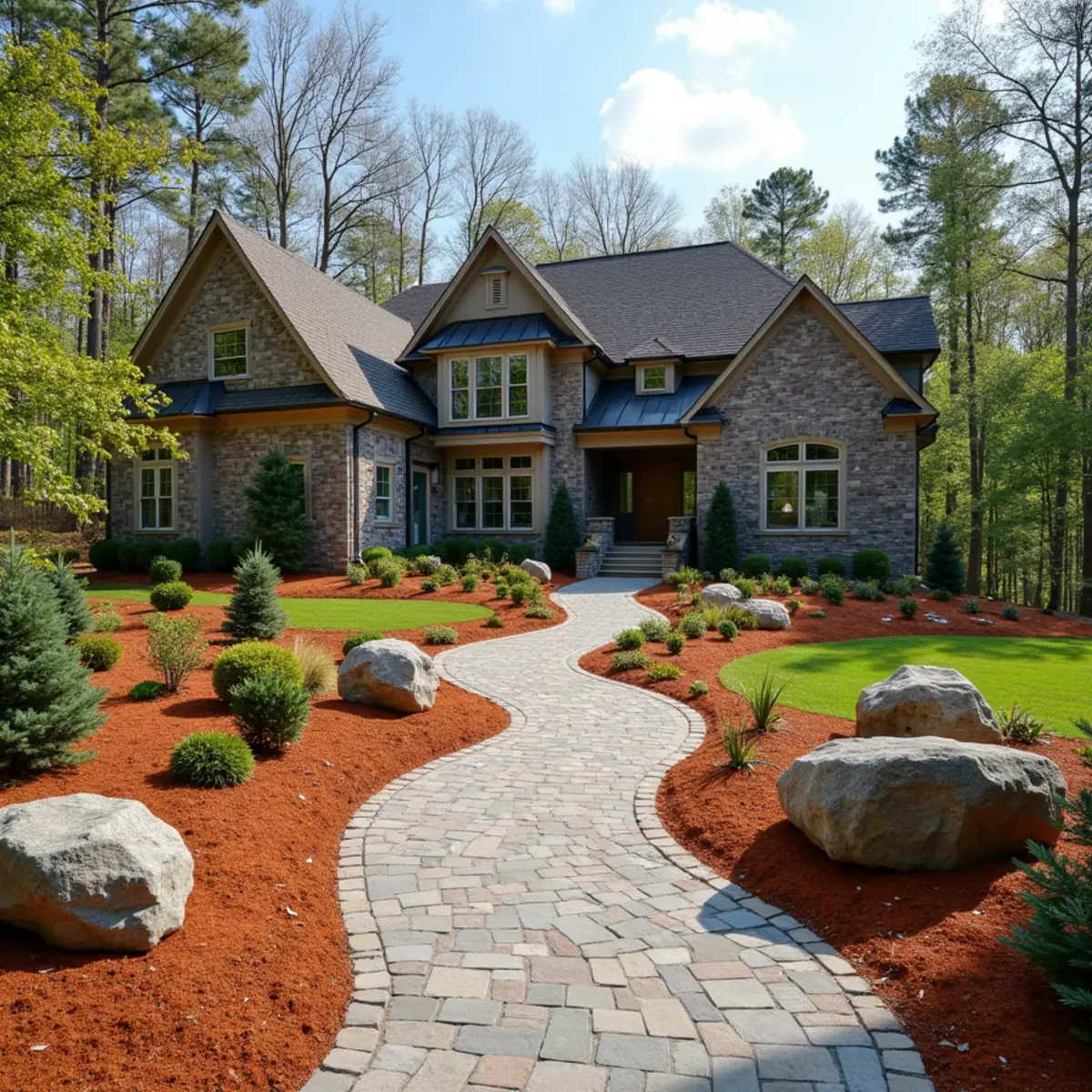
A commercial entrance in Commerce takes a beating: box trucks squaring off corners, customer traffic during outlet sale weekends, and snowplow or de-icing exposure a few times a winter. We build entrance hardscape on a compacted aggregate base thick enough to handle vehicle loading, not the residential-depth base that looks fine for two years and then rutting shows up at every turning radius. Segmental concrete pavers or natural stone set in a proper herringbone or running bond pattern distribute that load far better than a monolithic concrete pour, and individual pavers can be pulled and reset if a utility cut is ever needed underneath, which saves a full-width concrete replacement.
We have also built landscaped medians and monument sign beds for several Commerce corridor properties, coordinating plant selection with sight-line requirements at intersections so mature growth does not become a visibility hazard the way overgrown ornamental grasses often do at retail entrances.
Jackson County Red Clay Meets Commercial Grading
Underneath the retail development, Commerce sits on the same red clay Piedmont soil found across Jackson County, but commercial grading compacts it far more severely than residential lots ever see. Heavy equipment traffic during construction leaves subsoil so dense that water will not infiltrate at all, sheeting straight across parking lots and landscape beds into storm inlets. Before any planting goes in on a new commercial pad, we rip and amend that compacted subgrade, because turf and shrubs planted directly into construction-compacted clay fail within a season regardless of how well they are watered. Our red clay drainage crews also cut discreet subsurface drains along building foundations where finish grade was set too close to slab height during construction.
Residential Streets Behind the Retail Boom
Not every Commerce property sits on the interstate frontage. The older residential streets around downtown and Harrison Square, along with newer rooftops built to house the workforce the outlet and distribution growth brought in, sit on the same Jackson County red clay but face a different set of problems than the retail pads. Homes backing up to new commercial grading often inherit runoff that was never accounted for in the original residential lot design, since a warehouse pad graded and paved after a house was already built can redirect water toward a yard that used to drain naturally toward open field.
We correct this with property-line swales and French drains sized for the added volume, not the original rural runoff the lot was designed around decades ago. For homeowners who simply want a durable lawn and a few defined beds without the commercial-scale drainage complications, we also handle standard residential grading and planting on these in-town Commerce streets, scaled down from the retail corridor work but built on the same red clay foundation.
Permits, Codes and Compliance in Jackson County
Commercial development along Commerce's I-85 corridor generally requires Jackson County approval of a stormwater detention plan before a building permit is issued, and any retaining wall over roughly four feet, on a retail pad or a residential lot, typically needs an engineered stamp submitted with the permit application. Larger commercial pad sites that disturb more than an acre of ground also usually fall under Georgia EPD erosion and sediment control rules, governing silt fencing, sediment basins, and inspection during construction. Property owners and developers should confirm the exact current threshold and submission process with the Jackson County building department, since requirements can be updated and vary by project scope.
We coordinate our grading and wall design around whatever the county and EPD actually require for a given Commerce parcel rather than assuming a standard specification applies everywhere. Our red clay drainage crews build detention basin slope and swale work to match the approved civil plan, and our boulder retaining walls team coordinates with a structural engineer whenever a wall design needs a stamped drawing before Jackson County will sign off.
What a Typical Commerce Project Looks Like
A typical Commerce project falls into one of two categories: a retail or distribution property along the I-85 frontage needing durable paver hardscape and detention basin maintenance, or a residential lot on the older in-town streets needing standard drainage correction and a lawn that survives Jackson County's clay. On the commercial side, the work usually starts with subgrade correction before any turf or paver hardscape goes down, since construction traffic leaves the ground too compacted for either to perform without amendment first.
On the residential side, a typical project is smaller in scope but follows the same red clay logic, correcting a swale disrupted by nearby commercial grading and installing sod that can handle Jackson County's hot, humid summers. Whether the job is a monument sign bed on the interstate frontage or a backyard drainage fix a few blocks from downtown, we bring the same Zoysia sod and soil remediation and grading approach, scaled to the property.
Serving the Commerce and Jackson County Corridor
Commerce sits between Jefferson and Nicholson along the Jackson County growth belt, and we run crews throughout this corridor for both commercial grounds maintenance and residential estate grounds maintenance. Whether you manage a retail pad on the interstate or a home on the outskirts of town, call (323) 606-0255 for a site walk and maintenance proposal.
Our Services in Commerce
Every core Kipps Kustom Landscapes service is available to Commerce property owners:
Why Commerce Residents Choose Kipps Kustom
Built for I-85 Traffic, Not Just Foot Traffic
We base commercial entrance pavers and detention basin slopes on the actual loading the site sees, from box trucks to outlet weekend crowds, not a residential-depth spec that fails within two seasons.
28 Miles From Our Habersham County Shop
Commerce sits close enough to Clarkesville that our commercial grounds crews cover the I-85 corridor on the same routes we run for residential Jackson County work.
Free On-Site Walks for Retail Pads and Homes Alike
Whether it is a detention pond bank or a residential yard behind the retail boom, we walk the actual ground before quoting, since Jackson County red clay behaves differently under commercial grading than under a house lot.
15+ Years, Licensed and Insured
Miller Landscaping Group LLC has built and maintained commercial and residential ground across northeast Georgia for over fifteen years, with proof of insurance provided before work starts.
Commerce Landscaping FAQs
- Yes. We provide heavy-duty grounds maintenance built around actual traffic wear, including detention pond bank maintenance, turf built to handle compaction, and mulch beds serviced on a schedule that matches real use.