
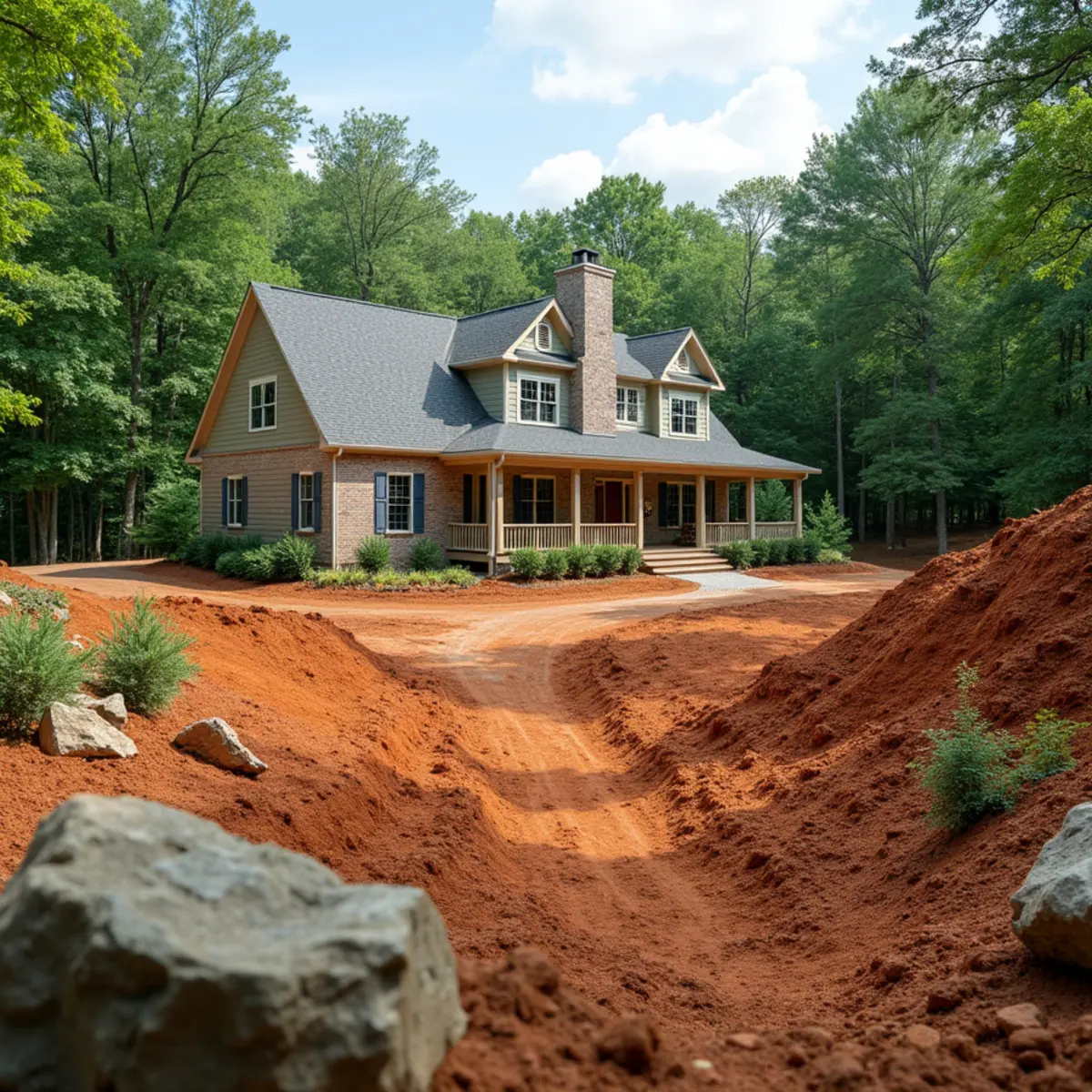
Working With Franklin County's Sandy Clay Loam
The ground around Royston differs from the tighter red Cecil clay found closer to Clarkesville. Much of Franklin County's agricultural land sits on a sandy clay loam that drains more freely and supports pasture grass well, but that same looser structure makes it prone to rutting under heavy equipment and erosion on any slope steeper than a gentle grade. Farm access roads, equipment turnarounds, and building pad sites cut into this soil need proper subsoil grading and compaction before any structure or driveway goes in, because sandy clay loam that looks firm when dry can turn to a rutted mess after a few passes of a loaded truck in wet weather.
We regularly grade and re-establish large equipment turnarounds and pad sites for Royston-area farm operations, cutting positive drainage away from barns and equipment sheds so standing water does not undermine gravel surfaces or foundation footings over time.
Large-Scale Hydroseeding for Pasture and Bare Ground
When a Royston property needs cover established over acreage rather than a residential lawn, seed and straw by hand is not practical or cost-effective. We run hydroseeding equipment that mixes seed, mulch fiber, fertilizer, and tackifier into a slurry sprayed directly over large graded areas, which gets germination started faster and holds the seed and topsoil in place through the first hard rain far better than dry broadcast seeding. This matters on Franklin County's sandy clay loam specifically, because that soil erodes fast on bare slopes before grass roots establish, and a single summer thunderstorm can wash a broadcast-seeded slope bare before anything sprouts.
We hydroseed everything from post-construction building pads to newly cleared pasture expansions and pond dam faces, selecting seed mixes suited to the intended use, whether that is a durable pasture forage blend or a lower-maintenance conservation mix for slopes that will not see grazing.
Homestead Hardscape and Drainage
Alongside the working land, Royston has plenty of homes on smaller acreage where owners want the same durable hardscape we build throughout our service area: boulder retaining walls for a sloped house pad, stone patios, and drainage around outbuildings. Franklin County's sandy clay loam drains better than tight clay, but it still needs proper French drain placement around structures built into any grade, since even well-draining soil concentrates surface water when a roofline or driveway funnels it into one path.
In-Town Royston and the Ty Cobb Museum District
Royston's small downtown, built up around the depot and now home to the Ty Cobb Museum, carries older residential streets that sit apart from the farm acreage ringing the town. These in-town lots are smaller and shadier than the working properties we grade and hydroseed outside city limits, with mature hardwood canopy and Franklin County's sandy clay loam compacted hard under decades of foot traffic and old driveway paving. Foundation drainage on these older homes often needs the same correction we handle throughout our service area, cutting French drains below compacted subsoil that was never engineered to modern standards.
We also build boulder retaining walls and stone patios for in-town Royston lots with real elevation change toward the street, using the same boulder retaining wall construction we use on farm building pads but scaled to a residential yard. Whether the job is a hydroseeded pasture on the edge of town or a patio two blocks from the museum, the same crew and equipment cover both.
Royston's cattle and small livestock operations near town also rely on secure perimeter fencing that a general residential contractor rarely stocks, and we build and repair board and wire fencing on these edge-of-town properties as part of the same visit that handles hardscape or drainage, since mobilizing equipment is the same regardless of which type of work a property needs that day. We also grade and stone-base the smaller equipment gates and livestock crossings tied into that fencing, since a gate set into ungraded sandy clay loam sinks and binds within a season, and fixing that after the fact costs more than building it correctly the first time.
Permits, Codes and Compliance for Royston Farm Properties
Franklin County farm and pasture work around Royston occasionally involves open burning of brush piles after clearing, and Georgia requires a burn permit from the Georgia Forestry Commission for most outdoor burning outside of small residential debris fires, with rules that vary by season and county. Property owners planning to burn cleared brush or storm debris should confirm the current permit requirement and any seasonal burn ban with the Georgia Forestry Commission before lighting a pile, since the rule differs from simply having a large enough clear space around the fire. Larger grading projects, including significant pond dam or pad site work, can also trigger Georgia EPD erosion control requirements handled through our red clay drainage crews, depending on the disturbed acreage.
We handle the grading and hydroseeding side of Royston farm projects, but burn permitting and any EPD threshold questions are best confirmed directly with the relevant state agency for the specific property and season, since requirements change. Our storm debris clearing and forestry mulching crews can process cleared brush mechanically instead of burning it where that is the more practical option for a given site.
What a Typical Royston Project Looks Like
A typical Royston project involves a working farm property needing an equipment pad, turnaround, or pond dam face graded and stabilized, paired with hydroseeding over several acres of freshly cleared or graded ground. We mobilize the same equipment for a homestead's boulder retaining wall or patio if the property has both a working side and a residential side, which is common on Franklin County's larger acreage parcels around Royston.
Closer to downtown and the Ty Cobb Museum district, a typical project looks more residential: a boulder retaining wall for a sloped in-town yard, or a French drain correcting foundation drainage on an older home with mature shade trees. Both versions of a Royston project usually pair well with fencing or grading work on the same site visit, since our hillside excavation and slope terracing equipment mobilizes the same way regardless of lot size.
Serving Royston and Franklin County Farmland
We cover Royston alongside neighboring Carnesville and Franklin Springs, running equipment across Franklin County's farm and residential properties on the same job days when schedules align. Call (323) 606-0255 to discuss grading, hydroseeding, or hardscape for your Royston property.
Our Services in Royston
Every core Kipps Kustom Landscapes service is available to Royston property owners:
Why Royston Residents Choose Kipps Kustom
Hydroseeding Equipment Sized for Real Acreage
We run hydroseeding rigs built for pasture expansions and pond dam faces, not a hand-broadcast setup that a Franklin County summer storm washes bare before it germinates.
33 Miles From Clarkesville
Royston's farm and in-town properties sit a straightforward drive from our Habersham County shop, close enough to run equipment out for both working land and residential jobs on the same day.
15+ Years Grading Sandy Clay Loam and Red Clay Alike
Franklin County's looser sandy clay loam behaves differently than the tight Cecil clay closer to Clarkesville, and we have graded both for over fifteen years.
Licensed, Insured, 4.9 Stars
Miller Landscaping Group LLC carries full licensing and insurance, with a 4.9-star average across 47 reviews from property owners we have actually worked for.
Royston Landscaping FAQs
- Franklin County's sandy clay loam drains faster than tight Piedmont clay but has less binding structure, so it compacts less consistently under heavy equipment and needs proper subsoil grading and stone base to resist rutting.