Elevation Changes Everything About Freeze-Thaw
Black Rock Mountain State Park, just up the road, holds the distinction of being the highest state park in Georgia, and Mountain City's own elevation sits high enough to see harder frosts, more frequent freeze-thaw cycling, and occasional snow accumulation that towns lower in the valley rarely get. That matters enormously for masonry, because water trapped in mortar joints or behind a stone face that freezes and expands repeatedly through a Mountain City winter will crack ordinary work within a few seasons.
We set stone patios, steps, and walls here with mortar mixes and joint detailing rated for real freeze-thaw exposure, and we make sure every masonry footing sits below frost depth for this elevation, which runs deeper than what would be adequate down in Clarkesville or Cornelia. Skipping that extra footing depth is the single most common reason we get called to repair stonework built by contractors used to lower-elevation jobs.
Cold-Hardy Turf for a Plateau Climate
Standard warm-season sod that thrives in the Georgia Piedmont struggles at Mountain City's elevation, going dormant earlier in fall and greening up later in spring, with a real risk of winterkill in an especially hard year. We steer plateau clients toward cold-hardy fescue blends bred for extended dormancy resistance and consistent performance through the longer, harder winters this elevation actually experiences, rather than installing the same warm-season sod we would use on a lower, warmer Habersham County lot.
Soil prep matters just as much as seed selection here. We aerate and amend compacted plateau soil before seeding or sodding, since cold-hardy turf still needs a root zone that can access water and nutrients through a shorter growing season, and we time planting windows around this elevation's actual last frost date rather than the general North Georgia calendar.
Retaining Structure on Plateau Terrain
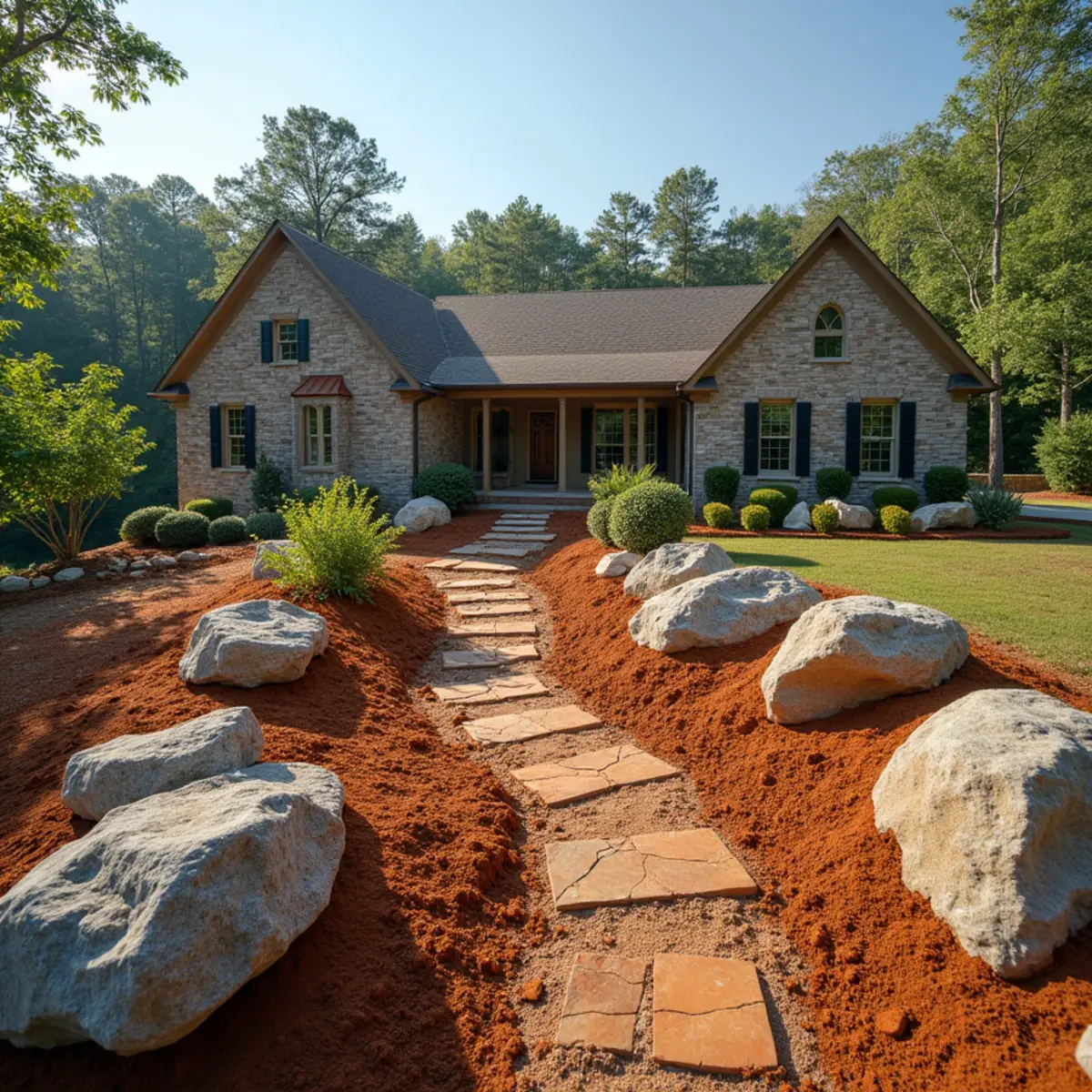
The plateau between Black Rock Mountain and the surrounding ridgeline is not flat, it rolls and drops in ways that surprise people used to seeing the term plateau and assuming level ground. We build boulder retaining walls on these rolling plateau lots with the same frost-depth footing standard we apply to all masonry here, and we pair walls with French drains to manage the meltwater that plateau lots see during winter thaw cycles that lower-elevation properties simply do not experience the same way.
Mountain City Between Clayton and Dillard
We work Mountain City regularly alongside Clayton to the south and Dillard toward the North Carolina line, and toward Tiger as well. For property owners planning a full build here, we recommend starting the conversation around elevation and frost depth first, since it drives nearly every material and footing decision in a mountain landscape design and build plan at this altitude.
Snow, Ice, and Roof Runoff at This Elevation
Mountain City is one of the few spots in our service area that sees measurable snow accumulation in a hard winter, and the freeze-thaw cycle that stresses masonry here does the same thing to roof lines and gutters. Snowmelt off a steep metal or shingle roof refreezes overnight into ice dams at the eaves, and when that ice finally lets go it dumps a concentrated slug of water right at the foundation line, often in the exact spot a standard gutter downspout was never sized to handle. We route downspout discharge on Mountain City homes into dedicated French drain runs rather than a simple splash block, since splash blocks do not do much against a sudden ice-dam release.
Winter weather at this elevation is also hard on trees, ice accumulation snaps weak limbs that lower-elevation properties rarely lose, and storm debris cleanup is a recurring need rather than an occasional one. We provide estate grounds maintenance and pruning for Mountain City properties that includes structural pruning aimed at reducing ice-load failure risk on mature trees near the house, not just seasonal shaping, which matters more here than it does down in the valley toward Clayton. We plan this maintenance visit for late fall, before the plateau's first hard freeze, so weak limbs are addressed before an ice event turns them into a bigger problem.
What a Typical Mountain City Project Looks Like
Most Mountain City calls start the same way: a property owner on the plateau near Black Rock Mountain State Park has stonework or a lawn that failed faster than it should have, and the culprit is almost always elevation. We start every job here by confirming the frost depth this altitude actually requires, since that single number drives the footing depth on any boulder retaining wall, the mortar spec on any patio or steps, and the turf recommendation for the lawn around it.
From there a typical project sequences footings and masonry first, sized for real freeze-thaw exposure, then a cold-hardy fescue lawn plan, then French drain runs positioned to handle winter meltwater rather than just summer thunderstorms. Clients splitting time between a plateau home here and property closer to Clayton often want both scoped together so the lower-elevation work is not held to the same overbuilt frost standard the plateau actually requires.
Neighborhoods and Elevation Across Mountain City
Mountain City sits on a rolling plateau rather than a single uniform elevation, and the ground drops and rises noticeably between properties close to Black Rock Mountain State Park and those lower along US 441 toward Clayton. That elevation difference, even within the same small town, changes frost depth, snow retention, and how long a north-facing slope stays icy after a winter storm.
We ask where on the plateau a property actually sits before quoting footing depth or turf selection, since a lot nearer the park's higher ground needs deeper footings and more cold-hardy planting than one closer to the Dillard-facing edge of town. This kind of elevation-specific planning is part of why we get called back to fix work built by contractors who treated all of Mountain City as one flat spec.
We have also noticed that snow tends to linger longest on the shaded, north-facing sections of the plateau nearest Black Rock Mountain, sometimes for several days after a storm has melted off everywhere else in Rabun County, which is one more reason we do not treat Mountain City's elevation as a single number when planning footing depth or a winter maintenance visit. A property tucked into one of these persistent shade pockets often needs a slightly deeper footing and a hardier turf blend than a sunnier lot just a few hundred yards away on the same plateau.
Our Services in Mountain City
Every core Kipps Kustom Landscapes service is available to Mountain City property owners:
Why Mountain City Residents Choose Kipps Kustom
Footings Set for This Elevation's Real Frost Depth
Mountain City's plateau freezes deeper than Clarkesville or Cornelia. We set every masonry footing to match that actual frost depth, which is the single most common repair we get called out to fix on work built by lower-elevation crews.
23 Miles From Clarkesville, Still a Prompt Response
Mountain City is farther out than most of our service area, but it sits on our regular Rabun County route alongside Clayton and Dillard, so a free estimate here does not mean a special trip.
24/7 Emergency Response When Ice Dams Let Go
Snowmelt refreezing into ice dams can overwhelm a standard downspout without warning. We answer emergency calls around the clock for the plateau's harder winter weather.
15+ Years Building for Blue Ridge Winters
Licensed and insured under Miller Landscaping Group LLC, with 15-plus years setting freeze-rated mortar and cold-hardy turf at elevations most North Georgia contractors rarely work, reflected in our 4.9-star rating across 47 reviews.
Mountain City Landscaping FAQs
- Higher elevation means harder and more frequent freeze-thaw cycling. Water trapped in mortar joints or shallow footings expands when it freezes, which cracks stonework not built with deeper footings and freeze-rated mortar for this altitude.